




In a conductor \[10\] coulomb of charge flows for \[5\] seconds. The value of electric current will be
$(A). 4{\text{ volt}}$
\[(B). 2{\text{ Ampere}}\]
\[(C). 2{\text{ volt}}\]
\[(D). 4{\text{ Ampere}}\]
Answer
 Verified
597.3k+ views
Hint: The electric current is the rate of flow of electric charge past a point or region. The electric current is said to exist when there is a net flow of electric charge through a region. Electric charge is carried by charged particles, so an electric current is a flow of charged particles.
Complete step by step answer:
The electric current flow can be compared with the water-flow or the heat-flow. We know that the water flows from high level to low level and the heat flows from the hot object to cold object. The electric charge also flows from high potential to low potential if there is potential difference in a circuit.
The electric current is the rate of the flow of electric charge.
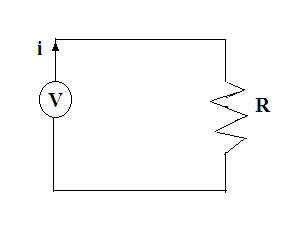
Given values are,
\[\begin{gathered}
Q = 10{\text{ C}} \\
t = 5{\text{ s}} \\
\end{gathered} \]
$\therefore $Electric current
$I = \dfrac{Q}{t}$
$ \Rightarrow I = \dfrac{{10}}{5}$
$ \Rightarrow I = 2$
The unit will be $\dfrac{{{\text{Coulomb}}}}{{{\text{second}}}}$ .
And the unit, $\dfrac{{{\text{Coulomb}}}}{{{\text{second}}}} = {\text{Ampere}}$
So the current $ \Rightarrow I = 2{\text{ Ampere}}$
Hence, the correct answer is option (B).
Additional information:
In a metal conductor the electric current flows due to free electrons. Since the electrons are of negative charge, so the flow will be from low potential to high potential. That clearly mentions the motion of the electrons are in the opposite direction of the current flow.
There are two types of current exist:
1) Direct current
2) Alternative current.
Note:
• Good Conductors of Electricity: Known as good conductors are the materials which allow the current to pass through them,
• Poor Conductors of Electricity: Known as poor conductors are the materials which do not allow the current to pass through them,
• Conductivity in Liquids: If the bulb in the tester glows, the liquid is conducting it means that. But, if it does not glow then it...
• Heating effect of current: The glowing of the bulb is responsible for the heating effect of current.
Complete step by step answer:
The electric current flow can be compared with the water-flow or the heat-flow. We know that the water flows from high level to low level and the heat flows from the hot object to cold object. The electric charge also flows from high potential to low potential if there is potential difference in a circuit.
The electric current is the rate of the flow of electric charge.
Given values are,
\[\begin{gathered}
Q = 10{\text{ C}} \\
t = 5{\text{ s}} \\
\end{gathered} \]
$\therefore $Electric current
$I = \dfrac{Q}{t}$
$ \Rightarrow I = \dfrac{{10}}{5}$
$ \Rightarrow I = 2$
The unit will be $\dfrac{{{\text{Coulomb}}}}{{{\text{second}}}}$ .
And the unit, $\dfrac{{{\text{Coulomb}}}}{{{\text{second}}}} = {\text{Ampere}}$
So the current $ \Rightarrow I = 2{\text{ Ampere}}$
Hence, the correct answer is option (B).
Additional information:
In a metal conductor the electric current flows due to free electrons. Since the electrons are of negative charge, so the flow will be from low potential to high potential. That clearly mentions the motion of the electrons are in the opposite direction of the current flow.
There are two types of current exist:
1) Direct current
2) Alternative current.
Note:
• Good Conductors of Electricity: Known as good conductors are the materials which allow the current to pass through them,
• Poor Conductors of Electricity: Known as poor conductors are the materials which do not allow the current to pass through them,
• Conductivity in Liquids: If the bulb in the tester glows, the liquid is conducting it means that. But, if it does not glow then it...
• Heating effect of current: The glowing of the bulb is responsible for the heating effect of current.
Recently Updated Pages
Master Class 12 Business Studies: Engaging Questions & Answers for Success

Master Class 12 Chemistry: Engaging Questions & Answers for Success
Master Class 12 Biology: Engaging Questions & Answers for Success
Class 12 Question and Answer - Your Ultimate Solutions Guide
Master Class 11 English: Engaging Questions & Answers for Success
Master Class 11 Social Science: Engaging Questions & Answers for Success
Trending doubts
Which are the Top 10 Largest Countries of the World?
Draw a labelled sketch of the human eye class 12 physics CBSE
Differentiate between homogeneous and heterogeneous class 12 chemistry CBSE
Differentiate between Pyramid of energy and pyramid class 12 biology CBSE
Why is the cell called the structural and functional class 12 biology CBSE
Draw the diagram of the pyramid of energy Explain In class 12 biology CBSE