




In a circuit L, C and R are connected in series with an alternating voltage source of frequency f. The current leads the voltage by \[{{45}^{\circ }}\]. The value of C is:
A. $\dfrac{1}{\pi f(2\pi fL+R)}$
B. $\dfrac{1}{\pi f(2\pi fL-R)}$
C. $\dfrac{1}{2\pi f(2\pi fL+R)}$
D. $\dfrac{1}{2\pi f(2\pi fL-R)}$
Answer
 Verified
611.7k+ views
Hint: In this question, we can use the help of the relation between Capacitive Resistance (${{X}_{C}}$) and Inductive Resistance (${{X}_{L}}$). A calculation of the resistance of a capacitor to AC (alternating current) is capacitive reactance. Inductive reactance is the name assigned to a shifting current flow to the opposition. Much like resistance, this impedance is measured in ohms,
Formula used:
For solving this question, we will be using
$\tan \phi =\dfrac{{{X}_{L}}-{{X}_{C}}}{R}$
Complete step by step answer:
Before solving the question, let us take a look at all the given parameters
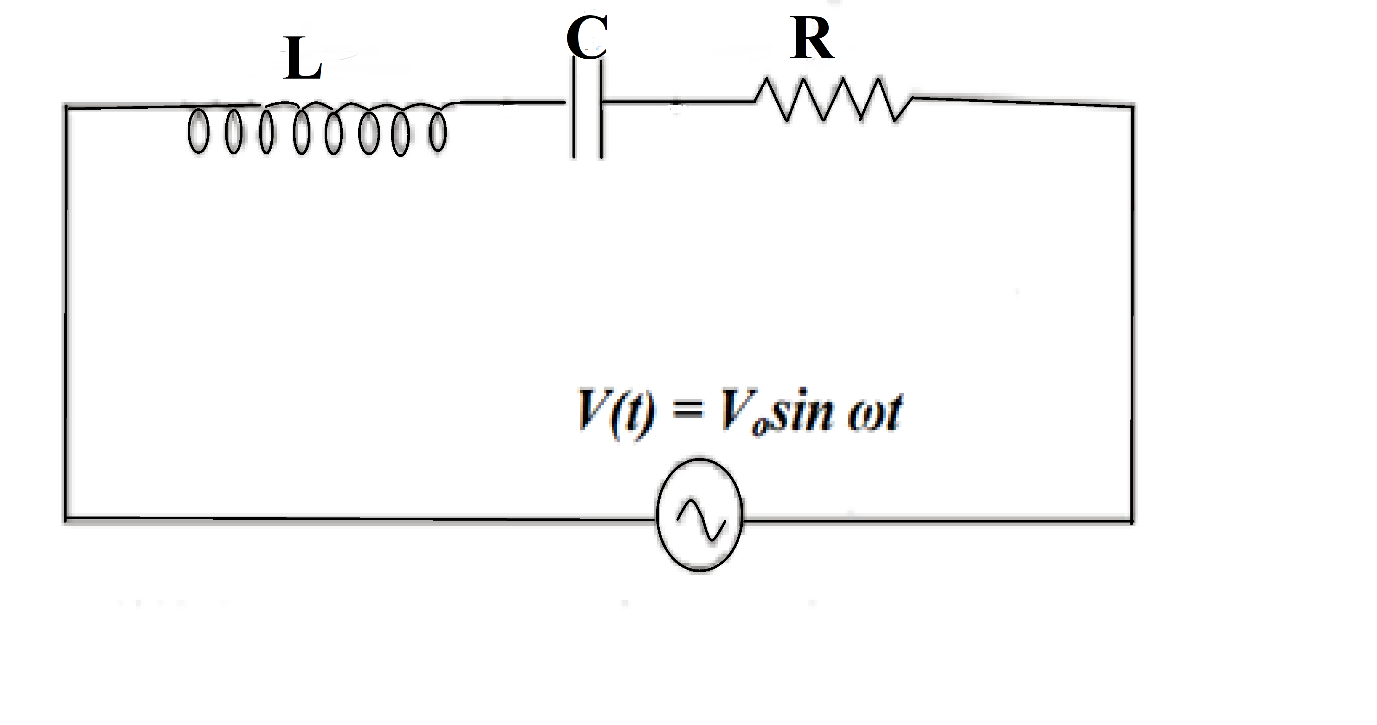
$\phi ={{45}^{\circ }}$
${{X}_{L}}=2\pi fL$
\[{{X}_{C}}=\dfrac{1}{2\pi fC}\]
Now, using the above values
We have,
$\tan {{45}^{\circ }}=\dfrac{{{X}_{L}}-{{X}_{C}}}{R}$
$\Rightarrow 1=\dfrac{{{X}_{L}}-{{X}_{C}}}{R}$
$\Rightarrow {{X}_{C}}={{X}_{L}}-R$
\[\Rightarrow \dfrac{1}{2\pi fC}=2\pi fL-R\]
$\Rightarrow 2\pi fC=\dfrac{1}{2\pi fL-R}$
$\Rightarrow C=\dfrac{1}{2\pi f(2\pi fL-R)}$
So, the correct answer to this question is $C=\dfrac{1}{2\pi f(2\pi fL-R)}$, i.e., Option D
Note:
In the above question, an LCR circuit has been discussed. An electrical circuit consisting of an inductor ( L), capacitor (C) and resistor (R) connected in series or parallel is an LCR circuit, also known as a resonant circuit, tuned circuit, or an RLC circuit. In terms of Phasors, the LCR circuit analysis can be best understood.
Formula used:
For solving this question, we will be using
$\tan \phi =\dfrac{{{X}_{L}}-{{X}_{C}}}{R}$
Complete step by step answer:
Before solving the question, let us take a look at all the given parameters
$\phi ={{45}^{\circ }}$
${{X}_{L}}=2\pi fL$
\[{{X}_{C}}=\dfrac{1}{2\pi fC}\]
Now, using the above values
We have,
$\tan {{45}^{\circ }}=\dfrac{{{X}_{L}}-{{X}_{C}}}{R}$
$\Rightarrow 1=\dfrac{{{X}_{L}}-{{X}_{C}}}{R}$
$\Rightarrow {{X}_{C}}={{X}_{L}}-R$
\[\Rightarrow \dfrac{1}{2\pi fC}=2\pi fL-R\]
$\Rightarrow 2\pi fC=\dfrac{1}{2\pi fL-R}$
$\Rightarrow C=\dfrac{1}{2\pi f(2\pi fL-R)}$
So, the correct answer to this question is $C=\dfrac{1}{2\pi f(2\pi fL-R)}$, i.e., Option D
Note:
In the above question, an LCR circuit has been discussed. An electrical circuit consisting of an inductor ( L), capacitor (C) and resistor (R) connected in series or parallel is an LCR circuit, also known as a resonant circuit, tuned circuit, or an RLC circuit. In terms of Phasors, the LCR circuit analysis can be best understood.
Recently Updated Pages
Master Class 12 Business Studies: Engaging Questions & Answers for Success

Master Class 12 Biology: Engaging Questions & Answers for Success
Master Class 12 Chemistry: Engaging Questions & Answers for Success
Class 12 Question and Answer - Your Ultimate Solutions Guide
Master Class 11 Social Science: Engaging Questions & Answers for Success
Master Class 11 English: Engaging Questions & Answers for Success
Trending doubts
Which are the Top 10 Largest Countries of the World?
Draw a labelled sketch of the human eye class 12 physics CBSE
Name the crygenes that control cotton bollworm and class 12 biology CBSE
Differentiate between homogeneous and heterogeneous class 12 chemistry CBSE
Ribosomal RNA is actively synthesised in A Nucleoplasm class 12 biology CBSE
How many molecules of ATP and NADPH are required information class 12 biology CBSE