




In a certain algebra 2 class of 30 students, 14 of them play basketball and 10 of them play baseball. There are 14 students who play neither sport. What is the probability that a student chosen randomly from the class plays both basketball and baseball?
Answer
 Verified
569.7k+ views
Hint: We draw Venn diagrams for the given situation and use set theory to find the required number of students. Subtract the number of students who neither play basketball nor play baseball from the total number of students to get the number of students who play either basketball or baseball. We find the number of students who play both basketball and baseball using the formula of set theory. Use the formula of probability to find the required probability.
* If \[P(A)\] denotes the number of elements in A, \[P(B)\]denotes the number of elements in B then their intersection \[P(A \cap B)\]denotes the number of elements in both A and B. Then the number of elements in A or B is given by\[P(A \cup B)\]. Then the formula for set theory is
\[P(A \cup B) = P(A) + P(B) - P(A \cap B)\]
* Probability of an event is given by dividing the number of favorable outcomes by total number of outcomes.
Complete step by step solution:
We are given that
Total number of students \[ = 30\]
\[U = 30\]
Let use denote basketball by A and baseball by B
Number of students who play basketball \[ = 14\]
\[P(A) = 14\]
Number of students who play baseball \[ = 10\]
\[P(B) = 10\]
Number of students who play neither basketball nor baseball \[ = 14\]
\[P(A \cup B)' = 14\]
Number of students who play either basketball or baseball is given by subtracting the number of students playing neither game from the total number of students.
\[ \Rightarrow P(A \cup B) = U - P(A \cup B)'\]
\[ \Rightarrow P(A \cup B) = 30 - 14\]
\[ \Rightarrow P(A \cup B) = 16\]
Then the number of students who play both the games is given by \[P(A \cap B)\]
Then we can draw a Venn diagram depicting the number of students who play A, B and both A and B. Here U is the universal set which depicts the total number of students.
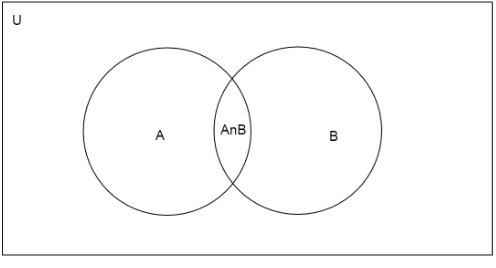
We use the formula \[P(A \cup B) = P(A) + P(B) - P(A \cap B)\] to find the value of intersection of A and B.
Substitute the value of \[P(A) = 14\],\[P(B) = 10\] and \[P(A \cup B) = 16\] in the formula
\[ \Rightarrow 16 = 14 + 10 - P(A \cap B)\]
Add the terms in RHS
\[ \Rightarrow 16 = 24 - P(A \cap B)\]
Shift all constant terms to one side of the equation
\[ \Rightarrow P(A \cap B) = 24 - 16\]
Calculate the difference
\[ \Rightarrow P(A \cap B) = 8\]
Now we have the number of students who play both basketball and baseball.
Now we know Probability of an event is given by dividing the number of favorable outcomes by the total number of outcomes.
Here the number of favorable outcomes is 8 and the total number of outcomes is 30.
\[ \Rightarrow \]Probability\[ = \dfrac{8}{{30}}\]
Cancel same factors from numerator and denominator
\[ \Rightarrow \]Probability\[ = \dfrac{4}{{15}}\]
\[\therefore \]Probability that chosen student plays both games is \[\dfrac{4}{{15}}\]
Note: Students might make the mistake of assuming the union of the two elements as the total number of elements. Keep in mind union denoted the elements that are in A, B or in both A and B but we have elements that are neither in A, nor in B also. So, the universal set denotes the total number of elements available. Also, keep in mind the probability should always be written in such a way that there is no common factor between numerator and denominator.
* If \[P(A)\] denotes the number of elements in A, \[P(B)\]denotes the number of elements in B then their intersection \[P(A \cap B)\]denotes the number of elements in both A and B. Then the number of elements in A or B is given by\[P(A \cup B)\]. Then the formula for set theory is
\[P(A \cup B) = P(A) + P(B) - P(A \cap B)\]
* Probability of an event is given by dividing the number of favorable outcomes by total number of outcomes.
Complete step by step solution:
We are given that
Total number of students \[ = 30\]
\[U = 30\]
Let use denote basketball by A and baseball by B
Number of students who play basketball \[ = 14\]
\[P(A) = 14\]
Number of students who play baseball \[ = 10\]
\[P(B) = 10\]
Number of students who play neither basketball nor baseball \[ = 14\]
\[P(A \cup B)' = 14\]
Number of students who play either basketball or baseball is given by subtracting the number of students playing neither game from the total number of students.
\[ \Rightarrow P(A \cup B) = U - P(A \cup B)'\]
\[ \Rightarrow P(A \cup B) = 30 - 14\]
\[ \Rightarrow P(A \cup B) = 16\]
Then the number of students who play both the games is given by \[P(A \cap B)\]
Then we can draw a Venn diagram depicting the number of students who play A, B and both A and B. Here U is the universal set which depicts the total number of students.
We use the formula \[P(A \cup B) = P(A) + P(B) - P(A \cap B)\] to find the value of intersection of A and B.
Substitute the value of \[P(A) = 14\],\[P(B) = 10\] and \[P(A \cup B) = 16\] in the formula
\[ \Rightarrow 16 = 14 + 10 - P(A \cap B)\]
Add the terms in RHS
\[ \Rightarrow 16 = 24 - P(A \cap B)\]
Shift all constant terms to one side of the equation
\[ \Rightarrow P(A \cap B) = 24 - 16\]
Calculate the difference
\[ \Rightarrow P(A \cap B) = 8\]
Now we have the number of students who play both basketball and baseball.
Now we know Probability of an event is given by dividing the number of favorable outcomes by the total number of outcomes.
Here the number of favorable outcomes is 8 and the total number of outcomes is 30.
\[ \Rightarrow \]Probability\[ = \dfrac{8}{{30}}\]
Cancel same factors from numerator and denominator
\[ \Rightarrow \]Probability\[ = \dfrac{4}{{15}}\]
\[\therefore \]Probability that chosen student plays both games is \[\dfrac{4}{{15}}\]
Note: Students might make the mistake of assuming the union of the two elements as the total number of elements. Keep in mind union denoted the elements that are in A, B or in both A and B but we have elements that are neither in A, nor in B also. So, the universal set denotes the total number of elements available. Also, keep in mind the probability should always be written in such a way that there is no common factor between numerator and denominator.
Recently Updated Pages
Master Class 12 Economics: Engaging Questions & Answers for Success

Master Class 12 Physics: Engaging Questions & Answers for Success
Master Class 12 English: Engaging Questions & Answers for Success
Master Class 12 Social Science: Engaging Questions & Answers for Success
Master Class 12 Maths: Engaging Questions & Answers for Success
Master Class 12 Business Studies: Engaging Questions & Answers for Success
Trending doubts
Which are the Top 10 Largest Countries of the World?
What are the major means of transport Explain each class 12 social science CBSE
Draw a labelled sketch of the human eye class 12 physics CBSE
Why cannot DNA pass through cell membranes class 12 biology CBSE
Differentiate between insitu conservation and exsitu class 12 biology CBSE
Draw a neat and well labeled diagram of TS of ovary class 12 biology CBSE