




How many images of a candle will be formed if it is placed between two parallel plane mirrors separated by 40cm?
Answer
 Verified
616.5k+ views
Hint: The image is formed in a plane mirror when the light gets reflected by the interface of the mirror. The number of reflections on the mirror is equal to the number of images formed for the object in front of the mirror.
Complete step by step answer:
The reflection of light by a plane mirror follows all the laws of reflection which are given as
1. The incident ray of light, the reflected ray of light and the normal to the plane of the mirror, all lie in the same plane.
2. The angle of incidence of light is always equal to the angle at which the light gets reflected.
When we have two plane mirrors placed parallel to each other as shown in the figure and an object is kept between these mirrors, then light from the object is incident normally on the mirror.
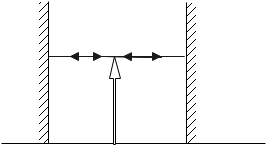
The light ray gets reflected normally from the mirror following the same path as the incident light ray. This reflected light ray is again incident on the second mirror which has been placed parallel to the first mirror undergoing reflection again. This reflected light ray is again incident on the first mirror and the same process continues.
The number of images formed is equal to the number of reflections taking place. Since in our case, we have innumerable number of reflections taking place between two mirrors.
So, the number of images formed is infinite.
Note: The number of images formed by two parallel mirrors does not depend on the distance between the mirrors. Only the distance of image from the mirror changes with the change in the distance of the object from the mirror.
Complete step by step answer:
The reflection of light by a plane mirror follows all the laws of reflection which are given as
1. The incident ray of light, the reflected ray of light and the normal to the plane of the mirror, all lie in the same plane.
2. The angle of incidence of light is always equal to the angle at which the light gets reflected.
When we have two plane mirrors placed parallel to each other as shown in the figure and an object is kept between these mirrors, then light from the object is incident normally on the mirror.
The light ray gets reflected normally from the mirror following the same path as the incident light ray. This reflected light ray is again incident on the second mirror which has been placed parallel to the first mirror undergoing reflection again. This reflected light ray is again incident on the first mirror and the same process continues.
The number of images formed is equal to the number of reflections taking place. Since in our case, we have innumerable number of reflections taking place between two mirrors.
So, the number of images formed is infinite.
Note: The number of images formed by two parallel mirrors does not depend on the distance between the mirrors. Only the distance of image from the mirror changes with the change in the distance of the object from the mirror.
Recently Updated Pages
Master Class 12 Business Studies: Engaging Questions & Answers for Success

Master Class 12 Chemistry: Engaging Questions & Answers for Success
Master Class 12 Biology: Engaging Questions & Answers for Success
Class 12 Question and Answer - Your Ultimate Solutions Guide
Master Class 11 English: Engaging Questions & Answers for Success
Master Class 11 Maths: Engaging Questions & Answers for Success
Trending doubts
Which is more stable and why class 12 chemistry CBSE
Which are the Top 10 Largest Countries of the World?
Draw a labelled sketch of the human eye class 12 physics CBSE
Differentiate between homogeneous and heterogeneous class 12 chemistry CBSE
What are the major means of transport Explain each class 12 social science CBSE
Sulphuric acid is known as the king of acids State class 12 chemistry CBSE