




Illustrate with examples the limitations of Williamson’s synthesis for the preparation of certain types of ethers.
Answer
 Verified
660.6k+ views
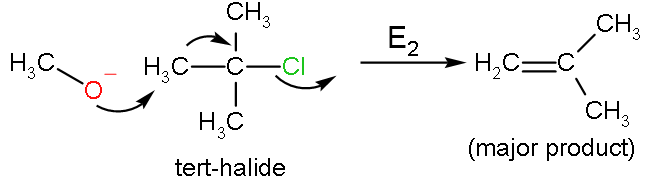
Hint: The reaction was developed by Alexander Williamson in 1850. A few limitations of Williamson Ether Synthesis are tertiary alkyl halides or hindered primary or secondary alkyl halides undergo elimination in the presence of an alkoxide, this nucleophile also acts as a base.
Complete step by step answer:
The Williamson ether synthesis is an organic reaction, forming an ether from a deprotonated alcohol (alkoxide) and organohalide. Reaction involves reactants as alkoxide ions with primary alkyl halide through ${{\text{S}}_{\text{N}}}2$ or bimolecular nucleophilic substitution mechanism. This is a coupling reaction.
The general reaction mechanism is-
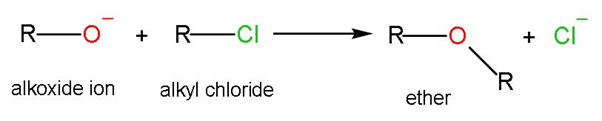
An example of this reaction is
${{\left[ {{\text{C}}_{2}}{{\text{H}}_{5}}\text{O} \right]}^{-}}{{\left[ \text{Na} \right]}^{+}}+{{\text{C}}_{2}}{{\text{H}}_{5}}\text{Cl}\to
{{\text{C}}_{2}}{{\text{H}}_{5}}\text{O}{{\text{C}}_{2}}{{\text{H}}_{5}}+\text{NaCl}$; where sodium ethoxide reacts with chloroethane to form diethyl ether.
-Limitations of Williamson’s synthesis:
For ${{\text{S}}_{\text{N}}}2$ reaction, there must be a good leaving group which is strongly electronegative mainly a halide. In the Williamson ether reaction, there is an alkoxide ion ($\text{R}{{\text{O}}^{-}}$) which acts as the nucleophile, attacks the electrophilic carbon with leaving group, which is an alkyl tosylate. The leaving site should be a primary carbon, because secondary and tertiary carbon prefers an elimination reaction. This reaction does not favour the formation of bulky ethers such as di-tert butyl ether, due to steric hindrance and formation of alkenes is largely preferred.
Note:
The reaction between tert-butyl alcohol with primary halide is ether formation takes place, but primary alkoxide reacts with tert-butyl halide to do elimination.
Complete step by step answer:
The Williamson ether synthesis is an organic reaction, forming an ether from a deprotonated alcohol (alkoxide) and organohalide. Reaction involves reactants as alkoxide ions with primary alkyl halide through ${{\text{S}}_{\text{N}}}2$ or bimolecular nucleophilic substitution mechanism. This is a coupling reaction.
The general reaction mechanism is-
An example of this reaction is
${{\left[ {{\text{C}}_{2}}{{\text{H}}_{5}}\text{O} \right]}^{-}}{{\left[ \text{Na} \right]}^{+}}+{{\text{C}}_{2}}{{\text{H}}_{5}}\text{Cl}\to
{{\text{C}}_{2}}{{\text{H}}_{5}}\text{O}{{\text{C}}_{2}}{{\text{H}}_{5}}+\text{NaCl}$; where sodium ethoxide reacts with chloroethane to form diethyl ether.
-Limitations of Williamson’s synthesis:
For ${{\text{S}}_{\text{N}}}2$ reaction, there must be a good leaving group which is strongly electronegative mainly a halide. In the Williamson ether reaction, there is an alkoxide ion ($\text{R}{{\text{O}}^{-}}$) which acts as the nucleophile, attacks the electrophilic carbon with leaving group, which is an alkyl tosylate. The leaving site should be a primary carbon, because secondary and tertiary carbon prefers an elimination reaction. This reaction does not favour the formation of bulky ethers such as di-tert butyl ether, due to steric hindrance and formation of alkenes is largely preferred.
Note:
The reaction between tert-butyl alcohol with primary halide is ether formation takes place, but primary alkoxide reacts with tert-butyl halide to do elimination.
Recently Updated Pages
Which of the following graphs shows the variation of class 12 physics CBSE

Draw a labelled diagram of the human male reproductive class 12 biology CBSE
Describe the experiment to compare the emf of two cells class 12 physics CBSE
What is standard hydrogen electrode
What is conventional current and electric current class 12 physics CBSE
2Bromopentane is treated with an alcoholic KOH solution class 12 chemistry CBSE
Trending doubts
Draw a labelled sketch of the human eye class 12 physics CBSE
Which are the Top 10 Largest Countries of the World?
A member of Simon commission later became Prime Minister class 12 social science CBSE
Draw ray diagrams each showing i myopic eye and ii class 12 physics CBSE
Differentiate between homogeneous and heterogeneous class 12 chemistry CBSE
Which is the correct genotypic ratio of mendel dihybrid class 12 biology CBSE