




If \[X\] and \[Y\] are two nonempty sets, where \[f:X\to Y\] is function is defined such that \[f(c)=\{f(x):x\in C\}\] for \[C\subseteq X\] and \[{{f}^{-1}}(D)=\{x:f(x)\in D\}\] for \[D\subseteq Y\] , for any \[A\subseteq Y\] and \[B\subseteq Y\] then,
A). \[{{f}^{-1}}\{f(A)\}=A\]
B). \[{{f}^{-1}}\{f(A)\}=\text{A only if f(X)=Y}\]
C). \[\text{f }\!\!\{\!\!\text{ }{{\text{f}}^{\text{-1}}}\text{(B) }\!\!\}\!\!\text{ =B only if B}\subseteq \text{f(x)}\]
D). \[\text{f }\!\!\{\!\!\text{ }{{\text{f}}^{\text{-1}}}\text{(B) }\!\!\}\!\!\text{ =B }\]
Answer
 Verified
507.9k+ views
Hint: First of all we will define \[f\] and \[{{f}^{-1}}\] in the two nonempty sets that is \[X\] and \[Y\] then by the figure \[(1)\] we can determine that we cannot define \[f(A)\] and \[f(B)\] so we will define \[{{f}^{-1}}(A)\] and \[{{f}^{-1}}(B)\] after this check all the options to find which one is correct among them.
Complete step-by-step solution:
In mathematics the word set was first of all used by a German Mathematician George Cantor. He defined the set as follows: a set is any collection into a whole of definite and distinct objects of our intuition or thought.
The objects belonging to the set are called elements or members of the set.
A set containing no element is called the empty set. It is denoted by the symbol \[\phi \]
If \[X\] and \[Y\] are two nonempty sets
Here \[f\] is defined as:
\[\Rightarrow f:X\to Y\]
Therefore the inverse of \[f\] will be defined as:
\[\Rightarrow {{f}^{-1}}:Y\to X\]
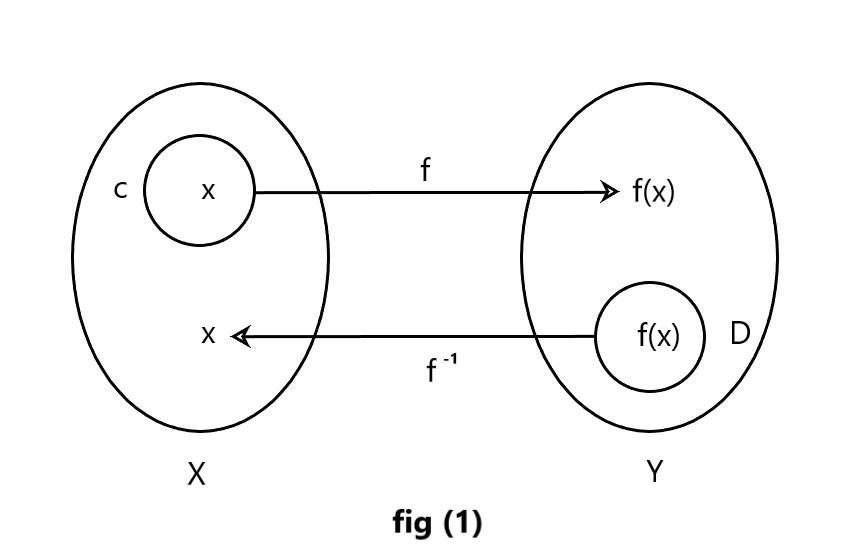
In the given figure \[(1)\] we have given two sets \[X\] and \[Y\] and define \[f\] from \[X\] to \[Y\]
Take a set inside set \[X\] and name it \[C\] such that \[C\subseteq X\] . Then take any value inside set \[C\] name it \[x\] such that image of \[x\] comes in set \[Y\] name it \[f(x)\]
If we define the inverse of these two sets in figure \[(1)\] . Take a set inside set \[Y\] name it \[D\] and take any element inside the set \[D\] and name it \[f(x)\] such that image of \[f(x)\] comes in set \[X\] name it \[x\] and the image is defined as \[{{f}^{-1}}\]
We have given that \[A\subseteq Y\] and \[B\subseteq Y\]
Hence we cannot define \[f(A)\] and \[f(B)\] so we will define \[{{f}^{-1}}(A)\] and \[{{f}^{-1}}(B)\]
Now we will check the given options:
In option \[(1)\] \[{{f}^{-1}}\{f(A)\}=A\] , \[f(A)\] is defined hence this option is incorrect.
In option \[(2)\] \[{{f}^{-1}}\{f(A)\}=\text{A only if f(X)=Y}\] , \[f(A)\] is defined hence this option is also incorrect.
In option \[(3)\] \[\text{f }\!\!\{\!\!\text{ }{{\text{f}}^{\text{-1}}}\text{(B) }\!\!\}\!\!\text{ =B only if B}\subseteq \text{f(x)}\]
\[\text{f }\!\!\{\!\!\text{ }{{\text{f}}^{\text{-1}}}\text{(B) }\!\!\}\!\!\text{ =B }\]
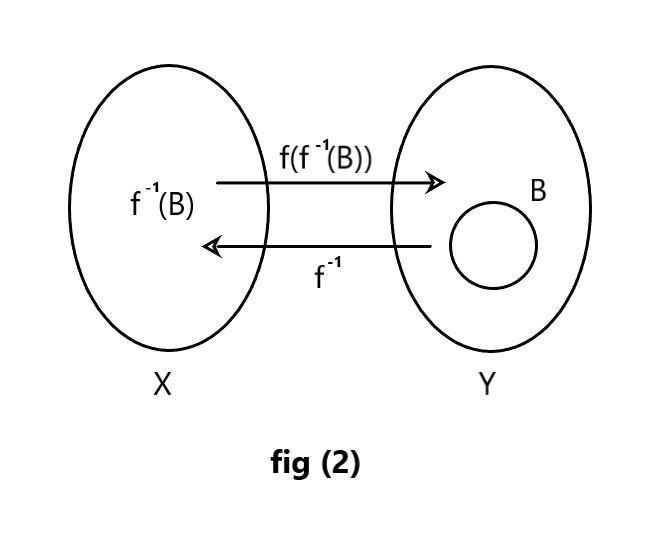
In figure \[(2)\] you can see that you have given two sets \[X\] and \[Y\] let us take a set inside set \[Y\] name it \[B\] if we define \[{{f}^{-1}}\] from \[\text{B }\]and the image will be \[{{\text{f}}^{\text{-1}}}\text{(B)}\] if we again define \[{{\text{f}}^{\text{-1}}}\text{(B)}\] through \[\text{f}\] then the image will be defined as \[\text{ }\!\!\{\!\!\text{ }{{\text{f}}^{\text{-1}}}\text{(B) }\!\!\}\!\!\text{ }\] and will belong to set \[\text{B }\]
Hence option \[(3)\] is correct as \[\text{f }\!\!\{\!\!\text{ }{{\text{f}}^{\text{-1}}}\text{(B) }\!\!\}\!\!\text{ =B }\] and \[\text{B}\subseteq \text{f(x)}\] .
Note: If in any finite set, some elements are repeated then to find the cardinality of this set repeated elements counts only once, because repetition of elements is meaningless. For example: Let \[A=\{1,2,2,3,4,4,5\}\] then clearly \[n(A)=5\] .The number of distinct elements in a finite set is also called the order of a set.
Complete step-by-step solution:
In mathematics the word set was first of all used by a German Mathematician George Cantor. He defined the set as follows: a set is any collection into a whole of definite and distinct objects of our intuition or thought.
The objects belonging to the set are called elements or members of the set.
A set containing no element is called the empty set. It is denoted by the symbol \[\phi \]
If \[X\] and \[Y\] are two nonempty sets
Here \[f\] is defined as:
\[\Rightarrow f:X\to Y\]
Therefore the inverse of \[f\] will be defined as:
\[\Rightarrow {{f}^{-1}}:Y\to X\]
In the given figure \[(1)\] we have given two sets \[X\] and \[Y\] and define \[f\] from \[X\] to \[Y\]
Take a set inside set \[X\] and name it \[C\] such that \[C\subseteq X\] . Then take any value inside set \[C\] name it \[x\] such that image of \[x\] comes in set \[Y\] name it \[f(x)\]
If we define the inverse of these two sets in figure \[(1)\] . Take a set inside set \[Y\] name it \[D\] and take any element inside the set \[D\] and name it \[f(x)\] such that image of \[f(x)\] comes in set \[X\] name it \[x\] and the image is defined as \[{{f}^{-1}}\]
We have given that \[A\subseteq Y\] and \[B\subseteq Y\]
Hence we cannot define \[f(A)\] and \[f(B)\] so we will define \[{{f}^{-1}}(A)\] and \[{{f}^{-1}}(B)\]
Now we will check the given options:
In option \[(1)\] \[{{f}^{-1}}\{f(A)\}=A\] , \[f(A)\] is defined hence this option is incorrect.
In option \[(2)\] \[{{f}^{-1}}\{f(A)\}=\text{A only if f(X)=Y}\] , \[f(A)\] is defined hence this option is also incorrect.
In option \[(3)\] \[\text{f }\!\!\{\!\!\text{ }{{\text{f}}^{\text{-1}}}\text{(B) }\!\!\}\!\!\text{ =B only if B}\subseteq \text{f(x)}\]
\[\text{f }\!\!\{\!\!\text{ }{{\text{f}}^{\text{-1}}}\text{(B) }\!\!\}\!\!\text{ =B }\]
In figure \[(2)\] you can see that you have given two sets \[X\] and \[Y\] let us take a set inside set \[Y\] name it \[B\] if we define \[{{f}^{-1}}\] from \[\text{B }\]and the image will be \[{{\text{f}}^{\text{-1}}}\text{(B)}\] if we again define \[{{\text{f}}^{\text{-1}}}\text{(B)}\] through \[\text{f}\] then the image will be defined as \[\text{ }\!\!\{\!\!\text{ }{{\text{f}}^{\text{-1}}}\text{(B) }\!\!\}\!\!\text{ }\] and will belong to set \[\text{B }\]
Hence option \[(3)\] is correct as \[\text{f }\!\!\{\!\!\text{ }{{\text{f}}^{\text{-1}}}\text{(B) }\!\!\}\!\!\text{ =B }\] and \[\text{B}\subseteq \text{f(x)}\] .
Note: If in any finite set, some elements are repeated then to find the cardinality of this set repeated elements counts only once, because repetition of elements is meaningless. For example: Let \[A=\{1,2,2,3,4,4,5\}\] then clearly \[n(A)=5\] .The number of distinct elements in a finite set is also called the order of a set.
Recently Updated Pages
Master Class 12 Economics: Engaging Questions & Answers for Success

Master Class 12 Physics: Engaging Questions & Answers for Success
Master Class 12 English: Engaging Questions & Answers for Success
Master Class 12 Social Science: Engaging Questions & Answers for Success
Master Class 12 Maths: Engaging Questions & Answers for Success
Master Class 12 Business Studies: Engaging Questions & Answers for Success
Trending doubts
Which are the Top 10 Largest Countries of the World?
What are the major means of transport Explain each class 12 social science CBSE
Draw a labelled sketch of the human eye class 12 physics CBSE
Why cannot DNA pass through cell membranes class 12 biology CBSE
Differentiate between insitu conservation and exsitu class 12 biology CBSE
Draw a neat and well labeled diagram of TS of ovary class 12 biology CBSE