




If $\widehat i - \widehat j + 2\widehat k$, $2\widehat i + \widehat j - \widehat k$ and $3\widehat i - \widehat j + 2\widehat k$ are position vectors of vertices of a triangle then its area is
(A)$26$
(B)$13$
(C)$2\sqrt {13} $
(D)$\sqrt {13} $
Answer
 Verified
576k+ views
Hint: Find the vector form of any two adjacent sides of the triangle. Then use the formula of cross product to find the area of the triangle in vector form. Cross product is solved using determinants.
Complete step-by-step answer:
Let $\Delta ABC$ be a triangle whose vertices are given to us
Hence,$A = \widehat i - \widehat j + 2\widehat k$
$B = 2\widehat i + \widehat j - \widehat k$
$C = 3\widehat i - \widehat j + 2\widehat k$
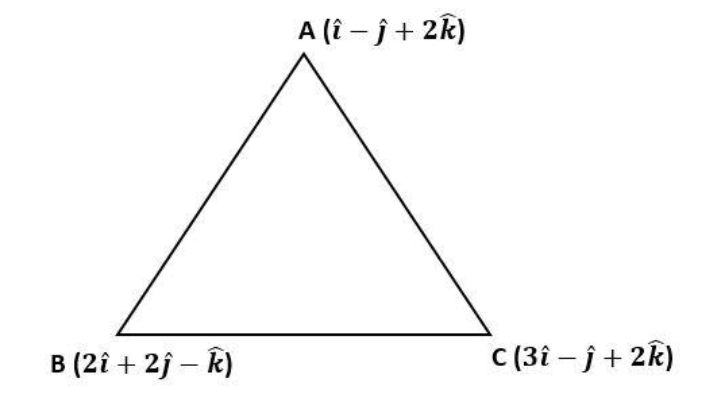
We can write the vertices in terms of position vectors as
$\overline {OA} = \widehat i - \widehat j + 2\widehat k$
$\overline {OB} = 2\widehat i + \widehat j - \widehat k$
$\overline {OC} = 3\widehat i - \widehat j + 2\widehat k$
We know that, area of a triangle in vector form is given as
Area of triangle$ = \dfrac{1}{2}\left| {\overrightarrow {AB} \times \overrightarrow {AC} } \right|$
Where, AB and BC are the adjacent sides of the triangle.
We can find AB as
$\overrightarrow {AB} = \overrightarrow {OB} - \overrightarrow {OA} $
$ = 2\widehat i + \widehat j - \widehat k - (\widehat i - \widehat j + 2\widehat k)$
$ = \left( {2 - 1} \right)\widehat i + \left( {1 + 1} \right)\widehat j + \left( { - 1 - 2} \right)\widehat k$
\[ \Rightarrow \overrightarrow {AB} = \widehat i + 2\widehat j - 3\widehat k\]
In the same way, we can find AC as
$\overrightarrow {AC} = \overrightarrow {OC} - \overrightarrow {OA} $
$ = 3\widehat i - \widehat j + 2\widehat k - (\widehat i - \widehat j + 2\widehat k)$
$ = \left( {3 - 1} \right)\widehat i + \left( { - 1 + 1} \right)\widehat j + \left( {2 - 2} \right)\widehat k$
$ = 2\widehat i + 0\widehat j + 0\widehat k$
$ \Rightarrow \overrightarrow {AC} = 2\widehat i$
Cross product of two vectors is given by determinants as
$\overrightarrow {AB} \times \overrightarrow {AC} =
\begin{vmatrix} {\widehat i}&{\widehat j}&{\widehat k} \\
{{a_1}}&{{a_2}}&{{a_3}} \\
{{b_1}}&{{b_2}}&{{b_3}} \\
\end{vmatrix}$
Using this formula of determinant, we can write
$\overrightarrow {AB} \times \overrightarrow {AC}=
\begin{vmatrix} {\widehat i}&{\widehat j}&{\widehat k} \\
1&2&{ - 3} \\
2&0&0
\end{vmatrix}$
Expanding the determinant, we get
$\overrightarrow {AB} \times \overrightarrow {AC} = \widehat i\left( {0 - 0} \right) - \widehat j\left( {0 + 6} \right) + \widehat k\left( {0 - 4} \right)$
$ = - 6\widehat j - 4\widehat k$
$\overrightarrow {AB} \times \overrightarrow {AC} = - 6\widehat j - 4\widehat k$
Now using the formula of area of a triangle in vector form, we can write
$ \dfrac{1}{2}\left| {\overrightarrow {AB} \times \overrightarrow {AC} } \right| = \dfrac{1}{2}\left| { - 6\widehat j - 4\widehat k} \right|$
Since $\left| {a\widehat i + b\widehat j + c\widehat k} \right| = \sqrt {{a^2} + {b^2} + {c^2}} $
We can write
$\dfrac{1}{2}\left| {\overline {AB} \times \overline {BC} } \right| = \dfrac{1}{2}\sqrt {{{\left( { - 6} \right)}^2} + {{\left( { - 4} \right)}^2}} $
$ = \dfrac{1}{2}\sqrt {36 + 16} $
$ = \dfrac{1}{2}\sqrt {52} $
We would take $2$ inside the square root sign to simplify the expression
$ = \sqrt {\dfrac{{52}}{4}} $
$ = \sqrt {13} $
Hence the area of the triangle is $\sqrt {13} $ square units.
Therefore, from the above explanation, the correct answer is, option (D) $\sqrt {13} $
So, the correct answer is “Option C”.
Note: In this question, we got, $\overrightarrow {AB} \times \overrightarrow {AC} = - 6\widehat j - 4\widehat k$. Do not get confused with it or think that the answer is wrong as the area cannot be negative. Remember that a cross product is a vector product. So negative sign in this case only represents the direction of the product and not the magnitude of the product. Area is given by the magnitude of the product. That is why we take the magnitude of the cross product that we get. So, whether the cross product is negative or not, the magnitude will always be a positive quantity.
Complete step-by-step answer:
Let $\Delta ABC$ be a triangle whose vertices are given to us
Hence,$A = \widehat i - \widehat j + 2\widehat k$
$B = 2\widehat i + \widehat j - \widehat k$
$C = 3\widehat i - \widehat j + 2\widehat k$
We can write the vertices in terms of position vectors as
$\overline {OA} = \widehat i - \widehat j + 2\widehat k$
$\overline {OB} = 2\widehat i + \widehat j - \widehat k$
$\overline {OC} = 3\widehat i - \widehat j + 2\widehat k$
We know that, area of a triangle in vector form is given as
Area of triangle$ = \dfrac{1}{2}\left| {\overrightarrow {AB} \times \overrightarrow {AC} } \right|$
Where, AB and BC are the adjacent sides of the triangle.
We can find AB as
$\overrightarrow {AB} = \overrightarrow {OB} - \overrightarrow {OA} $
$ = 2\widehat i + \widehat j - \widehat k - (\widehat i - \widehat j + 2\widehat k)$
$ = \left( {2 - 1} \right)\widehat i + \left( {1 + 1} \right)\widehat j + \left( { - 1 - 2} \right)\widehat k$
\[ \Rightarrow \overrightarrow {AB} = \widehat i + 2\widehat j - 3\widehat k\]
In the same way, we can find AC as
$\overrightarrow {AC} = \overrightarrow {OC} - \overrightarrow {OA} $
$ = 3\widehat i - \widehat j + 2\widehat k - (\widehat i - \widehat j + 2\widehat k)$
$ = \left( {3 - 1} \right)\widehat i + \left( { - 1 + 1} \right)\widehat j + \left( {2 - 2} \right)\widehat k$
$ = 2\widehat i + 0\widehat j + 0\widehat k$
$ \Rightarrow \overrightarrow {AC} = 2\widehat i$
Cross product of two vectors is given by determinants as
$\overrightarrow {AB} \times \overrightarrow {AC} =
\begin{vmatrix} {\widehat i}&{\widehat j}&{\widehat k} \\
{{a_1}}&{{a_2}}&{{a_3}} \\
{{b_1}}&{{b_2}}&{{b_3}} \\
\end{vmatrix}$
Using this formula of determinant, we can write
$\overrightarrow {AB} \times \overrightarrow {AC}=
\begin{vmatrix} {\widehat i}&{\widehat j}&{\widehat k} \\
1&2&{ - 3} \\
2&0&0
\end{vmatrix}$
Expanding the determinant, we get
$\overrightarrow {AB} \times \overrightarrow {AC} = \widehat i\left( {0 - 0} \right) - \widehat j\left( {0 + 6} \right) + \widehat k\left( {0 - 4} \right)$
$ = - 6\widehat j - 4\widehat k$
$\overrightarrow {AB} \times \overrightarrow {AC} = - 6\widehat j - 4\widehat k$
Now using the formula of area of a triangle in vector form, we can write
$ \dfrac{1}{2}\left| {\overrightarrow {AB} \times \overrightarrow {AC} } \right| = \dfrac{1}{2}\left| { - 6\widehat j - 4\widehat k} \right|$
Since $\left| {a\widehat i + b\widehat j + c\widehat k} \right| = \sqrt {{a^2} + {b^2} + {c^2}} $
We can write
$\dfrac{1}{2}\left| {\overline {AB} \times \overline {BC} } \right| = \dfrac{1}{2}\sqrt {{{\left( { - 6} \right)}^2} + {{\left( { - 4} \right)}^2}} $
$ = \dfrac{1}{2}\sqrt {36 + 16} $
$ = \dfrac{1}{2}\sqrt {52} $
We would take $2$ inside the square root sign to simplify the expression
$ = \sqrt {\dfrac{{52}}{4}} $
$ = \sqrt {13} $
Hence the area of the triangle is $\sqrt {13} $ square units.
Therefore, from the above explanation, the correct answer is, option (D) $\sqrt {13} $
So, the correct answer is “Option C”.
Note: In this question, we got, $\overrightarrow {AB} \times \overrightarrow {AC} = - 6\widehat j - 4\widehat k$. Do not get confused with it or think that the answer is wrong as the area cannot be negative. Remember that a cross product is a vector product. So negative sign in this case only represents the direction of the product and not the magnitude of the product. Area is given by the magnitude of the product. That is why we take the magnitude of the cross product that we get. So, whether the cross product is negative or not, the magnitude will always be a positive quantity.
Recently Updated Pages
Master Class 12 Economics: Engaging Questions & Answers for Success

Master Class 12 Physics: Engaging Questions & Answers for Success
Master Class 12 English: Engaging Questions & Answers for Success
Master Class 12 Social Science: Engaging Questions & Answers for Success
Master Class 12 Maths: Engaging Questions & Answers for Success
Master Class 12 Business Studies: Engaging Questions & Answers for Success
Trending doubts
Which are the Top 10 Largest Countries of the World?
What are the major means of transport Explain each class 12 social science CBSE
Draw a labelled sketch of the human eye class 12 physics CBSE
Why cannot DNA pass through cell membranes class 12 biology CBSE
Differentiate between insitu conservation and exsitu class 12 biology CBSE
Draw a neat and well labeled diagram of TS of ovary class 12 biology CBSE