




If we change the value of R, then
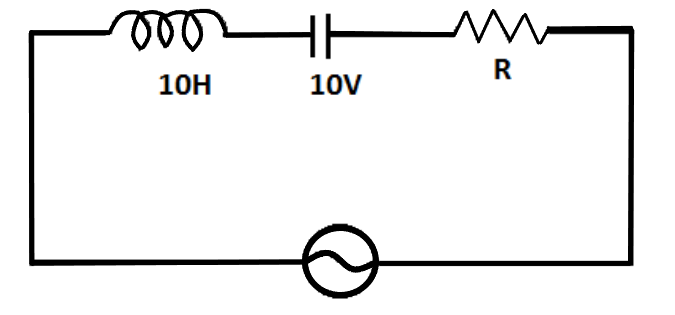
(A) Voltage does not change on L
(B) Voltage does not change on LC combination
(C) Voltage does not change on C
(D) Voltage does change on LC combination
Answer
 Verified
540k+ views
Hint :Voltage provides current into the circuit as known from the Ohm’s law. The circuit of inductor, resistor and capacitor produces impedance in the circuit and impedance resists the current that is flowing through the circuit. Now, when there is change in value of voltage, the current drops too.
Complete Step By Step Answer:
According to the Ohm’s law, voltage provides current to the battery and hence the current flows through the circuit. Inductor in a circuit stores the energy produced due to the magnetic field which is produced due to the electromagnetic induction when changing current flows through the circuit. For changing current flowing through the circuit, we need an A.C. (Alternating Current) voltage source. Capacitor stores the electrical energy produced due to the accumulation of charges inside the capacitor. Also, the resistor opposes the current flowing in the circuit.
According to their impedances, the voltage provided by the AC source is distributed in the Resistor, inductor and the capacitor elements. Thus, if the value of the resistor, that is R changes, then the value of the current changes as the resistance of the resistor opposes the current flowing. Thus, the total impedance changes, which change the current flowing and according to the Ohm’s law, the voltage changes. Thus voltage changes on LC combination.
Hence option (D) is the correct answer.
Note :
The inductor and the capacitor store energy in the form of magnetic energy and electrical energy respectively, while the resistor does not store energy, it produces heat in the system due to flowing current. This heat is directly proportional to the square of the current passing through the electrical circuit.
Complete Step By Step Answer:
According to the Ohm’s law, voltage provides current to the battery and hence the current flows through the circuit. Inductor in a circuit stores the energy produced due to the magnetic field which is produced due to the electromagnetic induction when changing current flows through the circuit. For changing current flowing through the circuit, we need an A.C. (Alternating Current) voltage source. Capacitor stores the electrical energy produced due to the accumulation of charges inside the capacitor. Also, the resistor opposes the current flowing in the circuit.
According to their impedances, the voltage provided by the AC source is distributed in the Resistor, inductor and the capacitor elements. Thus, if the value of the resistor, that is R changes, then the value of the current changes as the resistance of the resistor opposes the current flowing. Thus, the total impedance changes, which change the current flowing and according to the Ohm’s law, the voltage changes. Thus voltage changes on LC combination.
Hence option (D) is the correct answer.
Note :
The inductor and the capacitor store energy in the form of magnetic energy and electrical energy respectively, while the resistor does not store energy, it produces heat in the system due to flowing current. This heat is directly proportional to the square of the current passing through the electrical circuit.
Recently Updated Pages
Master Class 12 Economics: Engaging Questions & Answers for Success

Master Class 12 Physics: Engaging Questions & Answers for Success
Master Class 12 English: Engaging Questions & Answers for Success
Master Class 12 Social Science: Engaging Questions & Answers for Success
Master Class 12 Maths: Engaging Questions & Answers for Success
Master Class 12 Business Studies: Engaging Questions & Answers for Success
Trending doubts
Which are the Top 10 Largest Countries of the World?
What are the major means of transport Explain each class 12 social science CBSE
Draw a labelled sketch of the human eye class 12 physics CBSE
Why cannot DNA pass through cell membranes class 12 biology CBSE
Differentiate between insitu conservation and exsitu class 12 biology CBSE
Draw a neat and well labeled diagram of TS of ovary class 12 biology CBSE