




If two structures of same cross-sectional area, but different numerical apertures $N{A_1}$ and $N{A_2}$($N{A_2}$<$N{A_1}$) are joined longitudinally, the numerical aperture of the combined structure is
A. $\dfrac{{N{A_1}N{A_2}}}{{N{A_1} + N{A_2}}}$
B. $N{A_1} + N{A_2}$
C. $N{A_1}$
D. $N{A_2}$
Answer
 Verified
592.2k+ views
Hint: This question is based on the total internal reflection phenomenon. There are two parts here which are called the core and the cladding. Core must be of higher refractive index than of the cladding so that total internal reflection occurs at the interface of the core and cladding.
Formula used:
$NA{\text{ }}\propto {\text{ }}{i_m}$
Complete step by step answer:
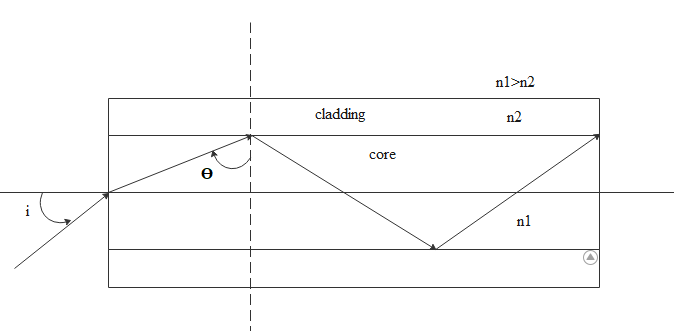
Whenever light travels from one medium to the other medium it bends. If the light travels from the denser medium to the rarer medium then there is a chance of total internal reflection(TIR). TIR is a phenomenon where the light ray travelling from denser to rarer medium hits the interface of the two mediums and will get reflected back to the denser medium itself. We consider the below diagram
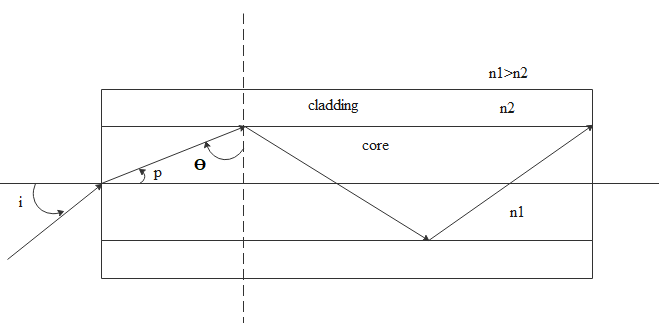
The light tries to go from core to the cladding and reflects back which means it hit the interface with the critical angle. All the angles of incidence greater than the critical angle results in the TIR.
If the angle of incidence at the interface increases then angle p will decrease. If angle p decreases as angle ‘i’ is proportional to angle ‘p’ angle ‘i’ also decreases. There exists one value called ${i_m}$ from where TIR starts. For all the entering angles less than ${i_m}$ TIR will take place.
Numerical aperture is proportional to ${i_m}$. i.e $NA{\text{ }}\propto {\text{ }}{i_m}$
It is also given as $N{A_2}$<$N{A_1}$
Which means ${i_m}_2$<${i_m}_1$
So if $i$<${i_m}_2$ is satisfied, the $i$<${i_m}_1$ also will be satisfied.
Hence the numerical aperture of the combined structure must be $N{A_2}$
So option D will be the answer.
Note: This TIR methodology is vastly used in fiber communication. The optical fibers carry the information without any leakage by using this technology. The signals are travelled for the longer distances effectively through these optical fibers. The basic requirement is that the core refractive index must be greater than the cladding one.
Formula used:
$NA{\text{ }}\propto {\text{ }}{i_m}$
Complete step by step answer:
Whenever light travels from one medium to the other medium it bends. If the light travels from the denser medium to the rarer medium then there is a chance of total internal reflection(TIR). TIR is a phenomenon where the light ray travelling from denser to rarer medium hits the interface of the two mediums and will get reflected back to the denser medium itself. We consider the below diagram
The light tries to go from core to the cladding and reflects back which means it hit the interface with the critical angle. All the angles of incidence greater than the critical angle results in the TIR.
If the angle of incidence at the interface increases then angle p will decrease. If angle p decreases as angle ‘i’ is proportional to angle ‘p’ angle ‘i’ also decreases. There exists one value called ${i_m}$ from where TIR starts. For all the entering angles less than ${i_m}$ TIR will take place.
Numerical aperture is proportional to ${i_m}$. i.e $NA{\text{ }}\propto {\text{ }}{i_m}$
It is also given as $N{A_2}$<$N{A_1}$
Which means ${i_m}_2$<${i_m}_1$
So if $i$<${i_m}_2$ is satisfied, the $i$<${i_m}_1$ also will be satisfied.
Hence the numerical aperture of the combined structure must be $N{A_2}$
So option D will be the answer.
Note: This TIR methodology is vastly used in fiber communication. The optical fibers carry the information without any leakage by using this technology. The signals are travelled for the longer distances effectively through these optical fibers. The basic requirement is that the core refractive index must be greater than the cladding one.
Recently Updated Pages
Three beakers labelled as A B and C each containing 25 mL of water were taken A small amount of NaOH anhydrous CuSO4 and NaCl were added to the beakers A B and C respectively It was observed that there was an increase in the temperature of the solutions contained in beakers A and B whereas in case of beaker C the temperature of the solution falls Which one of the following statements isarecorrect i In beakers A and B exothermic process has occurred ii In beakers A and B endothermic process has occurred iii In beaker C exothermic process has occurred iv In beaker C endothermic process has occurred

Master Class 12 Social Science: Engaging Questions & Answers for Success
Master Class 12 Physics: Engaging Questions & Answers for Success
Master Class 12 Maths: Engaging Questions & Answers for Success
Master Class 12 Economics: Engaging Questions & Answers for Success
Master Class 12 Chemistry: Engaging Questions & Answers for Success
Three beakers labelled as A B and C each containing 25 mL of water were taken A small amount of NaOH anhydrous CuSO4 and NaCl were added to the beakers A B and C respectively It was observed that there was an increase in the temperature of the solutions contained in beakers A and B whereas in case of beaker C the temperature of the solution falls Which one of the following statements isarecorrect i In beakers A and B exothermic process has occurred ii In beakers A and B endothermic process has occurred iii In beaker C exothermic process has occurred iv In beaker C endothermic process has occurred
Master Class 12 Social Science: Engaging Questions & Answers for Success
Master Class 12 Physics: Engaging Questions & Answers for Success
Trending doubts
Which are the Top 10 Largest Countries of the World?
Draw a labelled sketch of the human eye class 12 physics CBSE
Differentiate between homogeneous and heterogeneous class 12 chemistry CBSE
What are the major means of transport Explain each class 12 social science CBSE
Sulphuric acid is known as the king of acids State class 12 chemistry CBSE
Why should a magnesium ribbon be cleaned before burning class 12 chemistry CBSE