




If the work done by a body on application of a constant force is directly proportional to the distance travelled by the body, express this in the form of an equation in two variables and draw the graph of the same by taking the constant force as 5 units. Also read from the graph the work done when the distance travelled by the body is (i) 2 units (ii) 0 units.
Answer
 Verified
611.4k+ views
Hint: Work done is equal to force multiplied by distance that is $W=FD$ where W is work done, F is force and D is distance travelled. Substitute F=5, because constant force exerted is 5 units. Plot the graph using the function $W=5D$ .
Complete step by step answer:
In the question it is given that work done is directly proportional to the distance. Also we know that work done is directly proportional to the force applied on the body. Assuming that the distance travelled by the body is in the direction of force applied. So if we express work done (W) in the form of equation of two variable which is force (F) and distance (D), we can write W as
$W=FD.........(1)$
We are given the question that the force applied is a constant of 5 units. So substituting in equation (1)
$F=5$ we get,
$W=5D.........(2)$
Now we will plot the graph of equation (2), we will take work done (W) along y-axis and distance (D) along x-axis direction. Taking D=0, 1, 2, 3, 4 in equation (2) we get the following values work done (W);
We will plot the graph using these points (0,0), (1,5), (2,10), (3,15) and (4,20).
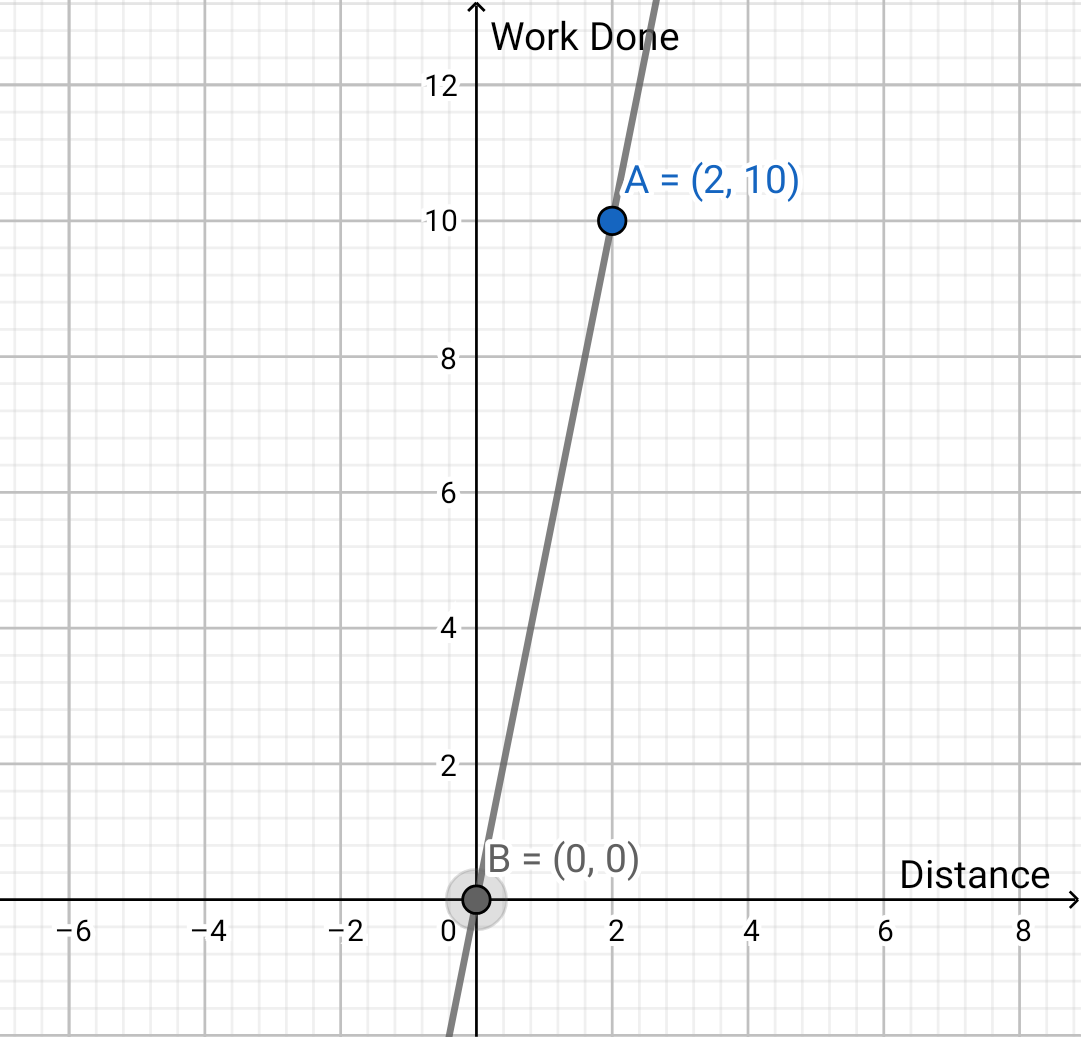
From the graph it is clear that at distance 2 the value of work done is 10 units and at distance 0 the value of work done is 0. Hence, work done is 10 units when distance travelled is 2 units and work done is 0 units when distance travelled is 0 units.
Note: Work done is directly proportional to the distance. Also we know that work done is directly proportional to the force applied on the body. Assuming that the distance travelled by the body is in the direction of force applied. So if we express work done (W) in the form of an equation of two variables which is force (F) and distance (D), we can write W as $W=FD$ .
Complete step by step answer:
In the question it is given that work done is directly proportional to the distance. Also we know that work done is directly proportional to the force applied on the body. Assuming that the distance travelled by the body is in the direction of force applied. So if we express work done (W) in the form of equation of two variable which is force (F) and distance (D), we can write W as
$W=FD.........(1)$
We are given the question that the force applied is a constant of 5 units. So substituting in equation (1)
$F=5$ we get,
$W=5D.........(2)$
Now we will plot the graph of equation (2), we will take work done (W) along y-axis and distance (D) along x-axis direction. Taking D=0, 1, 2, 3, 4 in equation (2) we get the following values work done (W);
| Distance (D) | 0 | 1 | 2 | 3 | 4 |
| Work done (W) | 0 | 5 | 10 | 15 | 20 |
We will plot the graph using these points (0,0), (1,5), (2,10), (3,15) and (4,20).
From the graph it is clear that at distance 2 the value of work done is 10 units and at distance 0 the value of work done is 0. Hence, work done is 10 units when distance travelled is 2 units and work done is 0 units when distance travelled is 0 units.
Note: Work done is directly proportional to the distance. Also we know that work done is directly proportional to the force applied on the body. Assuming that the distance travelled by the body is in the direction of force applied. So if we express work done (W) in the form of an equation of two variables which is force (F) and distance (D), we can write W as $W=FD$ .
Recently Updated Pages
Master Class 12 Business Studies: Engaging Questions & Answers for Success

Master Class 12 Biology: Engaging Questions & Answers for Success
Master Class 12 Chemistry: Engaging Questions & Answers for Success
Class 12 Question and Answer - Your Ultimate Solutions Guide
Master Class 11 Social Science: Engaging Questions & Answers for Success
Master Class 11 English: Engaging Questions & Answers for Success
Trending doubts
What is the Full Form of ICSE / ISC ?
Fill the blanks with the suitable prepositions 1 The class 9 english CBSE
Difference Between Plant Cell and Animal Cell
How many hours before the closure of election must class 9 social science CBSE
What is pollution? How many types of pollution? Define it
Name 10 Living and Non living things class 9 biology CBSE