




If the volume of a Tetrahedron formed by coterminous edges $\vec{a},\vec{b},\vec{c}$ is 2,then the volume of parallelepiped formed by coterminous edges $\vec{a}\times \vec{b},\vec{b}\times \vec{c},\vec{c}\times \vec{a}$ is
(a) 72
(b) 144
(c) 36
(d) 108
Answer
 Verified
653.7k+ views
Hint: First, we will draw the figure of a tetrahedron. Then we should know the formula of volume of tetrahedron formed by coterminous edges is given as $\dfrac{1}{6}\left[ \begin{matrix}
{\vec{a}} & {\vec{b}} & {\vec{c}} \\
\end{matrix} \right]$ . Using this, we will get value of $\left[ \begin{matrix}
{\vec{a}} & {\vec{b}} & {\vec{c}} \\
\end{matrix} \right]$ . Then for finding value of $\vec{a}\times \vec{b},\vec{b}\times \vec{c},\vec{c}\times \vec{a}$ , formula to be used is given as ${{\left[ \begin{matrix}
{\vec{a}} & {\vec{b}} & {\vec{c}} \\
\end{matrix} \right]}^{2}}$ . Thus, on substituting the values and solving we will get the answer. The general formula of volume of parallelepiped having coterminous edges $\vec{a},\vec{b},\vec{c}$ is given as $\left| \left( \vec{a}\times \vec{b} \right)\cdot \vec{c} \right|$ .
Complete step-by-step answer:
Here, we will draw a tetrahedron figure.
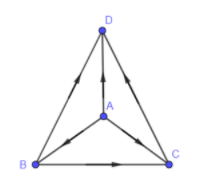
We should know that volume of Tetrahedron formed by coterminous edges $\vec{a},\vec{b},\vec{c}$ is given as $\dfrac{1}{6}\left[ \begin{matrix}
{\vec{a}} & {\vec{b}} & {\vec{c}} \\
\end{matrix} \right]$ .
We are also given that this volume is equal to 2. So, we can write it as
$\dfrac{1}{6}\left[ \begin{matrix}
{\vec{a}} & {\vec{b}} & {\vec{c}} \\
\end{matrix} \right]=2$
On solving this, we get as
$\left[ \begin{matrix}
{\vec{a}} & {\vec{b}} & {\vec{c}} \\
\end{matrix} \right]=2\times 6=12$ ………………….(1)
Now, we have to find value of parallelepiped formed by coterminous edges $\vec{a}\times \vec{b},\vec{b}\times \vec{c},\vec{c}\times \vec{a}$ . So, we can write this as by replacing $\vec{a}$ as $\vec{a}\times \vec{b}$ , $\vec{b}$ as $\vec{b}\times \vec{c}$ , $\vec{c}$ as $\vec{c}\times \vec{a}$ in the general formula $\left| \left( \vec{a}\times \vec{b} \right)\cdot \vec{c} \right|$ which is basically written as $\left[ \begin{matrix}
{\vec{a}} & {\vec{b}} & {\vec{c}} \\
\end{matrix} \right]$ . So, after replacing the values we will get as
$\left[ \begin{matrix}
\vec{a}\times \vec{b} & \vec{b}\times \vec{c} & \vec{c}\times \vec{a} \\
\end{matrix} \right]$
So, we can write it as $\left( \vec{a}\times \vec{b} \right).\left( \left( \vec{b}\times \vec{c} \right)\times \left( \vec{c}\times \vec{a} \right) \right)$ which is known as quadrupole product of four product.
We have formula i.e. $\left( \vec{a}\times \vec{b} \right)\times \left( \vec{c}\times \vec{d} \right)=\left[ \begin{matrix}
a & b & d \\
\end{matrix} \right]c-\left[ \begin{matrix}
a & b & c \\
\end{matrix} \right]d$ . So, on applying this we get as
$\left( \vec{a}\times \vec{b} \right).\left( \left( \vec{b}\times \vec{c} \right)\times \left( \vec{c}\times \vec{a} \right) \right)=\left( \vec{a}\times \vec{b} \right)\cdot \left( \left[ \begin{matrix}
b & c & a \\
\end{matrix} \right]c-\left[ \begin{matrix}
b & c & c \\
\end{matrix} \right]a \right)$
We also know that if two out of three vectors are the same then that is equal to zero. So, we can write it as
$\left( \vec{a}\times \vec{b} \right).\left( \left( \vec{b}\times \vec{c} \right)\times \left( \vec{c}\times \vec{a} \right) \right)=\left( \vec{a}\times \vec{b} \right)\cdot \left( \left[ \begin{matrix}
b & c & a \\
\end{matrix} \right]c \right)=\left( \left( \vec{a}\times \vec{b} \right)\cdot c \right)\left[ \begin{matrix}
b & c & a \\
\end{matrix} \right]$
So, we get as $=\left[ \begin{matrix}
a & b & c \\
\end{matrix} \right]\left[ \begin{matrix}
b & c & a \\
\end{matrix} \right]$ . We know the cumulative rule of box i.e. given as $\left[ \begin{matrix}
a & b & c \\
\end{matrix} \right]=\left[ \begin{matrix}
b & c & a \\
\end{matrix} \right]=\left[ \begin{matrix}
c & a & b \\
\end{matrix} \right]$
So, we will get as
${{\left[ \begin{matrix}
{\vec{a}} & {\vec{b}} & {\vec{c}} \\
\end{matrix} \right]}^{2}}$ ………………..(2)
So, we will directly substitute the value in above equation, and we get as
$\left[ \begin{matrix}
\vec{a}\times \vec{b} & \vec{b}\times \vec{c} & {\vec{c}} \\
\end{matrix}\times \vec{a} \right]={{\left[ \begin{matrix}
{\vec{a}} & {\vec{b}} & {\vec{c}} \\
\end{matrix} \right]}^{2}}={{\left[ 12 \right]}^{2}}$
Thus, on solving we get as
$\left[ \begin{matrix}
\vec{a}\times \vec{b} & \vec{b}\times \vec{c} & {\vec{c}} \\
\end{matrix}\times \vec{a} \right]=144$
Hence, option (b) is the correct answer.
Note: Students sometimes do not read question carefully and end up finding the value of $\left[ \begin{matrix}
\vec{a}+\vec{b} & \vec{b}+\vec{c} & {\vec{c}} \\
\end{matrix}+\vec{a} \right]$ . For finding this formula is almost similar as compare to finding value of $\left[ \begin{matrix}
\vec{a}\times \vec{b} & \vec{b}\times \vec{c} & \vec{c}\times \vec{a} \\
\end{matrix} \right]$ i.e. $2\left[ \begin{matrix}
{\vec{a}} & {\vec{b}} & {\vec{c}} \\
\end{matrix} \right]$ . By placing value in the formula answer will be 24 which is wrong. So, do not solve it in a hurry and please read the question carefully and then attempt it.
{\vec{a}} & {\vec{b}} & {\vec{c}} \\
\end{matrix} \right]$ . Using this, we will get value of $\left[ \begin{matrix}
{\vec{a}} & {\vec{b}} & {\vec{c}} \\
\end{matrix} \right]$ . Then for finding value of $\vec{a}\times \vec{b},\vec{b}\times \vec{c},\vec{c}\times \vec{a}$ , formula to be used is given as ${{\left[ \begin{matrix}
{\vec{a}} & {\vec{b}} & {\vec{c}} \\
\end{matrix} \right]}^{2}}$ . Thus, on substituting the values and solving we will get the answer. The general formula of volume of parallelepiped having coterminous edges $\vec{a},\vec{b},\vec{c}$ is given as $\left| \left( \vec{a}\times \vec{b} \right)\cdot \vec{c} \right|$ .
Complete step-by-step answer:
Here, we will draw a tetrahedron figure.
We should know that volume of Tetrahedron formed by coterminous edges $\vec{a},\vec{b},\vec{c}$ is given as $\dfrac{1}{6}\left[ \begin{matrix}
{\vec{a}} & {\vec{b}} & {\vec{c}} \\
\end{matrix} \right]$ .
We are also given that this volume is equal to 2. So, we can write it as
$\dfrac{1}{6}\left[ \begin{matrix}
{\vec{a}} & {\vec{b}} & {\vec{c}} \\
\end{matrix} \right]=2$
On solving this, we get as
$\left[ \begin{matrix}
{\vec{a}} & {\vec{b}} & {\vec{c}} \\
\end{matrix} \right]=2\times 6=12$ ………………….(1)
Now, we have to find value of parallelepiped formed by coterminous edges $\vec{a}\times \vec{b},\vec{b}\times \vec{c},\vec{c}\times \vec{a}$ . So, we can write this as by replacing $\vec{a}$ as $\vec{a}\times \vec{b}$ , $\vec{b}$ as $\vec{b}\times \vec{c}$ , $\vec{c}$ as $\vec{c}\times \vec{a}$ in the general formula $\left| \left( \vec{a}\times \vec{b} \right)\cdot \vec{c} \right|$ which is basically written as $\left[ \begin{matrix}
{\vec{a}} & {\vec{b}} & {\vec{c}} \\
\end{matrix} \right]$ . So, after replacing the values we will get as
$\left[ \begin{matrix}
\vec{a}\times \vec{b} & \vec{b}\times \vec{c} & \vec{c}\times \vec{a} \\
\end{matrix} \right]$
So, we can write it as $\left( \vec{a}\times \vec{b} \right).\left( \left( \vec{b}\times \vec{c} \right)\times \left( \vec{c}\times \vec{a} \right) \right)$ which is known as quadrupole product of four product.
We have formula i.e. $\left( \vec{a}\times \vec{b} \right)\times \left( \vec{c}\times \vec{d} \right)=\left[ \begin{matrix}
a & b & d \\
\end{matrix} \right]c-\left[ \begin{matrix}
a & b & c \\
\end{matrix} \right]d$ . So, on applying this we get as
$\left( \vec{a}\times \vec{b} \right).\left( \left( \vec{b}\times \vec{c} \right)\times \left( \vec{c}\times \vec{a} \right) \right)=\left( \vec{a}\times \vec{b} \right)\cdot \left( \left[ \begin{matrix}
b & c & a \\
\end{matrix} \right]c-\left[ \begin{matrix}
b & c & c \\
\end{matrix} \right]a \right)$
We also know that if two out of three vectors are the same then that is equal to zero. So, we can write it as
$\left( \vec{a}\times \vec{b} \right).\left( \left( \vec{b}\times \vec{c} \right)\times \left( \vec{c}\times \vec{a} \right) \right)=\left( \vec{a}\times \vec{b} \right)\cdot \left( \left[ \begin{matrix}
b & c & a \\
\end{matrix} \right]c \right)=\left( \left( \vec{a}\times \vec{b} \right)\cdot c \right)\left[ \begin{matrix}
b & c & a \\
\end{matrix} \right]$
So, we get as $=\left[ \begin{matrix}
a & b & c \\
\end{matrix} \right]\left[ \begin{matrix}
b & c & a \\
\end{matrix} \right]$ . We know the cumulative rule of box i.e. given as $\left[ \begin{matrix}
a & b & c \\
\end{matrix} \right]=\left[ \begin{matrix}
b & c & a \\
\end{matrix} \right]=\left[ \begin{matrix}
c & a & b \\
\end{matrix} \right]$
So, we will get as
${{\left[ \begin{matrix}
{\vec{a}} & {\vec{b}} & {\vec{c}} \\
\end{matrix} \right]}^{2}}$ ………………..(2)
So, we will directly substitute the value in above equation, and we get as
$\left[ \begin{matrix}
\vec{a}\times \vec{b} & \vec{b}\times \vec{c} & {\vec{c}} \\
\end{matrix}\times \vec{a} \right]={{\left[ \begin{matrix}
{\vec{a}} & {\vec{b}} & {\vec{c}} \\
\end{matrix} \right]}^{2}}={{\left[ 12 \right]}^{2}}$
Thus, on solving we get as
$\left[ \begin{matrix}
\vec{a}\times \vec{b} & \vec{b}\times \vec{c} & {\vec{c}} \\
\end{matrix}\times \vec{a} \right]=144$
Hence, option (b) is the correct answer.
Note: Students sometimes do not read question carefully and end up finding the value of $\left[ \begin{matrix}
\vec{a}+\vec{b} & \vec{b}+\vec{c} & {\vec{c}} \\
\end{matrix}+\vec{a} \right]$ . For finding this formula is almost similar as compare to finding value of $\left[ \begin{matrix}
\vec{a}\times \vec{b} & \vec{b}\times \vec{c} & \vec{c}\times \vec{a} \\
\end{matrix} \right]$ i.e. $2\left[ \begin{matrix}
{\vec{a}} & {\vec{b}} & {\vec{c}} \\
\end{matrix} \right]$ . By placing value in the formula answer will be 24 which is wrong. So, do not solve it in a hurry and please read the question carefully and then attempt it.
Recently Updated Pages
Explain the structure of megasporangium class 12 biology CBSE

Why is chloroform kept in dark coloured bottles class 12 chemistry CBSE
Derive the balancing condition of a Wheatstone bri class 12 physics CBSE
Draw VI characteristics of a pn junction diode Explain class 12 physics CBSE
Is it possible to carry pride in ones language too class 12 english CBSE
In a population at Hardy Weinberg equilibrium the allele class 12 biology CBSE
Trending doubts
Draw a labelled sketch of the human eye class 12 physics CBSE
Which are the Top 10 Largest Countries of the World?
Draw ray diagrams each showing i myopic eye and ii class 12 physics CBSE
Which is the correct genotypic ratio of mendel dihybrid class 12 biology CBSE
Differentiate between homogeneous and heterogeneous class 12 chemistry CBSE
Which animal never drinks water in its entire life class 12 biology CBSE