




If the temperature of a conductor is increased, its resistance will
A) not increase.
B) increase.
C) decrease.
D) change according to the weather.
Answer
 Verified
572.1k+ views
Hint:The absence of free electrons in a material to conduct electricity is an indication of better resistance offered by that material. A material is termed as a good conductor if it has a large number of free electrons or ions present in it. Now a change in the temperature will correspondingly change the number of free electrons present in the conductor.
Complete step by step answer.
Step 1: Try to explain the change caused by an increase in the temperature of a conductor.
A material is categorized as a conductor because of the large number of free electrons present in it. When the temperature increases, the vibration of the atoms of the conductor also increases. This causes the free electrons to collide with each other and with the other bounded electrons. These collisions reduce the energy of the free electron and they will no longer be considered as free electrons. This will then contribute to the resistance of the conductor.
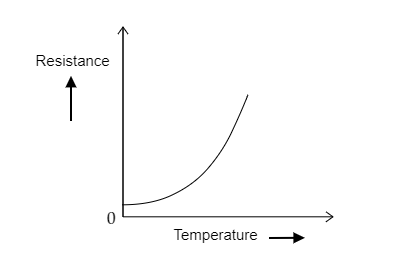
So as the temperature is increased more and more, collisions between charges take place which then, in turn, cause the resistance of the material to increase as well. Given below is a graph depicting the variation of resistance of a conductor with the increase in its temperature.
Hence, if the temperature of a conductor increases, its resistance will also increase.
So the correct option is B.
Note:When sketching the graph depicting the variation of resistance of a conductor with the rise in its temperature, it is important to remember that a conductor will always offer a feeble amount of resistance even at zero units of temperature and so the variation curve cannot start at the origin. It is the free movement of electrons and ions in a material which attributes to its good conduction of electricity.
Complete step by step answer.
Step 1: Try to explain the change caused by an increase in the temperature of a conductor.
A material is categorized as a conductor because of the large number of free electrons present in it. When the temperature increases, the vibration of the atoms of the conductor also increases. This causes the free electrons to collide with each other and with the other bounded electrons. These collisions reduce the energy of the free electron and they will no longer be considered as free electrons. This will then contribute to the resistance of the conductor.
So as the temperature is increased more and more, collisions between charges take place which then, in turn, cause the resistance of the material to increase as well. Given below is a graph depicting the variation of resistance of a conductor with the increase in its temperature.
Hence, if the temperature of a conductor increases, its resistance will also increase.
So the correct option is B.
Note:When sketching the graph depicting the variation of resistance of a conductor with the rise in its temperature, it is important to remember that a conductor will always offer a feeble amount of resistance even at zero units of temperature and so the variation curve cannot start at the origin. It is the free movement of electrons and ions in a material which attributes to its good conduction of electricity.
Recently Updated Pages
Master Class 12 Economics: Engaging Questions & Answers for Success

Master Class 12 Physics: Engaging Questions & Answers for Success
Master Class 12 English: Engaging Questions & Answers for Success
Master Class 12 Social Science: Engaging Questions & Answers for Success
Master Class 12 Maths: Engaging Questions & Answers for Success
Master Class 12 Business Studies: Engaging Questions & Answers for Success
Trending doubts
Which are the Top 10 Largest Countries of the World?
What are the major means of transport Explain each class 12 social science CBSE
Draw a labelled sketch of the human eye class 12 physics CBSE
Why cannot DNA pass through cell membranes class 12 biology CBSE
Differentiate between insitu conservation and exsitu class 12 biology CBSE
Draw a neat and well labeled diagram of TS of ovary class 12 biology CBSE