




If the slope of one line of the pair of lines represented by $a{{x}^{2}}+10xy+{{y}^{2}}=0$ is four times the slope of the other line, then ‘a’ equals to
(a) 1
(b) 2
(c) 4
(d) 16
Answer
 Verified
647.1k+ views
Hint: To solve this question, we will first understand the equation given to us and define the properties of slopes of pair lines. Then, we will use the second condition to derive a relation between the slopes. Once we get the relation, we can find the value of ‘a’.
Complete step-by-step answer:
The standard equation of pairs of real and different lines passing through the origin is given as $a{{x}^{2}}+2hxy+b{{y}^{2}}=0$, where h > ab.
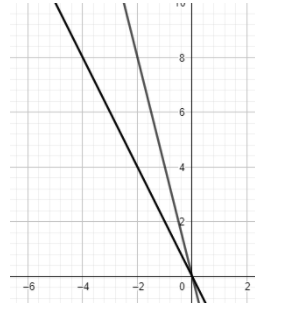
Equation of the pair of lines given to us is $a{{x}^{2}}+10xy+{{y}^{2}}=0$.
From the equation, we can say both the lines pass through the origin (0, 0), 2h = 10 and b = 1.
Now, we know that the sum of the slopes of pair of lines is given as $\dfrac{2h}{b}$ and the product of the slopes of the pairs of line is given as $\dfrac{a}{b}$.
Let k and l be the slopes of the two lines represented by the equation $a{{x}^{2}}+10xy+{{y}^{2}}=0$ and it is given to us that one slope is 4 times the other slope.
Thus, k = 4l
Since 2h = 10 and b = 1, k + l = $\dfrac{10}{1}$…….(1)
And kl = $\dfrac{a}{1}$……(2)
Put k = 4l in (1)
$\Rightarrow $ 4l + l = 10
$\Rightarrow $ 5l = 10
$\Rightarrow $ l = 2
And k = 4(2)
$\Rightarrow $ k = 8
Thus, the two slopes are 2 and 8.
Now, we put k = 8 and l = 2 in (2)
$\Rightarrow $ (2)(8) = a
$\Rightarrow $ a = 16
Hence, option (d) is the correct option.
Note: Once, the students derive the slopes of the lines of the equation of pair of straight lines, many other properties, such as deciding that the lines are parallel or perpendicular or at an angle, can be defined. Moreover, students are advised to be careful that in the equation $a{{x}^{2}}+10xy+{{y}^{2}}=0$, middle term is 2h and not h. Thus, h = 5.
Complete step-by-step answer:
The standard equation of pairs of real and different lines passing through the origin is given as $a{{x}^{2}}+2hxy+b{{y}^{2}}=0$, where h > ab.
Equation of the pair of lines given to us is $a{{x}^{2}}+10xy+{{y}^{2}}=0$.
From the equation, we can say both the lines pass through the origin (0, 0), 2h = 10 and b = 1.
Now, we know that the sum of the slopes of pair of lines is given as $\dfrac{2h}{b}$ and the product of the slopes of the pairs of line is given as $\dfrac{a}{b}$.
Let k and l be the slopes of the two lines represented by the equation $a{{x}^{2}}+10xy+{{y}^{2}}=0$ and it is given to us that one slope is 4 times the other slope.
Thus, k = 4l
Since 2h = 10 and b = 1, k + l = $\dfrac{10}{1}$…….(1)
And kl = $\dfrac{a}{1}$……(2)
Put k = 4l in (1)
$\Rightarrow $ 4l + l = 10
$\Rightarrow $ 5l = 10
$\Rightarrow $ l = 2
And k = 4(2)
$\Rightarrow $ k = 8
Thus, the two slopes are 2 and 8.
Now, we put k = 8 and l = 2 in (2)
$\Rightarrow $ (2)(8) = a
$\Rightarrow $ a = 16
Hence, option (d) is the correct option.
Note: Once, the students derive the slopes of the lines of the equation of pair of straight lines, many other properties, such as deciding that the lines are parallel or perpendicular or at an angle, can be defined. Moreover, students are advised to be careful that in the equation $a{{x}^{2}}+10xy+{{y}^{2}}=0$, middle term is 2h and not h. Thus, h = 5.
Recently Updated Pages
Master Class 12 Economics: Engaging Questions & Answers for Success

Master Class 12 Social Science: Engaging Questions & Answers for Success
Master Class 12 English: Engaging Questions & Answers for Success
Master Class 12 Maths: Engaging Questions & Answers for Success
Master Class 12 Physics: Engaging Questions & Answers for Success
Master Class 12 Biology: Engaging Questions & Answers for Success
Trending doubts
Draw a labelled sketch of the human eye class 12 physics CBSE
Which are the Top 10 Largest Countries of the World?
Draw ray diagrams each showing i myopic eye and ii class 12 physics CBSE
Which is the correct genotypic ratio of mendel dihybrid class 12 biology CBSE
Differentiate between homogeneous and heterogeneous class 12 chemistry CBSE
Which animal never drinks water in its entire life class 12 biology CBSE