




If the principal quantum number n=6, the correct sequence of filling of electron will be:
(A) $ns\to \left( n-2 \right)$$f\to np\to \left( n-1 \right)d$
(B) $ns\to \left( n-1 \right)$$f\to np\to \left( n-2 \right)d$
(C) $ns\to np\to \left( n-1 \right)d\to \left( n-2 \right)f$
(D) $ns\to \left( n-2 \right)f\to \left( n-1 \right)d\to np$
Answer
 Verified
603.6k+ views
Hint: Think about the Aufbau’s principle. Recollect what a principal quantum number is. Carefully take a look at the options and then choose the correct option. Take a look at the periodic table and think about the order in which the electrons will fill in the orbitals to get the answer.
Complete step by step solution:
- Principle quantum number (n) tells us the number of shells in which the last electron enters.
- Basically, the principal quantum number tells us about the valence shell.
- According to Aufbau’s rule, electrons will fill lower energy atomic levels first and then get filled up in the higher energy levels.
- Aufbau’s rule is represented below in the given diagram.
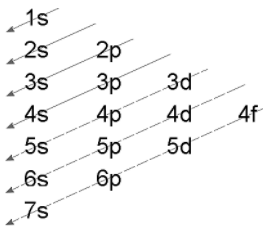
- The electrons will start filling up in the order:
1s then 2s then 2p then 3s, 3p, 4s, 3d, 4p, 5s, 4d, 5p, 6s, 4f, 5d, 6p and then 7s and 7p.
- 1s orbital has the least amount of energy.
- If the valence electron enters in the sixth orbital then, the electron enters in 6s orbital followed by 4f orbital then 5d orbital and then 6p orbital.
- Therefore, when n=6, the electron fills in the order 6s, 4f, 5d and 6p.
- So, the option $ns\to \left( n-2 \right)f\to \left( n-1 \right)d\to np$ is correct.
Therefore, option (D) is correct.
Note: Remember the electrons will start filling up from lower orbitals and then get filled in higher orbitals. This rule is known as Aufbau’s principle. The Principal quantum number is represented as ‘n’ which is the number of main shells in which electrons enter.
Complete step by step solution:
- Principle quantum number (n) tells us the number of shells in which the last electron enters.
- Basically, the principal quantum number tells us about the valence shell.
- According to Aufbau’s rule, electrons will fill lower energy atomic levels first and then get filled up in the higher energy levels.
- Aufbau’s rule is represented below in the given diagram.
- The electrons will start filling up in the order:
1s then 2s then 2p then 3s, 3p, 4s, 3d, 4p, 5s, 4d, 5p, 6s, 4f, 5d, 6p and then 7s and 7p.
- 1s orbital has the least amount of energy.
- If the valence electron enters in the sixth orbital then, the electron enters in 6s orbital followed by 4f orbital then 5d orbital and then 6p orbital.
- Therefore, when n=6, the electron fills in the order 6s, 4f, 5d and 6p.
- So, the option $ns\to \left( n-2 \right)f\to \left( n-1 \right)d\to np$ is correct.
Therefore, option (D) is correct.
Note: Remember the electrons will start filling up from lower orbitals and then get filled in higher orbitals. This rule is known as Aufbau’s principle. The Principal quantum number is represented as ‘n’ which is the number of main shells in which electrons enter.
Recently Updated Pages
Master Class 11 Social Science: Engaging Questions & Answers for Success

Master Class 11 English: Engaging Questions & Answers for Success
Master Class 11 Maths: Engaging Questions & Answers for Success
Master Class 11 Chemistry: Engaging Questions & Answers for Success
Master Class 11 Biology: Engaging Questions & Answers for Success
Master Class 11 Physics: Engaging Questions & Answers for Success
Trending doubts
Differentiate between an exothermic and an endothermic class 11 chemistry CBSE
One Metric ton is equal to kg A 10000 B 1000 C 100 class 11 physics CBSE
Difference Between Prokaryotic Cells and Eukaryotic Cells
There are 720 permutations of the digits 1 2 3 4 5 class 11 maths CBSE
Draw a diagram of a plant cell and label at least eight class 11 biology CBSE
1 Quintal is equal to a 110 kg b 10 kg c 100kg d 1000 class 11 physics CBSE