




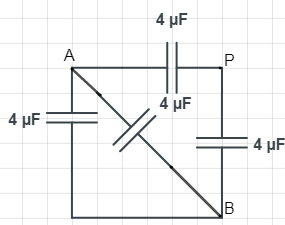
If the potential difference across AB is 5V find the charge on each capacitor.
Answer
 Verified
558k+ views
Hint: The amount of charge into plates of capacitors depends upon the capacitance and the applied voltage charge is equal to the product of capacitance and the potential difference between the plates. Use the mathematical expression for the charge stored in the capacitor to get the required answer.
Formula used:
$\begin{align}
& q=CV \\
& {{C}_{Parallel}}={{C}_{1}}\,+\,{{\text{C}}_{2}} \\
& {{C}_{Series}}=\dfrac{1}{\dfrac{1}{{{C}_{1}}}+\dfrac{1}{{{C}_{2}}}} \\
\end{align}$
Complete step-by-step solution
Capacitors are a combination of two conducting plates or conductors placed close to each other. One of the conductors is given a positive charge and the other is given an equal negative charge. The conductor with positive charge is called the positive plate and the other is called the negative plate.
We know that it is shown in figure that there are four capacitors each having same value of capacitance that is $4\mu F.$
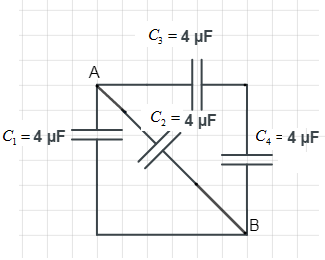
Now, we give or assume the names of each capacitance to differentiate between them for easier calculations.
Using the formula of charge,
$q\,=\,CV$, where ‘q’ is charged, ‘C’ is the capacitance and ‘V’ is the potential difference between the plates.
We know that the voltage is similar for capacitors that are connected in parallel combination and the voltage is distributed for capacitors that are connected in series combination.
From the above diagram, it is clear that ${{C}_{1}}\,\text{and }{{\text{C}}_{2}}$ are connected in parallel and ${{C}_{3}}\,\text{and }{{\text{C}}_{4}}$ are connected in series but it is parallel to ${{C}_{1}}\,\text{and }{{\text{C}}_{2}}$.
So, the net capacitor value for the combination of ${{C}_{3}}\,\text{and }{{\text{C}}_{4}}$ is:
$\begin{align}
& {{C}_{Net}}=\dfrac{1}{\dfrac{1}{{{C}_{3}}}+\dfrac{1}{{{C}_{4}}}} \\
& \Rightarrow {{C}_{Net}}=\dfrac{1}{\dfrac{1}{4}+\dfrac{1}{4}} \\
& \Rightarrow {{C}_{Net}}=\dfrac{1}{\dfrac{2}{4}} \\
& \therefore {{C}_{Net}}=2\,\mu C \\
\end{align}$
So, ${{C}_{1}},\,{{C}_{2}}\,\text{and }{{\text{C}}_{Net}}$ are connected in parallel combination, so the voltage is similar along these capacitors.
Hence, the charge of the capacitor is:
${{q}_{1}}={{C}_{1}}V=4\times 5=20\mu C$
${{q}_{2}}={{C}_{2}}V=4\times 5=20\mu C$
And,
${{q}_{Net}}={{C}_{Net}}V=2\times 5=10\mu C$
Therefore, the charge across ${{C}_{1}}\,\text{and }{{\text{C}}_{2}}$ capacitor will be $20\,\mu C$ and charge across ${{C}_{3}}\,\text{and }{{\text{C}}_{4}}$ capacitor will be $10\,\mu C$ for a potential difference of $5\,V$.
Note: The main point to take care while solving this kind of problem is to check the type of connection the capacitor is in, as the voltage distribution will depend on the net capacitor value in that wire. There are two types of connections that are possible, which are parallel and series connection, and the voltage is the same in capacitors that are parallel to each other and distributed for capacitors that are in series connection to each other.
Formula used:
$\begin{align}
& q=CV \\
& {{C}_{Parallel}}={{C}_{1}}\,+\,{{\text{C}}_{2}} \\
& {{C}_{Series}}=\dfrac{1}{\dfrac{1}{{{C}_{1}}}+\dfrac{1}{{{C}_{2}}}} \\
\end{align}$
Complete step-by-step solution
Capacitors are a combination of two conducting plates or conductors placed close to each other. One of the conductors is given a positive charge and the other is given an equal negative charge. The conductor with positive charge is called the positive plate and the other is called the negative plate.
We know that it is shown in figure that there are four capacitors each having same value of capacitance that is $4\mu F.$
Now, we give or assume the names of each capacitance to differentiate between them for easier calculations.
Using the formula of charge,
$q\,=\,CV$, where ‘q’ is charged, ‘C’ is the capacitance and ‘V’ is the potential difference between the plates.
We know that the voltage is similar for capacitors that are connected in parallel combination and the voltage is distributed for capacitors that are connected in series combination.
From the above diagram, it is clear that ${{C}_{1}}\,\text{and }{{\text{C}}_{2}}$ are connected in parallel and ${{C}_{3}}\,\text{and }{{\text{C}}_{4}}$ are connected in series but it is parallel to ${{C}_{1}}\,\text{and }{{\text{C}}_{2}}$.
So, the net capacitor value for the combination of ${{C}_{3}}\,\text{and }{{\text{C}}_{4}}$ is:
$\begin{align}
& {{C}_{Net}}=\dfrac{1}{\dfrac{1}{{{C}_{3}}}+\dfrac{1}{{{C}_{4}}}} \\
& \Rightarrow {{C}_{Net}}=\dfrac{1}{\dfrac{1}{4}+\dfrac{1}{4}} \\
& \Rightarrow {{C}_{Net}}=\dfrac{1}{\dfrac{2}{4}} \\
& \therefore {{C}_{Net}}=2\,\mu C \\
\end{align}$
So, ${{C}_{1}},\,{{C}_{2}}\,\text{and }{{\text{C}}_{Net}}$ are connected in parallel combination, so the voltage is similar along these capacitors.
Hence, the charge of the capacitor is:
${{q}_{1}}={{C}_{1}}V=4\times 5=20\mu C$
${{q}_{2}}={{C}_{2}}V=4\times 5=20\mu C$
And,
${{q}_{Net}}={{C}_{Net}}V=2\times 5=10\mu C$
Therefore, the charge across ${{C}_{1}}\,\text{and }{{\text{C}}_{2}}$ capacitor will be $20\,\mu C$ and charge across ${{C}_{3}}\,\text{and }{{\text{C}}_{4}}$ capacitor will be $10\,\mu C$ for a potential difference of $5\,V$.
Note: The main point to take care while solving this kind of problem is to check the type of connection the capacitor is in, as the voltage distribution will depend on the net capacitor value in that wire. There are two types of connections that are possible, which are parallel and series connection, and the voltage is the same in capacitors that are parallel to each other and distributed for capacitors that are in series connection to each other.
Recently Updated Pages
Master Class 12 Economics: Engaging Questions & Answers for Success

Master Class 12 Physics: Engaging Questions & Answers for Success
Master Class 12 English: Engaging Questions & Answers for Success
Master Class 12 Social Science: Engaging Questions & Answers for Success
Master Class 12 Maths: Engaging Questions & Answers for Success
Master Class 12 Business Studies: Engaging Questions & Answers for Success
Trending doubts
Which are the Top 10 Largest Countries of the World?
What are the major means of transport Explain each class 12 social science CBSE
Draw a labelled sketch of the human eye class 12 physics CBSE
Why cannot DNA pass through cell membranes class 12 biology CBSE
Differentiate between insitu conservation and exsitu class 12 biology CBSE
Draw a neat and well labeled diagram of TS of ovary class 12 biology CBSE