



If the point $\left( x,y \right)$ be equidistant from the point $\left( a+b,b-a \right)$ and $\left( a-b,a+b \right)$ prove that $bx=ay$ .
Answer
 Verified
594.9k+ views
Hint: e will assume points C be $\left( x,y \right)$ , A be $\left( a+b,b-a \right)$ and B be $\left( a-b,a+b \right)$ . So, we can say that $A\left( {{x}_{1}},{{y}_{1}} \right)$ and $B\left( {{x}_{2}},{{y}_{2}} \right)$ . Then we will use the distance formula $\sqrt{{{\left( x-{{x}_{1}} \right)}^{2}}+{{\left( y-{{y}_{1}} \right)}^{2}}}$ for $CA=CB$ . So, using this formula and on substituting the values and solving we will be proving $bx=ay$ . We will use the formula ${{\left( a-b \right)}^{2}}={{a}^{2}}+{{b}^{2}}-2ab$ .
Complete step-by-step answer:
Here, we will draw the figure for this where one point is equidistant from the other two points. So, we get as
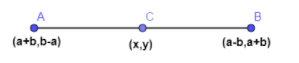
Let point C be $\left( x,y \right)$ , A be $\left( a+b,b-a \right)$ and B be $\left( a-b,a+b \right)$ . So, we will take $A\left( {{x}_{1}},{{y}_{1}} \right)$ and $B\left( {{x}_{2}},{{y}_{2}} \right)$ .
Now, it is given that $CA=CB$ . So, we will use distance formula which is given as $\sqrt{{{\left( x-{{x}_{1}} \right)}^{2}}+{{\left( y-{{y}_{1}} \right)}^{2}}}$ . So, using this we get as
$CA=CB$
Applying formula for CA and CB points i.e. $\left( x,y \right)$ , $\left( {{x}_{1}},{{y}_{1}} \right)$ and $\left( x,y \right)$ , $\left( {{x}_{2}},{{y}_{2}} \right)$ . So, we get as
$\Rightarrow \sqrt{{{\left( x-{{x}_{1}} \right)}^{2}}+{{\left( y-{{y}_{1}} \right)}^{2}}}=\sqrt{{{\left( x-{{x}_{2}} \right)}^{2}}+{{\left( y-{{y}_{2}} \right)}^{2}}}$
On putting values, we get as
$\Rightarrow \sqrt{{{\left( x-\left( a+b \right) \right)}^{2}}+{{\left( y-\left( b-a \right) \right)}^{2}}}=\sqrt{{{\left( x-\left( a-b \right) \right)}^{2}}+{{\left( y-\left( a+b \right) \right)}^{2}}}$
Now, we will square on both sides and remove the square root. So, we get as
$\Rightarrow {{\left( x-\left( a+b \right) \right)}^{2}}+{{\left( y-\left( b-a \right) \right)}^{2}}={{\left( x-\left( a-b \right) \right)}^{2}}+{{\left( y-\left( a+b \right) \right)}^{2}}$
Now, we apply the formula ${{\left( a-b \right)}^{2}}={{a}^{2}}+{{b}^{2}}-2ab$ . So, we can write the equation as
$\begin{align}
& \Rightarrow {{x}^{2}}+{{\left( a+b \right)}^{2}}-2x\left( a+b \right)+{{y}^{2}}+{{\left( b-a \right)}^{2}}-2y\left( b-a \right)= \\
& \text{ }{{x}^{2}}+{{\left( a-b \right)}^{2}}-2x\left( a-b \right)+{{y}^{2}}+{{\left( a+b \right)}^{2}}-2y\left( a+b \right) \\
\end{align}$
On further cancelling the ${{x}^{2}}$ , ${{y}^{2}}$ from both sides, we get as
$\begin{align}
& \Rightarrow {{\left( a+b \right)}^{2}}-2x\left( a+b \right)+{{\left( b-a \right)}^{2}}-2y\left( b-a \right)= \\
& \text{ }{{\left( a-b \right)}^{2}}-2x\left( a-b \right)+{{\left( a+b \right)}^{2}}-2y\left( a+b \right) \\
\end{align}$
Now, if we take square terms on one side and remaining terms on other side, we get as
$\begin{align}
& \Rightarrow {{\left( a+b \right)}^{2}}+{{\left( b-a \right)}^{2}}-{{\left( a-b \right)}^{2}}-{{\left( a+b \right)}^{2}}= \\
& 2x\left( a+b \right)+2y\left( b-a \right)-2x\left( a-b \right)-2y\left( a+b \right) \\
\end{align}$
On cancelling plus minus terms from both sides, we get as
$\Rightarrow {{\left( b-a \right)}^{2}}-{{\left( a-b \right)}^{2}}=2x\left( a+b \right)+2y\left( b-a \right)-2x\left( a-b \right)-2y\left( a+b \right)$
On expanding Left hand side terms, we get as
$\begin{align}
& \Rightarrow {{a}^{2}}+{{b}^{2}}-2ab-\left( {{a}^{2}}+{{b}^{2}}-2ab \right)= \\
& 2x\left( a+b \right)+2y\left( b-a \right)-2x\left( a-b \right)-2y\left( a+b \right) \\
\end{align}$
Thus, on simplification and rearranging terms we get equation as
$\Rightarrow 2x\left( a+b \right)+2y\left( b-a \right)=2x\left( a-b \right)+2y\left( a+b \right)$
On cancelling 2 from both sides and multiplying the brackets we get as
$\Rightarrow ax+bx+by-ay=ax-bx+ay+by$
On cancelling the same terms on both sides, we get as
$\Rightarrow bx-ay=-bx+ay$
$\Rightarrow 2bx=2ay$
Thus, we get as
$\Rightarrow bx=ay$
Hence, proved.
Note: Students should understand the question and then draw the figure accordingly then only we can know that $CA=CB$ . Also, equidistant formulas should be known, then only by solving the equation we will get the answer. Be careful while solving long equations if there is a single sign mistake then the answer will not come, and students will get confused. So, please avoid this mistake.
Complete step-by-step answer:
Here, we will draw the figure for this where one point is equidistant from the other two points. So, we get as
Let point C be $\left( x,y \right)$ , A be $\left( a+b,b-a \right)$ and B be $\left( a-b,a+b \right)$ . So, we will take $A\left( {{x}_{1}},{{y}_{1}} \right)$ and $B\left( {{x}_{2}},{{y}_{2}} \right)$ .
Now, it is given that $CA=CB$ . So, we will use distance formula which is given as $\sqrt{{{\left( x-{{x}_{1}} \right)}^{2}}+{{\left( y-{{y}_{1}} \right)}^{2}}}$ . So, using this we get as
$CA=CB$
Applying formula for CA and CB points i.e. $\left( x,y \right)$ , $\left( {{x}_{1}},{{y}_{1}} \right)$ and $\left( x,y \right)$ , $\left( {{x}_{2}},{{y}_{2}} \right)$ . So, we get as
$\Rightarrow \sqrt{{{\left( x-{{x}_{1}} \right)}^{2}}+{{\left( y-{{y}_{1}} \right)}^{2}}}=\sqrt{{{\left( x-{{x}_{2}} \right)}^{2}}+{{\left( y-{{y}_{2}} \right)}^{2}}}$
On putting values, we get as
$\Rightarrow \sqrt{{{\left( x-\left( a+b \right) \right)}^{2}}+{{\left( y-\left( b-a \right) \right)}^{2}}}=\sqrt{{{\left( x-\left( a-b \right) \right)}^{2}}+{{\left( y-\left( a+b \right) \right)}^{2}}}$
Now, we will square on both sides and remove the square root. So, we get as
$\Rightarrow {{\left( x-\left( a+b \right) \right)}^{2}}+{{\left( y-\left( b-a \right) \right)}^{2}}={{\left( x-\left( a-b \right) \right)}^{2}}+{{\left( y-\left( a+b \right) \right)}^{2}}$
Now, we apply the formula ${{\left( a-b \right)}^{2}}={{a}^{2}}+{{b}^{2}}-2ab$ . So, we can write the equation as
$\begin{align}
& \Rightarrow {{x}^{2}}+{{\left( a+b \right)}^{2}}-2x\left( a+b \right)+{{y}^{2}}+{{\left( b-a \right)}^{2}}-2y\left( b-a \right)= \\
& \text{ }{{x}^{2}}+{{\left( a-b \right)}^{2}}-2x\left( a-b \right)+{{y}^{2}}+{{\left( a+b \right)}^{2}}-2y\left( a+b \right) \\
\end{align}$
On further cancelling the ${{x}^{2}}$ , ${{y}^{2}}$ from both sides, we get as
$\begin{align}
& \Rightarrow {{\left( a+b \right)}^{2}}-2x\left( a+b \right)+{{\left( b-a \right)}^{2}}-2y\left( b-a \right)= \\
& \text{ }{{\left( a-b \right)}^{2}}-2x\left( a-b \right)+{{\left( a+b \right)}^{2}}-2y\left( a+b \right) \\
\end{align}$
Now, if we take square terms on one side and remaining terms on other side, we get as
$\begin{align}
& \Rightarrow {{\left( a+b \right)}^{2}}+{{\left( b-a \right)}^{2}}-{{\left( a-b \right)}^{2}}-{{\left( a+b \right)}^{2}}= \\
& 2x\left( a+b \right)+2y\left( b-a \right)-2x\left( a-b \right)-2y\left( a+b \right) \\
\end{align}$
On cancelling plus minus terms from both sides, we get as
$\Rightarrow {{\left( b-a \right)}^{2}}-{{\left( a-b \right)}^{2}}=2x\left( a+b \right)+2y\left( b-a \right)-2x\left( a-b \right)-2y\left( a+b \right)$
On expanding Left hand side terms, we get as
$\begin{align}
& \Rightarrow {{a}^{2}}+{{b}^{2}}-2ab-\left( {{a}^{2}}+{{b}^{2}}-2ab \right)= \\
& 2x\left( a+b \right)+2y\left( b-a \right)-2x\left( a-b \right)-2y\left( a+b \right) \\
\end{align}$
Thus, on simplification and rearranging terms we get equation as
$\Rightarrow 2x\left( a+b \right)+2y\left( b-a \right)=2x\left( a-b \right)+2y\left( a+b \right)$
On cancelling 2 from both sides and multiplying the brackets we get as
$\Rightarrow ax+bx+by-ay=ax-bx+ay+by$
On cancelling the same terms on both sides, we get as
$\Rightarrow bx-ay=-bx+ay$
$\Rightarrow 2bx=2ay$
Thus, we get as
$\Rightarrow bx=ay$
Hence, proved.
Note: Students should understand the question and then draw the figure accordingly then only we can know that $CA=CB$ . Also, equidistant formulas should be known, then only by solving the equation we will get the answer. Be careful while solving long equations if there is a single sign mistake then the answer will not come, and students will get confused. So, please avoid this mistake.

Recently Updated Pages
Complete reduction of benzene diazonium chloride with class 12 chemistry CBSE

How can you identify optical isomers class 12 chemistry CBSE
The coating formed on the metals such as iron silver class 12 chemistry CBSE
Metals are refined by using different methods Which class 12 chemistry CBSE
What do you understand by denaturation of proteins class 12 chemistry CBSE
Assertion Nitrobenzene is used as a solvent in FriedelCrafts class 12 chemistry CBSE
Trending doubts
Difference Between Plant Cell and Animal Cell
Fill the blanks with the suitable prepositions 1 The class 9 english CBSE
Which places in India experience sunrise first and class 9 social science CBSE
What is pollution? How many types of pollution? Define it
Name 10 Living and Non living things class 9 biology CBSE
What is the full form of pH?