




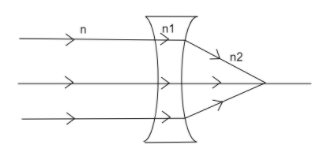
If the path of parallel light through a concave lens is as shown in the figure, where $\eta $, ${{\eta }_{1}}$ and ${{\eta }_{2}}$ are refractive indices, then
A.$\eta >{{\eta }_{1}}={{\eta }_{2}}$
B.$\eta ={{\eta }_{1}}<{{\eta }_{2}}$
C.$\eta ={{\eta }_{1}}>{{\eta }_{2}}$
D.$\eta <{{\eta }_{1}}={{\eta }_{2}}$
Answer
 Verified
574.8k+ views
Hint: To solve this problem we will look at the deviation of the ray as it passes through mediums with different refractive indices. The refractive index of a medium is the ratio of speed of light in vacuum and the speed of light in that medium.
Complete answer:
As we can observe from the ray diagram that when the ray passes from a medium of refractive index $\eta $ to a medium with refractive index ${{\eta }_{1}}$, it does not deviate at all, therefore the refractive index of both these mediums must be equal and hence we can conclude that $\eta ={{\eta }_{1}}$. Now once again look at the ray diagram, we can observe that the ray bends when it travels from the medium of refractive index ${{\eta }_{1}}$ to a medium of refractive index ${{\eta }_{2}}$. Hence, we can conclude that the refractive indices of both these mediums must be different. Since the ray of light bends away from the normal as compared to its original path hence the medium of refractive index ${{\eta }_{2}}$ is rarer as compared to the medium of refractive index ${{\eta }_{1}}$. Hence, we can say that ${{\eta }_{1}}>{{\eta }_{2}}$.
Finally, we can conclude that $\eta ={{\eta }_{1}}>{{\eta }_{2}}$ i.e., the correct option is $C$.
Note:
When a ray travels from a medium to another medium of same refractive index it does not deviate from its original path while, when the it travels from a denser medium to a rarer medium then it bends away from the normal as we saw in the above case. This behavior of rays is explained by Snell’s law.
Complete answer:
As we can observe from the ray diagram that when the ray passes from a medium of refractive index $\eta $ to a medium with refractive index ${{\eta }_{1}}$, it does not deviate at all, therefore the refractive index of both these mediums must be equal and hence we can conclude that $\eta ={{\eta }_{1}}$. Now once again look at the ray diagram, we can observe that the ray bends when it travels from the medium of refractive index ${{\eta }_{1}}$ to a medium of refractive index ${{\eta }_{2}}$. Hence, we can conclude that the refractive indices of both these mediums must be different. Since the ray of light bends away from the normal as compared to its original path hence the medium of refractive index ${{\eta }_{2}}$ is rarer as compared to the medium of refractive index ${{\eta }_{1}}$. Hence, we can say that ${{\eta }_{1}}>{{\eta }_{2}}$.
Finally, we can conclude that $\eta ={{\eta }_{1}}>{{\eta }_{2}}$ i.e., the correct option is $C$.
Note:
When a ray travels from a medium to another medium of same refractive index it does not deviate from its original path while, when the it travels from a denser medium to a rarer medium then it bends away from the normal as we saw in the above case. This behavior of rays is explained by Snell’s law.
Recently Updated Pages
Master Class 12 Business Studies: Engaging Questions & Answers for Success

Master Class 12 Chemistry: Engaging Questions & Answers for Success
Master Class 12 Biology: Engaging Questions & Answers for Success
Class 12 Question and Answer - Your Ultimate Solutions Guide
Master Class 11 English: Engaging Questions & Answers for Success
Master Class 11 Social Science: Engaging Questions & Answers for Success
Trending doubts
Which are the Top 10 Largest Countries of the World?
The total number of vertebrae in man is a30 b31 c32 class 12 biology CBSE
Draw a labelled sketch of the human eye class 12 physics CBSE
The number of cranial nerves in a frog is A 10 pairs class 12 biology CBSE
Differentiate between homogeneous and heterogeneous class 12 chemistry CBSE
Differentiate between Pyramid of energy and pyramid class 12 biology CBSE