




If the optician’s prescription for the spectacles reads: Left eye: -3.00D, Right eye: -3.5D, then the person is suffering from the defect of vision called:
A) Astigmatism
B) Myopia
C) Presbyopia
D) Hypermetropia
Answer
 Verified
585k+ views
Hint: There are different-different vision defects which can be corrected by using a particular i.e. either convex or concave. Here we have given the power of the lenses which are used to correct the vision problem and we have to find the type of defect the person is suffering from. From the power we can find which lens is used and hence accordingly the defect.
Complete step by step answer:
The power of the lens is given as the inverse of the focal length of the lens.
Here given power for both the eyes are negative which means the focal length of the lenses are negative too. A lens having negative focal length is a concave lens.
Now a concave lens is used to correct a vision problem where a person cannot see a far distance object as the front in front of the retina. A concave lens is a diverging lens therefore by using its image it is formed at the retina.
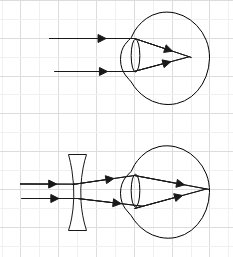
The vision defect in which a person cannot see a far distant object is near-sightedness or myopia.
So, the correct answer is “Option B”.
Note:
Detecting the defect with the lens used is easy but one should remember which lens has negative and positive focal length. One can also get confused in hypermetropia and presbyopia due to similar names, but hypermetropia is just the opposite case of myopia where a person cannot see near an object. Whereas presbyopia is a special case of hypermetropia in which a person cannot see near an object due to aging.
Complete step by step answer:
The power of the lens is given as the inverse of the focal length of the lens.
Here given power for both the eyes are negative which means the focal length of the lenses are negative too. A lens having negative focal length is a concave lens.
Now a concave lens is used to correct a vision problem where a person cannot see a far distance object as the front in front of the retina. A concave lens is a diverging lens therefore by using its image it is formed at the retina.
The vision defect in which a person cannot see a far distant object is near-sightedness or myopia.
So, the correct answer is “Option B”.
Note:
Detecting the defect with the lens used is easy but one should remember which lens has negative and positive focal length. One can also get confused in hypermetropia and presbyopia due to similar names, but hypermetropia is just the opposite case of myopia where a person cannot see near an object. Whereas presbyopia is a special case of hypermetropia in which a person cannot see near an object due to aging.
Recently Updated Pages
Master Class 12 Economics: Engaging Questions & Answers for Success

Master Class 12 Physics: Engaging Questions & Answers for Success
Master Class 12 English: Engaging Questions & Answers for Success
Master Class 12 Social Science: Engaging Questions & Answers for Success
Master Class 12 Maths: Engaging Questions & Answers for Success
Master Class 12 Business Studies: Engaging Questions & Answers for Success
Trending doubts
Which are the Top 10 Largest Countries of the World?
What are the major means of transport Explain each class 12 social science CBSE
Draw a labelled sketch of the human eye class 12 physics CBSE
Why cannot DNA pass through cell membranes class 12 biology CBSE
Differentiate between insitu conservation and exsitu class 12 biology CBSE
Draw a neat and well labeled diagram of TS of ovary class 12 biology CBSE