




If the L.S.A. of a cube is 64 ${\text{c}}{{\text{m}}^2}$ what will be the side of the cube.
Answer
 Verified
628.8k+ views
HINT- Proceed the solution of this question on equalising the given lateral surface area of the cube with the formula of L.S.A. of a cube which states below.
Lateral surface area [L.S.A.] of cube =$4{l^2}$
Complete step-by-step answer:
In question it is given the L.S.A. of a cube is 64 ${\text{c}}{{\text{m}}^2}$ and we know that
Lateral surface area of a Cube is the sum of surface areas of all the sides except the top and bottom face of the solid is defined as the lateral surface area of a solid.
As we know that length, breadth and height of a cube are the same so consider a Cube of length, breadth and height to be l meters.
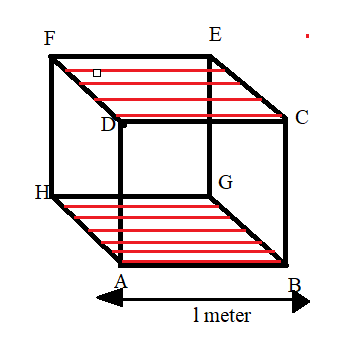
Lateral surface area of the cube = Area of face ABCD + Area of face BCGE + Area of face EFGH + Area of face ADFH [ leaving upper and lower face as shown by red colour in figure]
And formula of Lateral surface area [L.S.A.] of cube =$4{l^2}$
And in question it is given L.S.A. of a cube is 64 $cm^2$
So on equalising
$ \Rightarrow 4{l^2} = 64$
$ \Rightarrow {l^2} = \dfrac{{64}}{4}$
$ \Rightarrow {l^2} = 16$
On taking square root on both side
$ \Rightarrow \sqrt {{l^2}} = \sqrt {16} $
$ \Rightarrow l = 4$
Therefore, l = 4 cm
Thus, the side of the cube is 4 cm.
Note- In this particular question, we should have a clear understanding of lateral surface area i.e. surface area of a solid without its base areas.
We can also derive its formula with the formula of L.S.A. of a cuboid which is equal to
⇒2(b × h) + 2(l × h)
And as we know that Length, breadth and height of a cube are same so let it be equal to l meter
So put l=b=h= l in above formula
⇒2(l × l) + 2(l× l)
⇒$2{l^2} + 2{l^2} = 4{l^2}$
Hence LSA of Cube $ = 4{l^2}$
Lateral surface area [L.S.A.] of cube =$4{l^2}$
Complete step-by-step answer:
In question it is given the L.S.A. of a cube is 64 ${\text{c}}{{\text{m}}^2}$ and we know that
Lateral surface area of a Cube is the sum of surface areas of all the sides except the top and bottom face of the solid is defined as the lateral surface area of a solid.
As we know that length, breadth and height of a cube are the same so consider a Cube of length, breadth and height to be l meters.
Lateral surface area of the cube = Area of face ABCD + Area of face BCGE + Area of face EFGH + Area of face ADFH [ leaving upper and lower face as shown by red colour in figure]
And formula of Lateral surface area [L.S.A.] of cube =$4{l^2}$
And in question it is given L.S.A. of a cube is 64 $cm^2$
So on equalising
$ \Rightarrow 4{l^2} = 64$
$ \Rightarrow {l^2} = \dfrac{{64}}{4}$
$ \Rightarrow {l^2} = 16$
On taking square root on both side
$ \Rightarrow \sqrt {{l^2}} = \sqrt {16} $
$ \Rightarrow l = 4$
Therefore, l = 4 cm
Thus, the side of the cube is 4 cm.
Note- In this particular question, we should have a clear understanding of lateral surface area i.e. surface area of a solid without its base areas.
We can also derive its formula with the formula of L.S.A. of a cuboid which is equal to
⇒2(b × h) + 2(l × h)
And as we know that Length, breadth and height of a cube are same so let it be equal to l meter
So put l=b=h= l in above formula
⇒2(l × l) + 2(l× l)
⇒$2{l^2} + 2{l^2} = 4{l^2}$
Hence LSA of Cube $ = 4{l^2}$
Recently Updated Pages
Master Class 10 Social Science: Engaging Questions & Answers for Success

Master Class 10 Science: Engaging Questions & Answers for Success
Master Class 10 Maths: Engaging Questions & Answers for Success
Master Class 10 General Knowledge: Engaging Questions & Answers for Success
Master Class 10 Computer Science: Engaging Questions & Answers for Success
Class 10 Question and Answer - Your Ultimate Solutions Guide
Trending doubts
What is the full form of PNG A Petrol Natural Gas B class 10 chemistry CBSE
Explain the Treaty of Vienna of 1815 class 10 social science CBSE
In cricket, how many legal balls are there in a standard over?
Why is there a time difference of about 5 hours between class 10 social science CBSE
Who Won 36 Oscar Awards? Record Holder Revealed
What is the median of the first 10 natural numbers class 10 maths CBSE