




If the line passes through the points \[P\left( 6,-1,2 \right),Q\left( 8,-7,2\lambda \right)\] and \[R\left( 5,2,4 \right)\] then value of \[\lambda \] is ___________.
(a) \[-3\]
(b) \[0\]
(c) \[-1\]
(d) \[2\]
Answer
 Verified
597k+ views
Hint: Direction ratio of any line is calculated by any two points lying on it will be the same for a line.
Complete step-by-step answer:
As we have been given that the points \[P\left( 6,-1,2 \right),Q\left( 8,-7,2\lambda \right)\] and \[R\left( 5,2,4 \right)\] are lying on a line
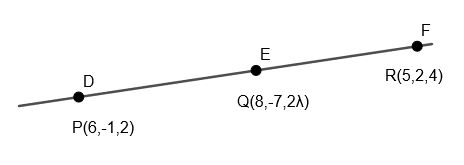
We know that as any line in 2D has slope like that, any line in 3D has direction ratio and direction cosine.
Now, the formula for direction ratio of any line if two points \[\left( x{{}_{1}},{{y}_{1}},{{z}_{1}} \right)\] and \[\left( x{{}_{2}},{{y}_{2}},{{z}_{2}} \right)\] are given.
\[dr=\left( {{x}_{2}}-{{x}_{1}},{{y}_{2}}-{{y}_{1}},{{z}_{2}}-{{z}_{1}} \right)\]
Let us calculate the direction ratio of the given line with the help of points P and R as following:
\[dr=\left( {{x}_{R}}-{{x}_{P}},{{y}_{R}}-{{y}_{P}},{{z}_{R}}-{{z}_{P}} \right)\]
\[dr=\left( 5-6,2+1,4-2 \right)\]
\[dr=\left( -1,3,2 \right)....\left( i \right)\]
Let us calculate the direction ratio with the help of Q and R as follows.
\[dr=\left( {{x}_{R}}-{{x}_{Q}},{{y}_{R}}-{{y}_{Q}},{{z}_{R}}-{{z}_{Q}} \right)\]
\[dr=\left( -3,9,4-2\lambda \right).....\left( ii \right)\]
Since equation (i) and (ii) are representing the direction ratios of the same line, hence their ratios should be equal in the following way:
\[\dfrac{-1}{-3}=\dfrac{3}{9}=\dfrac{2}{4-2\lambda }\]
Taking the first two fractions from the above equation, we get that
\[\dfrac{1}{3}=\dfrac{3}{9}=\dfrac{1}{3}\]
Hence, it is verifying that the given line is linear if we see only the first two terms of the direction ratios. Now, in the third term of direction ratio, we have a variable \[\lambda \] which we need to find, and hence, the ratio \[\dfrac{2}{4-2\lambda }\] should be equal to \[\dfrac{1}{3}\] as well.
\[\dfrac{1}{3}=\dfrac{2}{4-2\lambda }\]
On cross – multiplying the above terms, we get
\[4-2\lambda =6\]
\[-2\lambda =2\]
\[\lambda =-1\]
Hence, we have \[\lambda =-1\]. To verify it, we can put \[\lambda =-1\] in the equation (iii) as
\[\dfrac{1}{3}=\dfrac{1}{3}=\dfrac{2}{4-2\left( -1 \right)}=\dfrac{2}{6}=\dfrac{1}{3}\]
Hence, \[\lambda =-1\] is the answer, i.e., option (c).
Note: We can solve the above question by calculating the ratio Q divides PQ
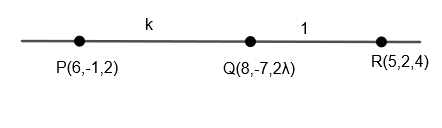
Let Q divide PR in (k:1) and we can write points Q by formula\[M\left( \dfrac{m{{x}_{2}}+n{{x}_{1}}}{m+n},\dfrac{m{{y}_{2}}+n{{y}_{1}}}{m+n},\dfrac{m{{z}_{2}}+n{{z}_{1}}}{m+n} \right)\] if two points \[A\left( {{x}_{1}},{{y}_{1}},{{z}_{1}} \right)\] and \[B\left( {{x}_{2}},{{y}_{2}},{{z}_{2}} \right)\] are given and point M can be written as above mentioned.
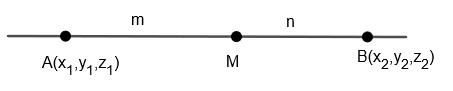
Hence, apply the above formula for calculating point Q.
\[\Rightarrow 8=\dfrac{5k+6}{k+1},-7=\dfrac{2k-1}{k+1}\] and \[2\lambda =\dfrac{4k+2}{k+1}\]
\[\Rightarrow 5k+6=8k+8,\text{ }-7k-7=2k-1\] and \[2\lambda =\dfrac{4k+2}{k+1}\]
\[3k=-2\], \[-9k=6\] and \[2\lambda =\dfrac{4k+2}{k+1}\]
\[k=\dfrac{-2}{3},k=\dfrac{-2}{3}\]
Hence, it is clear that points will lie on line as \[k=\dfrac{-2}{3}\] is calculated from the first two equations.
Now, \[2\lambda =\dfrac{4k+2}{k+1}\]
\[2\lambda k+2\lambda =4k+2\]
\[2\lambda \times \left( \dfrac{-2}{3} \right)+2\lambda =4\times \left( \dfrac{-2}{3} \right)+2\]
\[\dfrac{-4\lambda }{3}+2\lambda =\dfrac{-8}{3}+2\]
\[\dfrac{2\lambda }{3}=\dfrac{-2}{3}\Rightarrow \lambda =-1\]
We have one more method where we can calculate the angle between two lines; here angle will be \[{{180}^{o}}\]if points lie on the line.
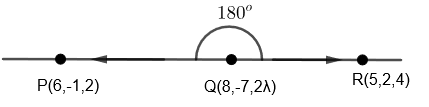
\[\cos {{180}^{o}}=\dfrac{\overrightarrow{QR}.\overrightarrow{QP}}{\left| QR \right|.\left| QP \right|}=-1\]
\[\overrightarrow{QR}=13i+9j+\left( 4-2\lambda \right)\widehat{k}\]
\[\overrightarrow{QP}=14i-8j+\left( 2-2\lambda \right)\widehat{k}\]
By putting all these values in the equation (i), we can calculate \['\lambda '\].
Complete step-by-step answer:
As we have been given that the points \[P\left( 6,-1,2 \right),Q\left( 8,-7,2\lambda \right)\] and \[R\left( 5,2,4 \right)\] are lying on a line
We know that as any line in 2D has slope like that, any line in 3D has direction ratio and direction cosine.
Now, the formula for direction ratio of any line if two points \[\left( x{{}_{1}},{{y}_{1}},{{z}_{1}} \right)\] and \[\left( x{{}_{2}},{{y}_{2}},{{z}_{2}} \right)\] are given.
\[dr=\left( {{x}_{2}}-{{x}_{1}},{{y}_{2}}-{{y}_{1}},{{z}_{2}}-{{z}_{1}} \right)\]
Let us calculate the direction ratio of the given line with the help of points P and R as following:
\[dr=\left( {{x}_{R}}-{{x}_{P}},{{y}_{R}}-{{y}_{P}},{{z}_{R}}-{{z}_{P}} \right)\]
\[dr=\left( 5-6,2+1,4-2 \right)\]
\[dr=\left( -1,3,2 \right)....\left( i \right)\]
Let us calculate the direction ratio with the help of Q and R as follows.
\[dr=\left( {{x}_{R}}-{{x}_{Q}},{{y}_{R}}-{{y}_{Q}},{{z}_{R}}-{{z}_{Q}} \right)\]
\[dr=\left( -3,9,4-2\lambda \right).....\left( ii \right)\]
Since equation (i) and (ii) are representing the direction ratios of the same line, hence their ratios should be equal in the following way:
\[\dfrac{-1}{-3}=\dfrac{3}{9}=\dfrac{2}{4-2\lambda }\]
Taking the first two fractions from the above equation, we get that
\[\dfrac{1}{3}=\dfrac{3}{9}=\dfrac{1}{3}\]
Hence, it is verifying that the given line is linear if we see only the first two terms of the direction ratios. Now, in the third term of direction ratio, we have a variable \[\lambda \] which we need to find, and hence, the ratio \[\dfrac{2}{4-2\lambda }\] should be equal to \[\dfrac{1}{3}\] as well.
\[\dfrac{1}{3}=\dfrac{2}{4-2\lambda }\]
On cross – multiplying the above terms, we get
\[4-2\lambda =6\]
\[-2\lambda =2\]
\[\lambda =-1\]
Hence, we have \[\lambda =-1\]. To verify it, we can put \[\lambda =-1\] in the equation (iii) as
\[\dfrac{1}{3}=\dfrac{1}{3}=\dfrac{2}{4-2\left( -1 \right)}=\dfrac{2}{6}=\dfrac{1}{3}\]
Hence, \[\lambda =-1\] is the answer, i.e., option (c).
Note: We can solve the above question by calculating the ratio Q divides PQ
Let Q divide PR in (k:1) and we can write points Q by formula\[M\left( \dfrac{m{{x}_{2}}+n{{x}_{1}}}{m+n},\dfrac{m{{y}_{2}}+n{{y}_{1}}}{m+n},\dfrac{m{{z}_{2}}+n{{z}_{1}}}{m+n} \right)\] if two points \[A\left( {{x}_{1}},{{y}_{1}},{{z}_{1}} \right)\] and \[B\left( {{x}_{2}},{{y}_{2}},{{z}_{2}} \right)\] are given and point M can be written as above mentioned.
Hence, apply the above formula for calculating point Q.
\[\Rightarrow 8=\dfrac{5k+6}{k+1},-7=\dfrac{2k-1}{k+1}\] and \[2\lambda =\dfrac{4k+2}{k+1}\]
\[\Rightarrow 5k+6=8k+8,\text{ }-7k-7=2k-1\] and \[2\lambda =\dfrac{4k+2}{k+1}\]
\[3k=-2\], \[-9k=6\] and \[2\lambda =\dfrac{4k+2}{k+1}\]
\[k=\dfrac{-2}{3},k=\dfrac{-2}{3}\]
Hence, it is clear that points will lie on line as \[k=\dfrac{-2}{3}\] is calculated from the first two equations.
Now, \[2\lambda =\dfrac{4k+2}{k+1}\]
\[2\lambda k+2\lambda =4k+2\]
\[2\lambda \times \left( \dfrac{-2}{3} \right)+2\lambda =4\times \left( \dfrac{-2}{3} \right)+2\]
\[\dfrac{-4\lambda }{3}+2\lambda =\dfrac{-8}{3}+2\]
\[\dfrac{2\lambda }{3}=\dfrac{-2}{3}\Rightarrow \lambda =-1\]
We have one more method where we can calculate the angle between two lines; here angle will be \[{{180}^{o}}\]if points lie on the line.
\[\cos {{180}^{o}}=\dfrac{\overrightarrow{QR}.\overrightarrow{QP}}{\left| QR \right|.\left| QP \right|}=-1\]
\[\overrightarrow{QR}=13i+9j+\left( 4-2\lambda \right)\widehat{k}\]
\[\overrightarrow{QP}=14i-8j+\left( 2-2\lambda \right)\widehat{k}\]
By putting all these values in the equation (i), we can calculate \['\lambda '\].
Recently Updated Pages
Complete reduction of benzene diazonium chloride with class 12 chemistry CBSE

How can you identify optical isomers class 12 chemistry CBSE
The coating formed on the metals such as iron silver class 12 chemistry CBSE
Metals are refined by using different methods Which class 12 chemistry CBSE
What do you understand by denaturation of proteins class 12 chemistry CBSE
Assertion Nitrobenzene is used as a solvent in FriedelCrafts class 12 chemistry CBSE
Trending doubts
Which are the Top 10 Largest Countries of the World?
What are the major means of transport Explain each class 12 social science CBSE
Draw a labelled sketch of the human eye class 12 physics CBSE
Differentiate between insitu conservation and exsitu class 12 biology CBSE
Draw a neat and well labeled diagram of TS of ovary class 12 biology CBSE
RNA and DNA are chiral molecules their chirality is class 12 chemistry CBSE