




If the line joining the points A (1, 0, 0) and B (0, 0, 1) is a normal to the plane $\pi $ which passes through the point A, then what will be the angle between the planes $\pi $ and x + y + z = 6 ?
Answer
 Verified
603.9k+ views
Hint: To solve this problem first we have to find the cosines ratios of the plane in which the given points lie, after that we will find the equation of the plane $\pi $ by letting any point on the plane as (x,y,z) and taking dot product with the obtained direction ratios as both are normal to each other dot product will be zero. After that we will find the angle between the obtained angle and the given plane $\pi $, x + y + z = 6, using the formula,
$\cos \theta $ = \[\dfrac{\left( {{a}_{1}}\times {{a}_{2}}+{{b}_{1}}\times {{b}_{2}}+{{c}_{1}}\times {{c}_{2}} \right)}{\left( \sqrt{{{a}_{1}}\times {{a}_{1}}+{{b}_{1}}\times {{b}_{1}}+{{c}_{1}}\times {{c}_{1}}}\times \sqrt{{{a}_{2}}\times {{a}_{2}}+{{b}_{2}}\times {{b}_{2}}+{{c}_{2}}\times {{c}_{2}}} \right)}\]
Where $\left( {{a}_{1}},{{b}_{1}},{{c}_{1}} \right)\,and\,\left( {{a}_{2}},{{b}_{2}},{{c}_{2}} \right)$ are the direction ratios of the two planes.
Complete step by step answer:
We are given the points A (1, 0, 0) and B (0, 0, 1),
So the direction cosines of the plane that contains the both points we will get as,
$\left\langle {{x}_{1}}-{{x}_{2}},{{y}_{1}}-{{y}_{2}},{{z}_{1}}-{{z}_{2}} \right\rangle $
$\begin{align}
& \left\langle 1-0,0-0,0-1 \right\rangle \\
& \left\langle 1,0,-1 \right\rangle \\
\end{align}$
Now for the equation of the plane $\pi $ we will get by assuming any coordinate on the plane as (x, y, z) and then subtracting the given point A from this random point and taking the dot product by the direction cosines of the plane containing both the points, because both planes are normal to each other so dot product will be zero
So we get the equation of the plane $\pi $ as,
\[\begin{align}
& \left( x-1 \right).1+0.\left( y-0 \right)-1.\left( z-0 \right)=0 \\
& \Rightarrow x-1-z=0 \\
& \Rightarrow x-z=1 \\
\end{align}\]
And the equation of the plane that is given to us with which we have to find the angle with plane $\pi $ is,
x + y + z = 6
And the angle $\cos \theta $ between the two planes is given by,
$\cos \theta $ = \[\dfrac{\left( {{a}_{1}}\times {{a}_{2}}+{{b}_{1}}\times {{b}_{2}}+{{c}_{1}}\times {{c}_{2}} \right)}{\left( \sqrt{{{a}_{1}}\times {{a}_{1}}+{{b}_{1}}\times {{b}_{1}}+{{c}_{1}}\times {{c}_{1}}}\times \sqrt{{{a}_{2}}\times {{a}_{2}}+{{b}_{2}}\times {{b}_{2}}+{{c}_{2}}\times {{c}_{2}}} \right)}\]
Where $\left( {{a}_{1}},{{b}_{1}},{{c}_{1}} \right)\,and\,\left( {{a}_{2}},{{b}_{2}},{{c}_{2}} \right)$ are the direction ratios of the two planes.
So the angle between plane x - z = 1 and x + y + z = 6 is,
\[\cos \theta =\dfrac{\left( 1\times 1+0\times 1+-1\times 1 \right)}{\left( \sqrt{{{\left( 1 \right)}^{2}}+{{\left( 0 \right)}^{2}}+{{\left( -1 \right)}^{2}}}\times \sqrt{{{\left( 1 \right)}^{2}}+{{\left( 1 \right)}^{2}}+{{\left( 1 \right)}^{2}}} \right)}\]
$\begin{align}
& \cos \theta =0 \\
& \theta ={{90}^{\circ }} \\
\end{align}$
Hence the angle between the two planes is ${{90}^{\circ }}$
So, finally we can represent it as below,
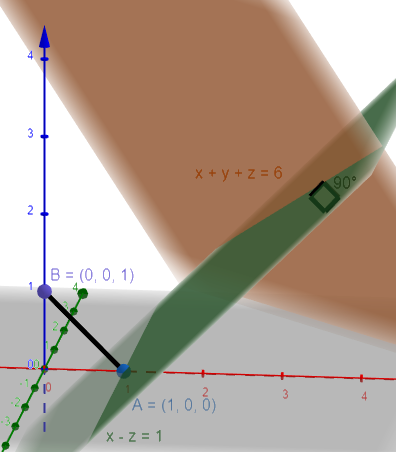
Note: You will have to try to think of this problem in 3D otherwise it would be difficult for you to understand the steps which we performed in the solution and also try to solve this problem step by step otherwise you may skip something and end up with the wrong answer. Also remember the formula mentioned to find the angle between the two planes.
$\cos \theta $ = \[\dfrac{\left( {{a}_{1}}\times {{a}_{2}}+{{b}_{1}}\times {{b}_{2}}+{{c}_{1}}\times {{c}_{2}} \right)}{\left( \sqrt{{{a}_{1}}\times {{a}_{1}}+{{b}_{1}}\times {{b}_{1}}+{{c}_{1}}\times {{c}_{1}}}\times \sqrt{{{a}_{2}}\times {{a}_{2}}+{{b}_{2}}\times {{b}_{2}}+{{c}_{2}}\times {{c}_{2}}} \right)}\]
Where $\left( {{a}_{1}},{{b}_{1}},{{c}_{1}} \right)\,and\,\left( {{a}_{2}},{{b}_{2}},{{c}_{2}} \right)$ are the direction ratios of the two planes.
Complete step by step answer:
We are given the points A (1, 0, 0) and B (0, 0, 1),
So the direction cosines of the plane that contains the both points we will get as,
$\left\langle {{x}_{1}}-{{x}_{2}},{{y}_{1}}-{{y}_{2}},{{z}_{1}}-{{z}_{2}} \right\rangle $
$\begin{align}
& \left\langle 1-0,0-0,0-1 \right\rangle \\
& \left\langle 1,0,-1 \right\rangle \\
\end{align}$
Now for the equation of the plane $\pi $ we will get by assuming any coordinate on the plane as (x, y, z) and then subtracting the given point A from this random point and taking the dot product by the direction cosines of the plane containing both the points, because both planes are normal to each other so dot product will be zero
So we get the equation of the plane $\pi $ as,
\[\begin{align}
& \left( x-1 \right).1+0.\left( y-0 \right)-1.\left( z-0 \right)=0 \\
& \Rightarrow x-1-z=0 \\
& \Rightarrow x-z=1 \\
\end{align}\]
And the equation of the plane that is given to us with which we have to find the angle with plane $\pi $ is,
x + y + z = 6
And the angle $\cos \theta $ between the two planes is given by,
$\cos \theta $ = \[\dfrac{\left( {{a}_{1}}\times {{a}_{2}}+{{b}_{1}}\times {{b}_{2}}+{{c}_{1}}\times {{c}_{2}} \right)}{\left( \sqrt{{{a}_{1}}\times {{a}_{1}}+{{b}_{1}}\times {{b}_{1}}+{{c}_{1}}\times {{c}_{1}}}\times \sqrt{{{a}_{2}}\times {{a}_{2}}+{{b}_{2}}\times {{b}_{2}}+{{c}_{2}}\times {{c}_{2}}} \right)}\]
Where $\left( {{a}_{1}},{{b}_{1}},{{c}_{1}} \right)\,and\,\left( {{a}_{2}},{{b}_{2}},{{c}_{2}} \right)$ are the direction ratios of the two planes.
So the angle between plane x - z = 1 and x + y + z = 6 is,
\[\cos \theta =\dfrac{\left( 1\times 1+0\times 1+-1\times 1 \right)}{\left( \sqrt{{{\left( 1 \right)}^{2}}+{{\left( 0 \right)}^{2}}+{{\left( -1 \right)}^{2}}}\times \sqrt{{{\left( 1 \right)}^{2}}+{{\left( 1 \right)}^{2}}+{{\left( 1 \right)}^{2}}} \right)}\]
$\begin{align}
& \cos \theta =0 \\
& \theta ={{90}^{\circ }} \\
\end{align}$
Hence the angle between the two planes is ${{90}^{\circ }}$
So, finally we can represent it as below,
Note: You will have to try to think of this problem in 3D otherwise it would be difficult for you to understand the steps which we performed in the solution and also try to solve this problem step by step otherwise you may skip something and end up with the wrong answer. Also remember the formula mentioned to find the angle between the two planes.
Recently Updated Pages
Master Class 12 Social Science: Engaging Questions & Answers for Success

Master Class 12 Physics: Engaging Questions & Answers for Success
Master Class 12 Maths: Engaging Questions & Answers for Success
Master Class 12 Economics: Engaging Questions & Answers for Success
Master Class 12 Chemistry: Engaging Questions & Answers for Success
Master Class 12 Business Studies: Engaging Questions & Answers for Success
Trending doubts
Which are the Top 10 Largest Countries of the World?
Draw a labelled sketch of the human eye class 12 physics CBSE
Explain the structure of megasporangium class 12 biology CBSE
What are the major means of transport Explain each class 12 social science CBSE
How many chromosomes are found in human ovum a 46 b class 12 biology CBSE
The diagram of the section of a maize grain is given class 12 biology CBSE