




If the line $\dfrac{x-2}{3}=\dfrac{y+1}{2}=\dfrac{z-1}{-1}$ intersects the plane 2x+3y-z-13=0 at a point P and the plane 3x+y+4z=16 at the point Q, then PQ is equal to
(a) $2\sqrt{14}$
(b) $\sqrt{14}$
(c) $2\sqrt{7}$
(d) 14
Answer
 Verified
586.2k+ views
Hint: First, before proceeding for this, we must take the proportionality constant for the given line as r and then we get $\dfrac{x-2}{3}=\dfrac{y+1}{2}=\dfrac{z-1}{-1}=r$. Then, we are given in the question with the condition that P lies on the plane with equation 2x+3y-z-13=0 and also given in the question with the condition that Q lies on the plane with equation 3x+y+4z=16 which gives the coordinates of P and Q. Then, by using the distance formula for the points P(-1, -3, 2) and Q(5, 1, 0), we get the distance between PQ.
Complete step-by-step answer:
In this question, we are supposed to find the length of PQ when the line $\dfrac{x-2}{3}=\dfrac{y+1}{2}=\dfrac{z-1}{-1}$ intersects the plane 2x+3y-z-13=0 at a point P and the plane 3x+y+4z=16 at the point Q.
So, we must draw a diagram of the planes with the equations 2x+3y-z-13=0 with point P and the plane 3x+y+4z=16 with point Q intersected by line as:
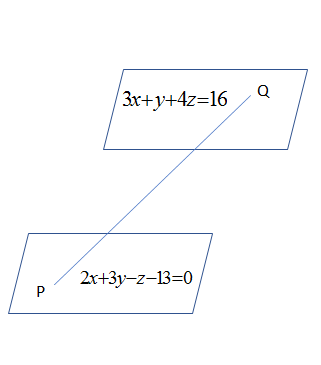
So, before proceeding for this, we must take the proportionality constant for the given line as r and then we get:
$\dfrac{x-2}{3}=\dfrac{y+1}{2}=\dfrac{z-1}{-1}=r$
Then, we get the coordinates of the above line as:
x=3r+2, y=2r-1 and z=-r+1
Now, let us assume for the points P and Q for the line be ${{r}_{1}}$and ${{r}_{2}}$respectively.
Then, we get the coordinates of the point P and Q as:
For P, points are $\left( 3{{r}_{1}}+2,2{{r}_{1}}-1,-{{r}_{1}}+1 \right)$
For Q, points are $\left( 3{{r}_{2}}+2,2{{r}_{2}}-1,-{{r}_{2}}+1 \right)$
Now, we are given the question with the condition that P lies on the plane with equation 2x+3y-z-13=0.
So, by substituting the coordinates of P found above in the equation of plane, we get:
$\begin{align}
& 2\left( 3{{r}_{1}}+2 \right)+3\left( 2{{r}_{1}}-1 \right)-\left( -{{r}_{1}}+1 \right)+13=0 \\
& \Rightarrow 6{{r}_{1}}+4+6{{r}_{1}}-3+{{r}_{1}}-1+13=0 \\
& \Rightarrow 13{{r}_{1}}=-13 \\
& \Rightarrow {{r}_{1}}=\dfrac{-13}{13} \\
& \Rightarrow {{r}_{1}}=-1 \\
\end{align}$
So, we get the coordinates of point P by substituting the value of ${{r}_{1}}$as -1 in the $\left( 3{{r}_{1}}+2,2{{r}_{1}}-1,-{{r}_{1}}+1 \right)$, we get:
$\begin{align}
& \left( 3\left( -1 \right)+2,2\left( -1 \right)-1,-\left( -1 \right)+1 \right) \\
& \Rightarrow \left( -3+2,-2-1,1+1 \right) \\
& \Rightarrow \left( -1,-3,2 \right) \\
\end{align}$
So, we get the coordinates of point P as (-1, -3, 2).
Similarly, we are given the question with the condition that Q lies on the plane with equation 3x+y+4z=16.
So, by substituting the coordinates of Q found above in the equation of plane, we get:
$\begin{align}
& 3\left( 3{{r}_{2}}+2 \right)+\left( 2{{r}_{2}}-1 \right)+4\left( -{{r}_{2}}+1 \right)=16 \\
& \Rightarrow 9{{r}_{2}}+6+2{{r}_{2}}-1-4{{r}_{2}}+4=16 \\
& \Rightarrow 7{{r}_{2}}=7 \\
& \Rightarrow {{r}_{2}}=\dfrac{7}{7} \\
& \Rightarrow {{r}_{2}}=1 \\
\end{align}$
So, we get the coordinates of point P by substituting the value of ${{r}_{2}}$as 1 in the $\left( 3{{r}_{2}}+2,2{{r}_{2}}-1,-{{r}_{2}}+1 \right)$, we get:
$\begin{align}
& \left( 3\left( 1 \right)+2,2\left( 1 \right)-1,-\left( 1 \right)+1 \right) \\
& \Rightarrow \left( 3+2,2-1,0 \right) \\
& \Rightarrow \left( 5,1,0 \right) \\
\end{align}$
So, we get the coordinates of point Q as (5, 1, 0).
Then, by using the distance formula for the points P(-1, -3, 2) and Q(5, 1, 0), we get the distance between PQ as:
$\begin{align}
& PQ=\sqrt{{{\left( 5-\left( -1 \right) \right)}^{2}}+{{\left( 1-\left( -3 \right) \right)}^{2}}+{{\left( 0-2 \right)}^{2}}} \\
& \Rightarrow PQ=\sqrt{{{\left( 5+1 \right)}^{2}}+{{\left( 1+3 \right)}^{2}}+{{\left( -2 \right)}^{2}}} \\
& \Rightarrow PQ=\sqrt{{{\left( 6 \right)}^{2}}+{{\left( 4 \right)}^{2}}+4} \\
& \Rightarrow PQ=\sqrt{36+16+4} \\
& \Rightarrow PQ=\sqrt{56} \\
& \Rightarrow PQ=2\sqrt{14} \\
\end{align}$
So, we get the distance PQ as $2\sqrt{14}$.
So, the correct answer is “Option A”.
Note: Now, to solve these type of the questions we need to know some of the basic formula for calculating the distance between the two points let A with coordinates $\left( {{x}_{1}},{{y}_{1}},{{z}_{1}} \right)$and B with coordinates $\left( {{x}_{2}},{{y}_{2}},{{z}_{2}} \right)$. So, the distance AB is given by:
$AB=\sqrt{{{\left( {{x}_{2}}-{{x}_{1}} \right)}^{2}}+{{\left( {{y}_{2}}-{{y}_{1}} \right)}^{2}}+{{\left( {{z}_{2}}-{{z}_{1}} \right)}^{2}}}$
Complete step-by-step answer:
In this question, we are supposed to find the length of PQ when the line $\dfrac{x-2}{3}=\dfrac{y+1}{2}=\dfrac{z-1}{-1}$ intersects the plane 2x+3y-z-13=0 at a point P and the plane 3x+y+4z=16 at the point Q.
So, we must draw a diagram of the planes with the equations 2x+3y-z-13=0 with point P and the plane 3x+y+4z=16 with point Q intersected by line as:
So, before proceeding for this, we must take the proportionality constant for the given line as r and then we get:
$\dfrac{x-2}{3}=\dfrac{y+1}{2}=\dfrac{z-1}{-1}=r$
Then, we get the coordinates of the above line as:
x=3r+2, y=2r-1 and z=-r+1
Now, let us assume for the points P and Q for the line be ${{r}_{1}}$and ${{r}_{2}}$respectively.
Then, we get the coordinates of the point P and Q as:
For P, points are $\left( 3{{r}_{1}}+2,2{{r}_{1}}-1,-{{r}_{1}}+1 \right)$
For Q, points are $\left( 3{{r}_{2}}+2,2{{r}_{2}}-1,-{{r}_{2}}+1 \right)$
Now, we are given the question with the condition that P lies on the plane with equation 2x+3y-z-13=0.
So, by substituting the coordinates of P found above in the equation of plane, we get:
$\begin{align}
& 2\left( 3{{r}_{1}}+2 \right)+3\left( 2{{r}_{1}}-1 \right)-\left( -{{r}_{1}}+1 \right)+13=0 \\
& \Rightarrow 6{{r}_{1}}+4+6{{r}_{1}}-3+{{r}_{1}}-1+13=0 \\
& \Rightarrow 13{{r}_{1}}=-13 \\
& \Rightarrow {{r}_{1}}=\dfrac{-13}{13} \\
& \Rightarrow {{r}_{1}}=-1 \\
\end{align}$
So, we get the coordinates of point P by substituting the value of ${{r}_{1}}$as -1 in the $\left( 3{{r}_{1}}+2,2{{r}_{1}}-1,-{{r}_{1}}+1 \right)$, we get:
$\begin{align}
& \left( 3\left( -1 \right)+2,2\left( -1 \right)-1,-\left( -1 \right)+1 \right) \\
& \Rightarrow \left( -3+2,-2-1,1+1 \right) \\
& \Rightarrow \left( -1,-3,2 \right) \\
\end{align}$
So, we get the coordinates of point P as (-1, -3, 2).
Similarly, we are given the question with the condition that Q lies on the plane with equation 3x+y+4z=16.
So, by substituting the coordinates of Q found above in the equation of plane, we get:
$\begin{align}
& 3\left( 3{{r}_{2}}+2 \right)+\left( 2{{r}_{2}}-1 \right)+4\left( -{{r}_{2}}+1 \right)=16 \\
& \Rightarrow 9{{r}_{2}}+6+2{{r}_{2}}-1-4{{r}_{2}}+4=16 \\
& \Rightarrow 7{{r}_{2}}=7 \\
& \Rightarrow {{r}_{2}}=\dfrac{7}{7} \\
& \Rightarrow {{r}_{2}}=1 \\
\end{align}$
So, we get the coordinates of point P by substituting the value of ${{r}_{2}}$as 1 in the $\left( 3{{r}_{2}}+2,2{{r}_{2}}-1,-{{r}_{2}}+1 \right)$, we get:
$\begin{align}
& \left( 3\left( 1 \right)+2,2\left( 1 \right)-1,-\left( 1 \right)+1 \right) \\
& \Rightarrow \left( 3+2,2-1,0 \right) \\
& \Rightarrow \left( 5,1,0 \right) \\
\end{align}$
So, we get the coordinates of point Q as (5, 1, 0).
Then, by using the distance formula for the points P(-1, -3, 2) and Q(5, 1, 0), we get the distance between PQ as:
$\begin{align}
& PQ=\sqrt{{{\left( 5-\left( -1 \right) \right)}^{2}}+{{\left( 1-\left( -3 \right) \right)}^{2}}+{{\left( 0-2 \right)}^{2}}} \\
& \Rightarrow PQ=\sqrt{{{\left( 5+1 \right)}^{2}}+{{\left( 1+3 \right)}^{2}}+{{\left( -2 \right)}^{2}}} \\
& \Rightarrow PQ=\sqrt{{{\left( 6 \right)}^{2}}+{{\left( 4 \right)}^{2}}+4} \\
& \Rightarrow PQ=\sqrt{36+16+4} \\
& \Rightarrow PQ=\sqrt{56} \\
& \Rightarrow PQ=2\sqrt{14} \\
\end{align}$
So, we get the distance PQ as $2\sqrt{14}$.
So, the correct answer is “Option A”.
Note: Now, to solve these type of the questions we need to know some of the basic formula for calculating the distance between the two points let A with coordinates $\left( {{x}_{1}},{{y}_{1}},{{z}_{1}} \right)$and B with coordinates $\left( {{x}_{2}},{{y}_{2}},{{z}_{2}} \right)$. So, the distance AB is given by:
$AB=\sqrt{{{\left( {{x}_{2}}-{{x}_{1}} \right)}^{2}}+{{\left( {{y}_{2}}-{{y}_{1}} \right)}^{2}}+{{\left( {{z}_{2}}-{{z}_{1}} \right)}^{2}}}$
Recently Updated Pages
Complete reduction of benzene diazonium chloride with class 12 chemistry CBSE

How can you identify optical isomers class 12 chemistry CBSE
The coating formed on the metals such as iron silver class 12 chemistry CBSE
Metals are refined by using different methods Which class 12 chemistry CBSE
What do you understand by denaturation of proteins class 12 chemistry CBSE
Assertion Nitrobenzene is used as a solvent in FriedelCrafts class 12 chemistry CBSE
Trending doubts
What are the major means of transport Explain each class 12 social science CBSE
RNA and DNA are chiral molecules their chirality is class 12 chemistry CBSE
RNA and DNA are chiral molecules their chirality is class 12 chemistry CBSE
India is a sovereign socialist secular democratic republic class 12 social science CBSE
The correct structure of ethylenediaminetetraacetic class 12 chemistry CBSE
How many states of matter are there in total class 12 chemistry CBSE