




If the latus rectum of a hyperbola is 8 and eccentricity is $\dfrac{3}{\sqrt{5}}$ then the equation of the hyperbola is?
(a) $4{{x}^{2}}-5{{y}^{2}}=100$
(b) $5{{x}^{2}}-4{{y}^{2}}=100$
(c) $4{{x}^{2}}+5{{y}^{2}}=100$
(d) $5{{x}^{2}}+4{{y}^{2}}=100$
Answer
 Verified
638.1k+ views
Hint:Assume the general equation of hyperbola as $\dfrac{{{x}^{2}}}{{{a}^{2}}}-\dfrac{{{y}^{2}}}{{{b}^{2}}}=1$. Here, a is the axis of the hyperbola and b is the conjugate axis. Apply the formula: $e=\sqrt{1+\dfrac{{{b}^{2}}}{{{a}^{2}}}}$, where ‘e’ is the eccentricity, to form a equation in a and b. Use another relation given by: $l=\dfrac{2{{b}^{2}}}{a}$, where ‘l’ is the length of the latus rectum, to form another equation in a and b. Now, solve the two equations to get the value of a and b. Finally, substitute the value of a and b in the general equation of hyperbola.
Complete step-by-step answer:
Now, let us assume the equation of hyperbola as $\dfrac{{{x}^{2}}}{{{a}^{2}}}-\dfrac{{{y}^{2}}}{{{b}^{2}}}=1$, where a is the axis of the hyperbola and b is the conjugate axis.
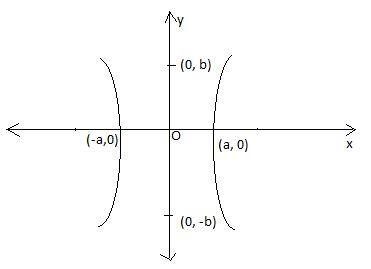
It is given that the length of the latus rectum is 8. Therefore, applying the formula for length of latus rectum of hyperbola, we get,
$\begin{align}
& l=\dfrac{2{{b}^{2}}}{a} \\
& \Rightarrow 8=\dfrac{2{{b}^{2}}}{a} \\
& \Rightarrow \dfrac{{{b}^{2}}}{a}=4..................(i) \\
\end{align}$
Also, it is given that eccentricity is $\dfrac{3}{\sqrt{5}}$. Therefore, applying the formula for eccentricity of hyperbola, we get,
$\begin{align}
& e=\sqrt{1+\dfrac{{{b}^{2}}}{{{a}^{2}}}} \\
& \Rightarrow \dfrac{3}{\sqrt{5}}=\sqrt{1+\dfrac{{{b}^{2}}}{{{a}^{2}}}} \\
\end{align}$
On squaring both sides, we get,
$\begin{align}
& \dfrac{9}{5}=1+\dfrac{{{b}^{2}}}{{{a}^{2}}} \\
& \Rightarrow \dfrac{{{b}^{2}}}{{{a}^{2}}}=\dfrac{9}{5}-1 \\
& \Rightarrow \dfrac{{{b}^{2}}}{{{a}^{2}}}=\dfrac{4}{5}.............................(ii) \\
\end{align}$
Substituting the value of $\dfrac{{{b}^{2}}}{a}$ from equation (i) in equation (ii), we get,
$\begin{align}
& \dfrac{{{b}^{2}}}{a}\times \dfrac{1}{a}=\dfrac{4}{5} \\
& \Rightarrow \dfrac{4}{a}=\dfrac{4}{5} \\
& \Rightarrow \dfrac{1}{a}=\dfrac{1}{5} \\
& \Rightarrow a=5 \\
\end{align}$
Substituting (a = 5) in equation (i), we get,
$\begin{align}
& {{b}^{2}}=5\times 4=20 \\
& \Rightarrow b=\sqrt{20} \\
\end{align}$
Now, substituting the value of a and b in the general equation of hyperbola, we get,
$\begin{align}
& \dfrac{{{x}^{2}}}{{{5}^{2}}}-\dfrac{{{y}^{2}}}{{{\left( \sqrt{20} \right)}^{2}}}=1 \\
& \Rightarrow \dfrac{{{x}^{2}}}{25}-\dfrac{{{y}^{2}}}{20}=1 \\
\end{align}$
Multiplying both sides by 100, we get,
$\begin{align}
& 100\times \left( \dfrac{{{x}^{2}}}{25}-\dfrac{{{y}^{2}}}{20} \right)=100 \\
& \Rightarrow 4{{x}^{2}}-5{{y}^{2}}=100 \\
\end{align}$
Hence, option (a) is the correct answer.
Note: One should not get confused in the general equation of hyperbola and ellipse that has a difference of only minus sign in the middle. Also note that the eccentricity of a hyperbola is always greater than 1 while that of ellipse is less than 1. As you can see that we have multiplied both sides of the equation with 100. This is because of the options given. You may note that 100 is the L.C.M of 25 and 20.
Complete step-by-step answer:
Now, let us assume the equation of hyperbola as $\dfrac{{{x}^{2}}}{{{a}^{2}}}-\dfrac{{{y}^{2}}}{{{b}^{2}}}=1$, where a is the axis of the hyperbola and b is the conjugate axis.
It is given that the length of the latus rectum is 8. Therefore, applying the formula for length of latus rectum of hyperbola, we get,
$\begin{align}
& l=\dfrac{2{{b}^{2}}}{a} \\
& \Rightarrow 8=\dfrac{2{{b}^{2}}}{a} \\
& \Rightarrow \dfrac{{{b}^{2}}}{a}=4..................(i) \\
\end{align}$
Also, it is given that eccentricity is $\dfrac{3}{\sqrt{5}}$. Therefore, applying the formula for eccentricity of hyperbola, we get,
$\begin{align}
& e=\sqrt{1+\dfrac{{{b}^{2}}}{{{a}^{2}}}} \\
& \Rightarrow \dfrac{3}{\sqrt{5}}=\sqrt{1+\dfrac{{{b}^{2}}}{{{a}^{2}}}} \\
\end{align}$
On squaring both sides, we get,
$\begin{align}
& \dfrac{9}{5}=1+\dfrac{{{b}^{2}}}{{{a}^{2}}} \\
& \Rightarrow \dfrac{{{b}^{2}}}{{{a}^{2}}}=\dfrac{9}{5}-1 \\
& \Rightarrow \dfrac{{{b}^{2}}}{{{a}^{2}}}=\dfrac{4}{5}.............................(ii) \\
\end{align}$
Substituting the value of $\dfrac{{{b}^{2}}}{a}$ from equation (i) in equation (ii), we get,
$\begin{align}
& \dfrac{{{b}^{2}}}{a}\times \dfrac{1}{a}=\dfrac{4}{5} \\
& \Rightarrow \dfrac{4}{a}=\dfrac{4}{5} \\
& \Rightarrow \dfrac{1}{a}=\dfrac{1}{5} \\
& \Rightarrow a=5 \\
\end{align}$
Substituting (a = 5) in equation (i), we get,
$\begin{align}
& {{b}^{2}}=5\times 4=20 \\
& \Rightarrow b=\sqrt{20} \\
\end{align}$
Now, substituting the value of a and b in the general equation of hyperbola, we get,
$\begin{align}
& \dfrac{{{x}^{2}}}{{{5}^{2}}}-\dfrac{{{y}^{2}}}{{{\left( \sqrt{20} \right)}^{2}}}=1 \\
& \Rightarrow \dfrac{{{x}^{2}}}{25}-\dfrac{{{y}^{2}}}{20}=1 \\
\end{align}$
Multiplying both sides by 100, we get,
$\begin{align}
& 100\times \left( \dfrac{{{x}^{2}}}{25}-\dfrac{{{y}^{2}}}{20} \right)=100 \\
& \Rightarrow 4{{x}^{2}}-5{{y}^{2}}=100 \\
\end{align}$
Hence, option (a) is the correct answer.
Note: One should not get confused in the general equation of hyperbola and ellipse that has a difference of only minus sign in the middle. Also note that the eccentricity of a hyperbola is always greater than 1 while that of ellipse is less than 1. As you can see that we have multiplied both sides of the equation with 100. This is because of the options given. You may note that 100 is the L.C.M of 25 and 20.
Recently Updated Pages
Master Class 12 Business Studies: Engaging Questions & Answers for Success

Master Class 12 Biology: Engaging Questions & Answers for Success
Master Class 12 Chemistry: Engaging Questions & Answers for Success
Class 12 Question and Answer - Your Ultimate Solutions Guide
Master Class 11 Social Science: Engaging Questions & Answers for Success
Master Class 11 English: Engaging Questions & Answers for Success
Trending doubts
Which are the Top 10 Largest Countries of the World?
Draw a labelled sketch of the human eye class 12 physics CBSE
Differentiate between homogeneous and heterogeneous class 12 chemistry CBSE
Sulphuric acid is known as the king of acids State class 12 chemistry CBSE
Why is the cell called the structural and functional class 12 biology CBSE
Which is the correct genotypic ratio of mendel dihybrid class 12 biology CBSE