




If the frequency of input alternating potential in n, then the ripple frequency of output potential of full wave rectifier will be-
A. $2n$
B. $n$
C. $\dfrac{n}{2}$
D. $\dfrac{n}{4}$
Answer
 Verified
571.8k+ views
Hint: Normally sinusoidal waves have both positive and negative displacements. Alternating waves are denoted with sinusoidal functions. We will get frequency either if displacement is there in both positive and negative directions or only in one direction. Repetition must be there to get it.
Complete answer:
Frequency is the number of waves passing through a point within one second. If we take inverse of that frequency, we will get the time period.
In case of currents we have alternating current where wave form of the current will be in sinusoidal form or cosecant form there will be current displacement existing in the both directions and frequency is something like the number of repetitions we get in a second.
But in the case of direct current we don’t have any repetitions because the plot of direct current with time itself is a straight line. Here there is no meaning if we are about to find the repetitions because no particular repeating waveform is present
Full wave rectifier converts the negative displacement of sinusoidal waves into positive displacement as shown in the below figure.
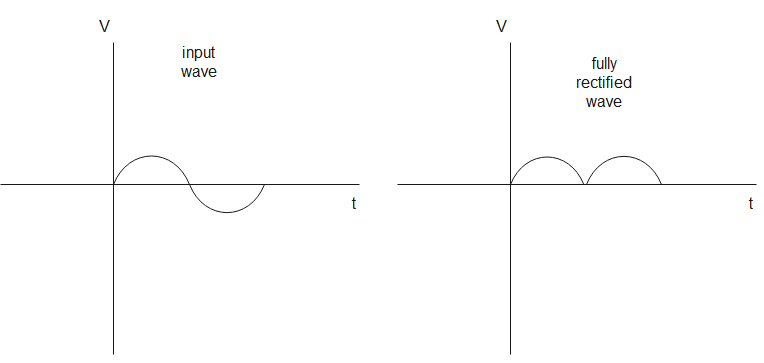
Hence in sine waves if the cycle repeats after one second, in the fully rectified wave it will repeat after half a second itself. Hence the frequency gets doubled.
That means if input frequency is ‘n’, output frequency will be ‘2n’
Hence option A will be the answer.
Note:
In case alternating currents there will be angular velocity of a wave and we can find frequency of an alternating wave from that. That frequency determines the capacitive reactance and inductive reactance and total impedance of the AC circuit if they are present in the circuit. Half wave rectifier completely removes the negative displacement wave portion.
Complete answer:
Frequency is the number of waves passing through a point within one second. If we take inverse of that frequency, we will get the time period.
In case of currents we have alternating current where wave form of the current will be in sinusoidal form or cosecant form there will be current displacement existing in the both directions and frequency is something like the number of repetitions we get in a second.
But in the case of direct current we don’t have any repetitions because the plot of direct current with time itself is a straight line. Here there is no meaning if we are about to find the repetitions because no particular repeating waveform is present
Full wave rectifier converts the negative displacement of sinusoidal waves into positive displacement as shown in the below figure.
Hence in sine waves if the cycle repeats after one second, in the fully rectified wave it will repeat after half a second itself. Hence the frequency gets doubled.
That means if input frequency is ‘n’, output frequency will be ‘2n’
Hence option A will be the answer.
Note:
In case alternating currents there will be angular velocity of a wave and we can find frequency of an alternating wave from that. That frequency determines the capacitive reactance and inductive reactance and total impedance of the AC circuit if they are present in the circuit. Half wave rectifier completely removes the negative displacement wave portion.
Recently Updated Pages
Master Class 12 Economics: Engaging Questions & Answers for Success

Master Class 12 Physics: Engaging Questions & Answers for Success
Master Class 12 English: Engaging Questions & Answers for Success
Master Class 12 Social Science: Engaging Questions & Answers for Success
Master Class 12 Maths: Engaging Questions & Answers for Success
Master Class 12 Business Studies: Engaging Questions & Answers for Success
Trending doubts
Which are the Top 10 Largest Countries of the World?
What are the major means of transport Explain each class 12 social science CBSE
Draw a labelled sketch of the human eye class 12 physics CBSE
Why cannot DNA pass through cell membranes class 12 biology CBSE
Differentiate between insitu conservation and exsitu class 12 biology CBSE
Draw a neat and well labeled diagram of TS of ovary class 12 biology CBSE