




If the external resistance is equal to the internal resistance of a cell of emf E, P.D across its terminals is:
A. \[\dfrac{E}{2}\]
B. $E$
C. $2E$
D. $Zero$
Answer
 Verified
521.1k+ views
Hint:As we all know that the work required to bring a unit positive charge from one point to another point is called a potential difference. We should know that if a potential difference exists between two bodies, the charge or current flows from a body at the higher potential to a body at lower potential. And firstly, we will find the value of current and then put the value in Ohm’s law to find the potential difference across the terminals.
Formula used:
$V = IR$
Where, $V$ is the voltage, $I$ is the current and $R$ is the resistance.
Complete step by step answer:
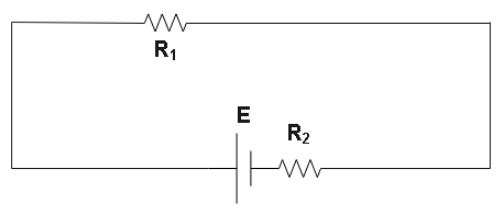
According to the question, resistance of the circuit,${R_1} = R$
Internal resistance ${R_2} = R$ (External resistance is equal to internal resistance.) and
Emf of the cell, $E = E$
First, we will calculate the current, and that is given by,
$I = \dfrac{V}{{{R_1} + {R_2}}} \\
\Rightarrow I = \dfrac{E}{{2R}} \\ $
Now we have to calculate the potential difference across the circuit i.e., Potential difference across the resistance is equal to potential difference across the cell.
$V = IR$
Now, substituting the values in above equation,
$V = I{R_2} \\
\Rightarrow V = \dfrac{E}{{2R}}R \\
\therefore V = \dfrac{E}{2} $
So, the potential difference across its terminals is $\dfrac{E}{2}$ .
Hence, the correct option is A.
Note:We should keep in mind that the terminal voltage is measured by voltmeter and the emf is measured by the potentiometer. Terminal voltage is always smaller than emf due to the drop in potential difference due to the current passing through the internal resistance of the cell.
Formula used:
$V = IR$
Where, $V$ is the voltage, $I$ is the current and $R$ is the resistance.
Complete step by step answer:
According to the question, resistance of the circuit,${R_1} = R$
Internal resistance ${R_2} = R$ (External resistance is equal to internal resistance.) and
Emf of the cell, $E = E$
First, we will calculate the current, and that is given by,
$I = \dfrac{V}{{{R_1} + {R_2}}} \\
\Rightarrow I = \dfrac{E}{{2R}} \\ $
Now we have to calculate the potential difference across the circuit i.e., Potential difference across the resistance is equal to potential difference across the cell.
$V = IR$
Now, substituting the values in above equation,
$V = I{R_2} \\
\Rightarrow V = \dfrac{E}{{2R}}R \\
\therefore V = \dfrac{E}{2} $
So, the potential difference across its terminals is $\dfrac{E}{2}$ .
Hence, the correct option is A.
Note:We should keep in mind that the terminal voltage is measured by voltmeter and the emf is measured by the potentiometer. Terminal voltage is always smaller than emf due to the drop in potential difference due to the current passing through the internal resistance of the cell.
Recently Updated Pages
Master Class 12 Business Studies: Engaging Questions & Answers for Success

Master Class 12 Biology: Engaging Questions & Answers for Success
Master Class 12 Chemistry: Engaging Questions & Answers for Success
Class 12 Question and Answer - Your Ultimate Solutions Guide
Master Class 11 Social Science: Engaging Questions & Answers for Success
Master Class 11 English: Engaging Questions & Answers for Success
Trending doubts
Which are the Top 10 Largest Countries of the World?
Draw a labelled sketch of the human eye class 12 physics CBSE
Name the crygenes that control cotton bollworm and class 12 biology CBSE
Differentiate between homogeneous and heterogeneous class 12 chemistry CBSE
Ribosomal RNA is actively synthesised in A Nucleoplasm class 12 biology CBSE
How many molecules of ATP and NADPH are required information class 12 biology CBSE