



If the attacking reagent is a nucleophile, the electrons are transferred away from the attacking reagent and into the system. This is known as:
A. E effect
B. +E effect
C. R effect
D. +R effect
Answer
 Verified
581.1k+ views
Hint: This effect is observed only in unsaturated compounds. In this effect, a dipole is formed in the molecule because of the complete sharing of pi electrons to the atom under the presence of the attacking group.
Complete step by step answer:
The electromeric effect is classified as the +E effect and - E effect.
When the nucleophile is exposed to the molecule having a double bond, the electron pair present in the pi bond proceeds away from the attacking group. Hence the attacking group gets attached to the atom carrying a positive charge as the atom loses its electron pair during the transfer.
The –E effect is seen when the attacking group is a nucleophile and the pi electrons are moved to the atom where the attacking group will not join.
Example: Addition of nucleophiles group to the carbonyl compound as shown below.
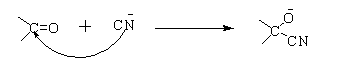
Here, the nucleophile cyanide ion attacks the carbonyl carbon to form a product.
This reaction shows –E effect.
Thus, if the attacking reagent is a nucleophile, the electrons are transferred away from the attacking reagent and into the system. This is known as the –E effect.
Therefore, the correct option is A.
Note:
The electromeric effect remains as long the attacking group is present and close to the organic compound. When the attacking group is removed, the polarized molecule changes to its original form.
Complete step by step answer:
The electromeric effect is classified as the +E effect and - E effect.
When the nucleophile is exposed to the molecule having a double bond, the electron pair present in the pi bond proceeds away from the attacking group. Hence the attacking group gets attached to the atom carrying a positive charge as the atom loses its electron pair during the transfer.
The –E effect is seen when the attacking group is a nucleophile and the pi electrons are moved to the atom where the attacking group will not join.
Example: Addition of nucleophiles group to the carbonyl compound as shown below.
Here, the nucleophile cyanide ion attacks the carbonyl carbon to form a product.
This reaction shows –E effect.
Thus, if the attacking reagent is a nucleophile, the electrons are transferred away from the attacking reagent and into the system. This is known as the –E effect.
Therefore, the correct option is A.
Note:
The electromeric effect remains as long the attacking group is present and close to the organic compound. When the attacking group is removed, the polarized molecule changes to its original form.
Recently Updated Pages
Master Class 12 Economics: Engaging Questions & Answers for Success

Master Class 12 Physics: Engaging Questions & Answers for Success
Master Class 12 English: Engaging Questions & Answers for Success
Master Class 12 Social Science: Engaging Questions & Answers for Success
Master Class 12 Maths: Engaging Questions & Answers for Success
Master Class 12 Business Studies: Engaging Questions & Answers for Success
Trending doubts
Which are the Top 10 Largest Countries of the World?
What are the major means of transport Explain each class 12 social science CBSE
Draw a labelled sketch of the human eye class 12 physics CBSE
Why cannot DNA pass through cell membranes class 12 biology CBSE
Differentiate between insitu conservation and exsitu class 12 biology CBSE
Draw a neat and well labeled diagram of TS of ovary class 12 biology CBSE