




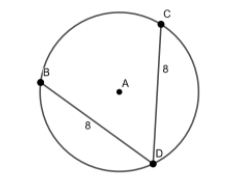
If the angle subtended by the minor arc BD at the centre is ${{125}^{\circ }}$, find the angle subtended by the minor arc CD at centre will be
A. ${{35}^{\circ }}$
B. ${{70}^{\circ }}$
C. ${{125}^{\circ }}$
D. ${{150}^{\circ }}$
Answer
 Verified
619.2k+ views
Hint: In the question, it is given that the two chords BD and CD are of 8 units in length and angle $\angle BAD$ is equal to ${{125}^{\circ }}$ and we are asked to find the angle $\angle CAD$ . To solve this question, we have to see the relation between the triangles $\Delta BAD\text{ and }\Delta CAD$ and find the relation between the angles $\angle BAD\text{ and }\angle \text{CAD}$ to get the value of angle $\angle CAD$. The two triangles $\Delta BAD\text{ and }\Delta CAD$ are congruent because of the SSS property of the congruence of triangles which states that two triangles are congruent if their corresponding sides are equal.
Complete step-by-step answer:
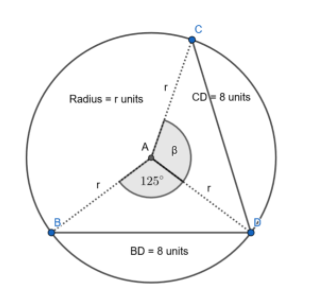
Consider the two triangles $\Delta BAD\text{ and }\Delta CAD$. In the question, it is given that the length of the sides
BD = 8 units.
CD = 8 units.
As seen in the above figures, the point A is the centre of the circle. The points B, C, D lie on the circle of radius of r units. So,
$AB=AC=AD=r\text{ units}$
Comparing the sides of the two triangles $\Delta BAD\text{ and }\Delta CAD$, we get
$BD=CD=8$ Unit (given in the question)
$AB=AC=r$ Unit (radius of the circle)
AD is the common side of the two triangles. So,
From the SSS (Side, Side, Side) property of the congruency of triangles which states that two triangles are congruent if their corresponding sides are equal, we can conclude that the triangles $\Delta BAD\text{ and }\Delta CAD$ are congruent.
In the congruent triangles the angles opposite to the corresponding sides are equal.
$\angle BAD$ is the corresponding angle to the side BD and $\angle CAD$ is the corresponding angle to the side CD. The sides BD and CD are corresponding sides to each other as they are the equal sides of two triangles.
$BD=CD\Leftrightarrow \angle BAD=\angle CAD$
$\therefore \angle CAD=\angle BAD={{125}^{\circ }}$.
Option C is the right answer.
Note:The two chords are meeting at the same point D in the given question. But even if there is no common point for the two chords, if the lengths of chords are equal, the angles subtended by the chords at the centre are equal. This is a property which will help in many questions of similar kind.
Complete step-by-step answer:
Consider the two triangles $\Delta BAD\text{ and }\Delta CAD$. In the question, it is given that the length of the sides
BD = 8 units.
CD = 8 units.
As seen in the above figures, the point A is the centre of the circle. The points B, C, D lie on the circle of radius of r units. So,
$AB=AC=AD=r\text{ units}$
Comparing the sides of the two triangles $\Delta BAD\text{ and }\Delta CAD$, we get
$BD=CD=8$ Unit (given in the question)
$AB=AC=r$ Unit (radius of the circle)
AD is the common side of the two triangles. So,
From the SSS (Side, Side, Side) property of the congruency of triangles which states that two triangles are congruent if their corresponding sides are equal, we can conclude that the triangles $\Delta BAD\text{ and }\Delta CAD$ are congruent.
In the congruent triangles the angles opposite to the corresponding sides are equal.
$\angle BAD$ is the corresponding angle to the side BD and $\angle CAD$ is the corresponding angle to the side CD. The sides BD and CD are corresponding sides to each other as they are the equal sides of two triangles.
$BD=CD\Leftrightarrow \angle BAD=\angle CAD$
$\therefore \angle CAD=\angle BAD={{125}^{\circ }}$.
Option C is the right answer.
Note:The two chords are meeting at the same point D in the given question. But even if there is no common point for the two chords, if the lengths of chords are equal, the angles subtended by the chords at the centre are equal. This is a property which will help in many questions of similar kind.
Recently Updated Pages
Master Class 12 Business Studies: Engaging Questions & Answers for Success

Master Class 12 Biology: Engaging Questions & Answers for Success
Master Class 12 Chemistry: Engaging Questions & Answers for Success
Class 12 Question and Answer - Your Ultimate Solutions Guide
Master Class 11 Social Science: Engaging Questions & Answers for Success
Master Class 11 English: Engaging Questions & Answers for Success
Trending doubts
Which is more stable and why class 12 chemistry CBSE
Which are the Top 10 Largest Countries of the World?
Draw a labelled sketch of the human eye class 12 physics CBSE
Differentiate between homogeneous and heterogeneous class 12 chemistry CBSE
What are the major means of transport Explain each class 12 social science CBSE
Sulphuric acid is known as the king of acids State class 12 chemistry CBSE