




If the angle of a prism is \[{{60}^{0}}\] and angle of minimum deviation is \[{{40}^{0}}\], then the angle of refraction in the prism will be –
\[\begin{align}
& \text{A) 3}{{\text{0}}^{0}} \\
& \text{B) 4}{{\text{5}}^{0}} \\
& \text{C) 5}{{\text{0}}^{0}} \\
& \text{D) 2}{{\text{0}}^{0}} \\
\end{align}\]
Answer
 Verified
574.5k+ views
Hint: We need to understand the relation between the angle of a prism, the angle of minimum deviation and the refracting angles to find the solution to our problem. The refraction through the prism has various relations with its parameters.
Complete step by step solution:
We are given the angle measures of the prism and the minimum deviation for a light through the same. We need to find the refracting angle in such a condition when the minimum deviation is attained. Consider the given figure, where A is the angle of the prism, r’ is the angle of minimum deviation, i is the incident angle, e is the emergence angle and \[{{\text{r}}_{\text{1}}}\text{ and }{{\text{r}}_{\text{2}}}\]are the refracted angles in the prism.
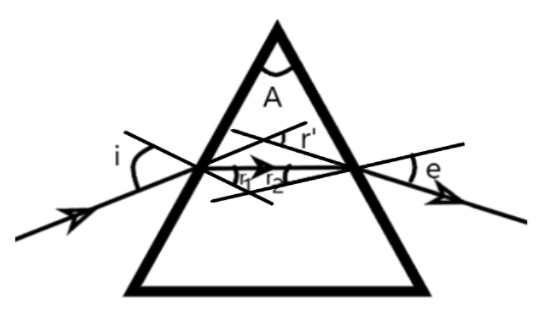
We know that at the condition when the minimum deviation condition is attained, the ray through the prism will be parallel to the base of the prism. Also, the refraction angle \[{{\text{r}}_{\text{1}}}\text{ and }{{\text{r}}_{\text{2}}}\]will be equal. The angle of incidence and the emergence angles are also equal.
We can understand that the refraction angles of the prism will be half the angle of the prism in this condition.
\[\begin{align}
& {{r}_{1}}={{r}_{2}}=r \\
& i=e \\
\end{align}\]
We get that from the exterior angle property of triangles as –
\[\begin{align}
& 180-2r=180-A \\
& \therefore r=\dfrac{A}{2} \\
\end{align}\]
So, the angle of refraction for a prism whose angle is \[{{60}^{0}}\], when the light ray has the minimum deviation through the prism is given as –
\[\begin{align}
& r=\dfrac{A}{2} \\
& \therefore r=\dfrac{{{60}^{0}}}{2}={{30}^{0}} \\
\end{align}\]
The required angle of refraction is \[{{30}^{0}}\].
The correct answer is option A.
Note:
The relation between the angle of prism and the angle of refraction can be derived from very simple calculations involving the exterior angle properties of the triangle and the angle sum property of the triangle including these angles in appropriate triangles.
Complete step by step solution:
We are given the angle measures of the prism and the minimum deviation for a light through the same. We need to find the refracting angle in such a condition when the minimum deviation is attained. Consider the given figure, where A is the angle of the prism, r’ is the angle of minimum deviation, i is the incident angle, e is the emergence angle and \[{{\text{r}}_{\text{1}}}\text{ and }{{\text{r}}_{\text{2}}}\]are the refracted angles in the prism.
We know that at the condition when the minimum deviation condition is attained, the ray through the prism will be parallel to the base of the prism. Also, the refraction angle \[{{\text{r}}_{\text{1}}}\text{ and }{{\text{r}}_{\text{2}}}\]will be equal. The angle of incidence and the emergence angles are also equal.
We can understand that the refraction angles of the prism will be half the angle of the prism in this condition.
\[\begin{align}
& {{r}_{1}}={{r}_{2}}=r \\
& i=e \\
\end{align}\]
We get that from the exterior angle property of triangles as –
\[\begin{align}
& 180-2r=180-A \\
& \therefore r=\dfrac{A}{2} \\
\end{align}\]
So, the angle of refraction for a prism whose angle is \[{{60}^{0}}\], when the light ray has the minimum deviation through the prism is given as –
\[\begin{align}
& r=\dfrac{A}{2} \\
& \therefore r=\dfrac{{{60}^{0}}}{2}={{30}^{0}} \\
\end{align}\]
The required angle of refraction is \[{{30}^{0}}\].
The correct answer is option A.
Note:
The relation between the angle of prism and the angle of refraction can be derived from very simple calculations involving the exterior angle properties of the triangle and the angle sum property of the triangle including these angles in appropriate triangles.
Recently Updated Pages
Master Class 12 Economics: Engaging Questions & Answers for Success

Master Class 12 Physics: Engaging Questions & Answers for Success
Master Class 12 English: Engaging Questions & Answers for Success
Master Class 12 Social Science: Engaging Questions & Answers for Success
Master Class 12 Maths: Engaging Questions & Answers for Success
Master Class 12 Business Studies: Engaging Questions & Answers for Success
Trending doubts
Which are the Top 10 Largest Countries of the World?
What are the major means of transport Explain each class 12 social science CBSE
Draw a labelled sketch of the human eye class 12 physics CBSE
Why cannot DNA pass through cell membranes class 12 biology CBSE
Differentiate between insitu conservation and exsitu class 12 biology CBSE
Draw a neat and well labeled diagram of TS of ovary class 12 biology CBSE