




If the adjacent sides of a triangle are represented by the vectors \[\hat i + 2\hat j + 2\hat k\] and \[3\hat i - 2\hat j + \hat k\], then the area of the triangle is
A) \[\dfrac{{\sqrt {66} }}{2}\]
B) \[\dfrac{{\sqrt {116} }}{3}\]
C) \[\dfrac{{\sqrt {56} }}{2}\]
D) \[\dfrac{{\sqrt {116} }}{2}\]
Answer
 Verified
594.6k+ views
Hint: The magnitude of the product is by definition the area of a parallelogram spanned by when placed tail-to-tail.
Formula used:
The cross product of two vectors is given by the following formula
\[\overrightarrow a \times \overrightarrow b = \left[ {\begin{array}{*{20}{c}}
{\hat i}&{\hat j}&{\hat k} \\
{{a_1}}&{{a_2}}&{{a_3}} \\
{{b_1}}&{{b_2}}&{{b_3}}
\end{array}} \right]\] , where \[
\overrightarrow a = {a_1}\hat i + {a_2}\hat j + {a_3}\hat k \\
\overrightarrow b = {b_1}\hat i + {b_2}\hat j + {b_3}\hat k \\
\]
The magnitude of a vector is given by the formula,
\[\left| {\overrightarrow {AB} } \right| = \sqrt {{m_1}^2 + {m_2}^2 + {m_3}^2} \], where\[\overrightarrow {AB} = {m_1}\hat i + {m_2}\hat j + {m_3}\hat k\].
In the cross
Hence we can use the vector product to compute the area of a triangle formed by three points A, B and C in space.
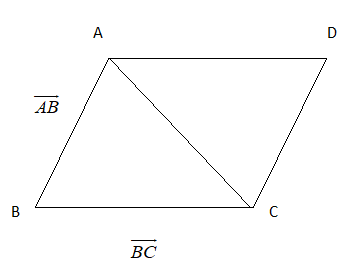
It follows that the area of the triangle ABC is given by the formula \[\dfrac{1}{2}\left| {\overrightarrow {AB} \times \overrightarrow {BC} } \right|\]
Complete step-by-step answer:
It is given that the adjacent sides of a triangle are represented by the vectors \[\hat i + 2\hat j + 2\hat k\] and \[3\hat i - 2\hat j + \hat k\] respectively.
Let us consider the vectors as
\[\overrightarrow {AB} = \hat i + 2\hat j + 2\hat k\]
\[\overrightarrow {BC} = 3\hat i - 2\hat j + \hat k\]
We know that, if \[\overrightarrow {AB} \]and \[\overrightarrow {BC} \]are the adjacent sides of a triangle, then the area of the triangle ABC is given by the formula mentioned in the hint.
Now to use the formula of area of triangle we are in need to find\[\overrightarrow {AB} \times \overrightarrow {BC} \],
Hence,
\[\overrightarrow {AB} \times \overrightarrow {BC} = \left[ {\begin{array}{*{20}{c}}
{\hat i}&{\hat j}&{\hat k} \\
1&2&2 \\
3&{ - 2}&1
\end{array}} \right]\]
Using the matrix we get,
\[
\left[ {\begin{array}{*{20}{c}}
{\hat i}&{\hat j}&{\hat k} \\
1&2&2 \\
3&{ - 2}&1
\end{array}} \right] = \hat i\{ 2 \times 1 - 2 \times ( - 2)\} - \hat j(1 \times 1 - 2 \times 3) + \hat k\{ 1 \times ( - 2) - 2 \times 3\} \\
= \hat i(2 + 4) - \hat j(1 - 6) + \hat k( - 2 - 6) \\
= 6\hat i + 5\hat j - 8\hat k \\
\]
Thus now let us find \[\left| {\overrightarrow {AB} \times \overrightarrow {BC} } \right|\]
\[\left| {\overrightarrow {AB} \times \overrightarrow {BC} } \right| = \left| {6\hat i + 5\hat j - 8\hat k} \right|\]
Using magnitude formula of vectors we get
\[
\left| {6\hat i + 5\hat j - 8\hat k} \right| = \sqrt {{6^2} + {5^2} + {{( - 8)}^2}} \\
= \sqrt {36 + 25 + 64} \\
= \sqrt {125} \\
\]
Now let us substitute the value of \[\left| {\overrightarrow {AB} \times \overrightarrow {BC} } \right|\]in the area of triangles formula, then we get,
The area of the triangle ABC
\[
\dfrac{1}{2}\left| {\overrightarrow {AB} \times \overrightarrow {BC} } \right| \\
= \dfrac{{\sqrt {125} }}{2}units \\
\]
Hence no option in the given question matches the values, therefore we can convey that none of the given options are correct.
Note:
The cross product of two vectors a and b is defined only in three-dimensional space and is denoted by a × b.
\[(a \times b)\] and the name cross product were possibly inspired by the fact that each scalar component of $a \times b$ is computed by multiplying non-corresponding components of a and b.
The standard basis vectors $i,j{\text{ and }}k$ satisfy the following equalities in a right hand coordinate system:
$
i \times j = k \\
j \times k = i \\
k \times i = j \\
$
By the anticommutativity of the cross product,
$
j \times i = - k \\
k \times j = - i \\
i \times k = - j \\
$
Again by the anticommutativity of the cross product,
$
i \times i = 0 \\
j \times j = 0 \\
k \times k = 0 \\
$
We make mistakes in finding the cross product value of the given two vectors.
Formula used:
The cross product of two vectors is given by the following formula
\[\overrightarrow a \times \overrightarrow b = \left[ {\begin{array}{*{20}{c}}
{\hat i}&{\hat j}&{\hat k} \\
{{a_1}}&{{a_2}}&{{a_3}} \\
{{b_1}}&{{b_2}}&{{b_3}}
\end{array}} \right]\] , where \[
\overrightarrow a = {a_1}\hat i + {a_2}\hat j + {a_3}\hat k \\
\overrightarrow b = {b_1}\hat i + {b_2}\hat j + {b_3}\hat k \\
\]
The magnitude of a vector is given by the formula,
\[\left| {\overrightarrow {AB} } \right| = \sqrt {{m_1}^2 + {m_2}^2 + {m_3}^2} \], where\[\overrightarrow {AB} = {m_1}\hat i + {m_2}\hat j + {m_3}\hat k\].
In the cross
Hence we can use the vector product to compute the area of a triangle formed by three points A, B and C in space.
It follows that the area of the triangle ABC is given by the formula \[\dfrac{1}{2}\left| {\overrightarrow {AB} \times \overrightarrow {BC} } \right|\]
Complete step-by-step answer:
It is given that the adjacent sides of a triangle are represented by the vectors \[\hat i + 2\hat j + 2\hat k\] and \[3\hat i - 2\hat j + \hat k\] respectively.
Let us consider the vectors as
\[\overrightarrow {AB} = \hat i + 2\hat j + 2\hat k\]
\[\overrightarrow {BC} = 3\hat i - 2\hat j + \hat k\]
We know that, if \[\overrightarrow {AB} \]and \[\overrightarrow {BC} \]are the adjacent sides of a triangle, then the area of the triangle ABC is given by the formula mentioned in the hint.
Now to use the formula of area of triangle we are in need to find\[\overrightarrow {AB} \times \overrightarrow {BC} \],
Hence,
\[\overrightarrow {AB} \times \overrightarrow {BC} = \left[ {\begin{array}{*{20}{c}}
{\hat i}&{\hat j}&{\hat k} \\
1&2&2 \\
3&{ - 2}&1
\end{array}} \right]\]
Using the matrix we get,
\[
\left[ {\begin{array}{*{20}{c}}
{\hat i}&{\hat j}&{\hat k} \\
1&2&2 \\
3&{ - 2}&1
\end{array}} \right] = \hat i\{ 2 \times 1 - 2 \times ( - 2)\} - \hat j(1 \times 1 - 2 \times 3) + \hat k\{ 1 \times ( - 2) - 2 \times 3\} \\
= \hat i(2 + 4) - \hat j(1 - 6) + \hat k( - 2 - 6) \\
= 6\hat i + 5\hat j - 8\hat k \\
\]
Thus now let us find \[\left| {\overrightarrow {AB} \times \overrightarrow {BC} } \right|\]
\[\left| {\overrightarrow {AB} \times \overrightarrow {BC} } \right| = \left| {6\hat i + 5\hat j - 8\hat k} \right|\]
Using magnitude formula of vectors we get
\[
\left| {6\hat i + 5\hat j - 8\hat k} \right| = \sqrt {{6^2} + {5^2} + {{( - 8)}^2}} \\
= \sqrt {36 + 25 + 64} \\
= \sqrt {125} \\
\]
Now let us substitute the value of \[\left| {\overrightarrow {AB} \times \overrightarrow {BC} } \right|\]in the area of triangles formula, then we get,
The area of the triangle ABC
\[
\dfrac{1}{2}\left| {\overrightarrow {AB} \times \overrightarrow {BC} } \right| \\
= \dfrac{{\sqrt {125} }}{2}units \\
\]
Hence no option in the given question matches the values, therefore we can convey that none of the given options are correct.
Note:
The cross product of two vectors a and b is defined only in three-dimensional space and is denoted by a × b.
\[(a \times b)\] and the name cross product were possibly inspired by the fact that each scalar component of $a \times b$ is computed by multiplying non-corresponding components of a and b.
The standard basis vectors $i,j{\text{ and }}k$ satisfy the following equalities in a right hand coordinate system:
$
i \times j = k \\
j \times k = i \\
k \times i = j \\
$
By the anticommutativity of the cross product,
$
j \times i = - k \\
k \times j = - i \\
i \times k = - j \\
$
Again by the anticommutativity of the cross product,
$
i \times i = 0 \\
j \times j = 0 \\
k \times k = 0 \\
$
We make mistakes in finding the cross product value of the given two vectors.
Recently Updated Pages
Master Class 12 Economics: Engaging Questions & Answers for Success

Master Class 12 Physics: Engaging Questions & Answers for Success
Master Class 12 English: Engaging Questions & Answers for Success
Master Class 12 Social Science: Engaging Questions & Answers for Success
Master Class 12 Maths: Engaging Questions & Answers for Success
Master Class 12 Business Studies: Engaging Questions & Answers for Success
Trending doubts
Which are the Top 10 Largest Countries of the World?
What are the major means of transport Explain each class 12 social science CBSE
Draw a labelled sketch of the human eye class 12 physics CBSE
Why cannot DNA pass through cell membranes class 12 biology CBSE
Differentiate between insitu conservation and exsitu class 12 biology CBSE
Draw a neat and well labeled diagram of TS of ovary class 12 biology CBSE