




If tangent drawn to a curve at a point is perpendicular to x-axis then at that point-
A. $ \dfrac{{dy}}{{dx}} = 0 $
B. $ \dfrac{{dx}}{{dy}} = 0 $
C. $ \dfrac{{dy}}{{dx}} = 1 $
D. $ \dfrac{{dy}}{{dx}} = - 1 $
Answer
 Verified
612.3k+ views
Hint: A tangent line to a curve at a certain point is a line that touches the curve only at one point. Given that a tangent line drawn to a curve at a point is perpendicular to the x-axis. When a line is perpendicular to x-axis, it will be parallel to the y-axis. So, the x-coordinates of the line will not change only the y-coordinates will be changing. Use this info to solve the given question.
Complete step-by-step answer:
We are given that a tangent which is drawn to a curve at a point is perpendicular to x-axis.
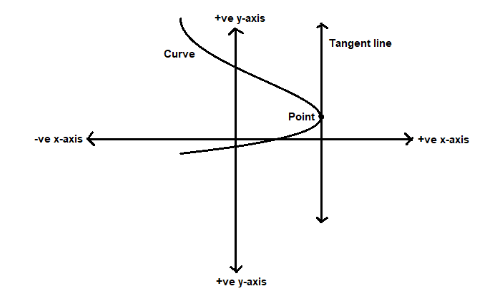
We know that when a line is perpendicular to x-axis, it is parallel to y-axis and when a line is perpendicular to y-axis then it is parallel to x-axis.
We know that the slope of a line m is equal to $ m = \dfrac{{{y_2} - {y_1}}}{{{x_2} - {x_1}}} $ , where $ {x_1},{x_2} $ are the x-coordinates of the points of a line and $ {y_1},{y_2} $ are the y-coordinates of the points of the line.
Slope can also be written as $ m = \dfrac{{dx}}{{dy}} $ , where $ dx $ is the change in x-coordinates and $ dy $ is the change in y-coordinates.
But the tangent line is parallel to the y-axis, just its y-coordinates will be changing keeping the x-coordinates constant.
Therefore,
$
dx = 0 \\
\Rightarrow \dfrac{{dy}}{{dx}} = \dfrac{{dy}}{0} \\
\Rightarrow \dfrac{{dx}}{{dy}} = \dfrac{0}{{dy}} \\
\therefore \dfrac{{dx}}{{dy}} = 0 \\
$
So, the correct option is Option B, $ \dfrac{{dx}}{{dy}} = 0 $
So, the correct answer is “Option B”.
Note: Another approach
Straight line equation with slope m is $ y = mx + c $
Differentiate the line equation with respect to x
$
y = mx + c \\
\dfrac{{dy}}{{dx}} = m\dfrac{{dx}}{{dx}} + \dfrac{d}{{dx}}c \\
$
c is a constant, so its differentiation will be zero.
$
\dfrac{{dy}}{{dx}} = m\left( 1 \right) + 0\left( {\because \dfrac{{dx}}{{dx}} = 1} \right) \\
\Rightarrow \dfrac{{dy}}{{dx}} = m \\
$
But for a line which is perpendicular to the x-axis the slope is infinity.
$
\Rightarrow \dfrac{{dy}}{{dx}} = \dfrac{1}{0} \\
\Rightarrow \dfrac{{dx}}{{dy}} = 0 \\
$
Therefore, if tangent drawn to a curve at a point is perpendicular to x-axis then at that point $\dfrac{{dx}}{{dy}} = 0$
Complete step-by-step answer:
We are given that a tangent which is drawn to a curve at a point is perpendicular to x-axis.
We know that when a line is perpendicular to x-axis, it is parallel to y-axis and when a line is perpendicular to y-axis then it is parallel to x-axis.
We know that the slope of a line m is equal to $ m = \dfrac{{{y_2} - {y_1}}}{{{x_2} - {x_1}}} $ , where $ {x_1},{x_2} $ are the x-coordinates of the points of a line and $ {y_1},{y_2} $ are the y-coordinates of the points of the line.
Slope can also be written as $ m = \dfrac{{dx}}{{dy}} $ , where $ dx $ is the change in x-coordinates and $ dy $ is the change in y-coordinates.
But the tangent line is parallel to the y-axis, just its y-coordinates will be changing keeping the x-coordinates constant.
Therefore,
$
dx = 0 \\
\Rightarrow \dfrac{{dy}}{{dx}} = \dfrac{{dy}}{0} \\
\Rightarrow \dfrac{{dx}}{{dy}} = \dfrac{0}{{dy}} \\
\therefore \dfrac{{dx}}{{dy}} = 0 \\
$
So, the correct option is Option B, $ \dfrac{{dx}}{{dy}} = 0 $
So, the correct answer is “Option B”.
Note: Another approach
Straight line equation with slope m is $ y = mx + c $
Differentiate the line equation with respect to x
$
y = mx + c \\
\dfrac{{dy}}{{dx}} = m\dfrac{{dx}}{{dx}} + \dfrac{d}{{dx}}c \\
$
c is a constant, so its differentiation will be zero.
$
\dfrac{{dy}}{{dx}} = m\left( 1 \right) + 0\left( {\because \dfrac{{dx}}{{dx}} = 1} \right) \\
\Rightarrow \dfrac{{dy}}{{dx}} = m \\
$
But for a line which is perpendicular to the x-axis the slope is infinity.
$
\Rightarrow \dfrac{{dy}}{{dx}} = \dfrac{1}{0} \\
\Rightarrow \dfrac{{dx}}{{dy}} = 0 \\
$
Therefore, if tangent drawn to a curve at a point is perpendicular to x-axis then at that point $\dfrac{{dx}}{{dy}} = 0$
Recently Updated Pages
Master Class 12 Economics: Engaging Questions & Answers for Success

Master Class 12 English: Engaging Questions & Answers for Success
Master Class 12 Social Science: Engaging Questions & Answers for Success
Master Class 12 Maths: Engaging Questions & Answers for Success
Master Class 12 Physics: Engaging Questions & Answers for Success
Master Class 9 General Knowledge: Engaging Questions & Answers for Success
Trending doubts
Which are the Top 10 Largest Countries of the World?
Draw a labelled sketch of the human eye class 12 physics CBSE
Differentiate between homogeneous and heterogeneous class 12 chemistry CBSE
Sulphuric acid is known as the king of acids State class 12 chemistry CBSE
Why is the cell called the structural and functional class 12 biology CBSE
Draw ray diagrams each showing i myopic eye and ii class 12 physics CBSE