




If suddenly the gravitational force of attraction between the earth and a satellite revolving around it becomes zero, then the satellite will
A) Continue to move in its orbit with the same velocity.
B) Move tangentially to the orbit and escape away from its orbit.
C) Become stationary in its orbit.
D) Move towards the earth.
Answer
 Verified
628.8k+ views
Hint: When a satellite revolves around the earth then a centrifugal force is created due to the motion of the satellite which is directed outward from the center of the earth. But the earth’s gravitational force acts towards the center of the earth and opposes the satellite to fly away. At a stable orbit, these two forces balance each other.
Formula used:
At orbit forces on the satellite is given by
$
\dfrac{{m{v^2}}}{R} = mg \\
\therefore \dfrac{{{v^2}}}{R} = g \\
$ …………………….. (1)
Where,
$m$ is the mass of the satellite,
$v$ is its linear velocity at any particular moment,
$R$ is the radius of the orbit,
$g$ is the acceleration due to gravity.
Here, the direction of the velocity v of the satellite is always tangential to the orbit of it (see the picture).
Complete step by step answer:
As the formula says, at equilibrium i.e. when the satellite revolves around the earth in a stable orbit the centrifugal force and the gravitational force of the earth balance each other.
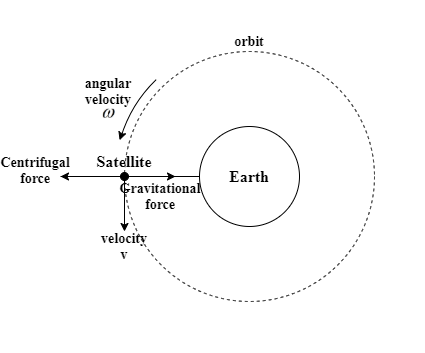
Now, if suddenly the gravitational force of earth becomes zero then the RHS of eq.(1) turns 0. Hence, the term $\dfrac{{{v^2}}}{R}$ must be zero. Now, $v$ can’t be 0 because no external force is applied on the satellite to stop its motion. Hence, $R$ must go to infinity. So, the satellite starts moving out at a velocity v which is tangential to the orbit towards infinity.
The satellite will Move tangentially to the original orbit with the same velocity. Hence option (B) is correct.
Note:
Many students might get confused as the relation in eq.(1) can be written in terms of the angular velocity $\omega $ as $m{\omega ^2}R = mg$. Now, making RHS of this equation 0 implies $R$ must be 0. But this form of the eq.(1) is misleading as $\omega $itself is inversely proportional to $R$. Hence, this conclusion is not true.
Formula used:
At orbit forces on the satellite is given by
$
\dfrac{{m{v^2}}}{R} = mg \\
\therefore \dfrac{{{v^2}}}{R} = g \\
$ …………………….. (1)
Where,
$m$ is the mass of the satellite,
$v$ is its linear velocity at any particular moment,
$R$ is the radius of the orbit,
$g$ is the acceleration due to gravity.
Here, the direction of the velocity v of the satellite is always tangential to the orbit of it (see the picture).
Complete step by step answer:
As the formula says, at equilibrium i.e. when the satellite revolves around the earth in a stable orbit the centrifugal force and the gravitational force of the earth balance each other.
Now, if suddenly the gravitational force of earth becomes zero then the RHS of eq.(1) turns 0. Hence, the term $\dfrac{{{v^2}}}{R}$ must be zero. Now, $v$ can’t be 0 because no external force is applied on the satellite to stop its motion. Hence, $R$ must go to infinity. So, the satellite starts moving out at a velocity v which is tangential to the orbit towards infinity.
The satellite will Move tangentially to the original orbit with the same velocity. Hence option (B) is correct.
Note:
Many students might get confused as the relation in eq.(1) can be written in terms of the angular velocity $\omega $ as $m{\omega ^2}R = mg$. Now, making RHS of this equation 0 implies $R$ must be 0. But this form of the eq.(1) is misleading as $\omega $itself is inversely proportional to $R$. Hence, this conclusion is not true.
Recently Updated Pages
Master Class 12 Business Studies: Engaging Questions & Answers for Success

Master Class 12 Chemistry: Engaging Questions & Answers for Success
Master Class 12 Biology: Engaging Questions & Answers for Success
Class 12 Question and Answer - Your Ultimate Solutions Guide
Master Class 11 English: Engaging Questions & Answers for Success
Master Class 11 Social Science: Engaging Questions & Answers for Success
Trending doubts
Which are the Top 10 Largest Countries of the World?
The total number of vertebrae in man is a30 b31 c32 class 12 biology CBSE
Draw a labelled sketch of the human eye class 12 physics CBSE
The number of cranial nerves in a frog is A 10 pairs class 12 biology CBSE
Differentiate between homogeneous and heterogeneous class 12 chemistry CBSE
Differentiate between Pyramid of energy and pyramid class 12 biology CBSE