




If ${\sec ^2}A\hat i + \hat j + \hat k$, $\hat i + {\sec ^2}B\hat j + \hat k$ and $\hat i + \hat j + {\sec ^2}C\hat k$ are coplanar then ${\cot ^2}A + {\cot ^2}B + {\cot ^2}C$ is
$\left( a \right)$ Equal to -1
$\left( b \right)$ Equal to 2
$\left( c \right)$ Equal to 0
$\left( d \right)$ Not defined
Answer
 Verified
594.3k+ views
Hint: In this question use the concept that if three vectors are coplanar then the dot product of a vector with the cross product of other two vectors is zero i.e. scalar triple product is zero i.e. $\left( {\vec a.\left( {\vec b \times \vec c} \right) = 0} \right)$, so use these concepts to reach the solution of the question.
Complete step-by-step solution:
Given data:
Three coplanar vectors
${\sec ^2}A\hat i + \hat j + \hat k$, $\hat i + {\sec ^2}B\hat j + \hat k$ and $\hat i + \hat j + {\sec ^2}C\hat k$
Let, $\vec a = {\sec ^2}A\hat i + \hat j + \hat k$
\[\vec b = \hat i + {\sec ^2}B\hat j + \hat k\]
And, $\vec c = \hat i + \hat j + {\sec ^2}C\hat k$
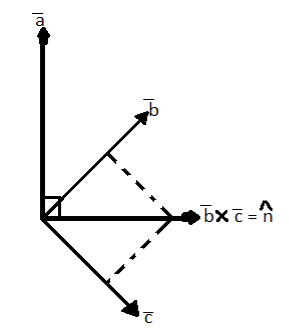
As we all know if two vectors are perpendicular to each other then their dot product is zero.
So in a coplanar vector the cross product of any two vectors is perpendicular to the other vector that’s why the dot product of a vector with the cross product of other two vectors is zero. Also called a scalar triple product is zero.
i.e. $\left( {\vec a.\left( {\vec b \times \vec c} \right) = 0} \right)$
So first find out the cross product of vectors b and c, so we have,
$ \Rightarrow \vec b \times \vec c = \left( {\hat i + {{\sec }^2}B\hat j + \hat k} \right) \times \left( {\hat i + \hat j + {{\sec }^2}C\hat k} \right)$
As we all know that the cross product of two vectors \[x\hat i + y\hat j + z\hat k,p\hat i + q\hat j + r\hat k\] is given as
$ \Rightarrow \left( {x\hat i + y\hat j + z\hat k} \right) \times \left( {p\hat i + q\hat j + r\hat k} \right) = \left| {\begin{array}{*{20}{c}}
{\hat i}&{\hat j}&{\hat k} \\
x&y&z \\
p&q&r
\end{array}} \right|$ so use this property we have,
$ \Rightarrow \vec b \times \vec c = \left( {\hat i + {{\sec }^2}B\hat j + \hat k} \right) \times \left( {\hat i + \hat j + {{\sec }^2}C\hat k} \right) = \left| {\begin{array}{*{20}{c}}
{\hat i}&{\hat j}&{\hat k} \\
1&{{{\sec }^2}B}&1 \\
1&1&{{{\sec }^2}C}
\end{array}} \right|$
Now expand the determinant we have,
$ \Rightarrow \vec b \times \vec c = \left| {\begin{array}{*{20}{c}}
{\hat i}&{\hat j}&{\hat k} \\
1&{{{\sec }^2}B}&1 \\
1&1&{{{\sec }^2}C}
\end{array}} \right| = \left( {{{\sec }^2}B{{\sec }^2}C - 1} \right)\hat i - \left( {{{\sec }^2}C - 1} \right)\hat j + \left( {1 - {{\sec }^2}B} \right)\hat k$
Now this vector is perpendicular with the vector a, so the dot product of vector a, and the above vector is zero and for coplanar vector this value is equal to zero.
$ \Rightarrow \vec a.\left( {\vec b \times \vec c} \right) = \left( {{{\sec }^2}A\hat i + \hat j + \hat k} \right).\left( {\left( {{{\sec }^2}B{{\sec }^2}C - 1} \right)\hat i - \left( {{{\sec }^2}C - 1} \right)\hat j + \left( {1 - {{\sec }^2}B} \right)\hat k} \right) = 0$
Now in a dot product the product of same unit vector is one and the product of different unit vector is zero i.e. $\hat i.\hat i = 1,\hat j.\hat j = 1,\hat k.\hat k = 1,\hat i.\hat j = 0,\hat j.\hat k = 0,{\text{ and }}\hat k.\hat i = 0$ so we have,
$ \Rightarrow \vec a.\left( {\vec b \times \vec c} \right) = {\sec ^2}A\left( {{{\sec }^2}B{{\sec }^2}C - 1} \right) - \left( {{{\sec }^2}C - 1} \right) + \left( {1 - {{\sec }^2}B} \right) = 0$
$ \Rightarrow {\sec ^2}A\left( {{{\sec }^2}B{{\sec }^2}C - 1} \right) - {\sec ^2}C + 1 + 1 - {\sec ^2}B = 0$
$ \Rightarrow {\sec ^2}A{\sec ^2}B{\sec ^2}C - {\sec ^2}A - {\sec ^2}C - {\sec ^2}B + 2 = 0$
Now as we know that ${\sec ^2}x = 1 + {\tan ^2}x$ so use this property in the above equation we have,
$ \Rightarrow \left( {1 + {{\tan }^2}A} \right)\left( {1 + {{\tan }^2}B} \right)\left( {1 + {{\tan }^2}C} \right) - \left( {1 + {{\tan }^2}A} \right) - \left( {1 + {{\tan }^2}B} \right) - \left( {1 + {{\tan }^2}C} \right) + 2 = 0$
Now simplify we have,
$ \Rightarrow \left( {1 + {{\tan }^2}A + {{\tan }^2}B + {{\tan }^2}A{{\tan }^2}B} \right)\left( {1 + {{\tan }^2}C} \right) - \left( {1 + {{\tan }^2}A} \right) - \left( {1 + {{\tan }^2}B} \right) - \left( {1 + {{\tan }^2}C} \right) + 2 = 0$
$\begin{gathered}
\Rightarrow 1 + {\tan ^2}A + {\tan ^2}B + {\tan ^2}A{\tan ^2}B + {\tan ^2}C + {\tan ^2}A{\tan ^2}C + {\tan ^2}B{\tan ^2}C + {\tan ^2}A{\tan ^2}B{\tan ^2}C \\
- {\tan ^2}A - {\tan ^2}B - {\tan ^2}C - 1 = 0 \\
\end{gathered} $
Now cancel out the same terms with positive and negative sign we have,
$ \Rightarrow {\tan ^2}A{\tan ^2}B + {\tan ^2}A{\tan ^2}C + {\tan ^2}B{\tan ^2}C + {\tan ^2}A{\tan ^2}B{\tan ^2}C = 0$
Now divide by ${\tan ^2}A{\tan ^2}B{\tan ^2}C$ throughout we have,
\[ \Rightarrow \dfrac{{{{\tan }^2}A{{\tan }^2}B}}{{{{\tan }^2}A{{\tan }^2}B{{\tan }^2}C}} + \dfrac{{{{\tan }^2}A{{\tan }^2}C}}{{{{\tan }^2}A{{\tan }^2}B{{\tan }^2}C}} + \dfrac{{{{\tan }^2}B{{\tan }^2}C}}{{{{\tan }^2}A{{\tan }^2}B{{\tan }^2}C}} + \dfrac{{{{\tan }^2}A{{\tan }^2}B{{\tan }^2}C}}{{{{\tan }^2}A{{\tan }^2}B{{\tan }^2}C}} = 0\]
\[ \Rightarrow \dfrac{1}{{{{\tan }^2}C}} + \dfrac{1}{{{{\tan }^2}B}} + \dfrac{1}{{{{\tan }^2}A}} + 1 = 0\]
Now as we know that cot x = (1/tan x) so use this property we have,
\[ \Rightarrow {\cot ^2}C + {\cot ^2}B + {\cot ^2}A + 1 = 0\]
\[ \Rightarrow {\cot ^2}A + {\cot ^2}B + {\cot ^2}C = - 1\]
So this is the required answer.
Hence option (a) is the correct answer.
Note: Whenever we face such types of questions the key concept we have to remember is that always recall the condition of coplanar vectors which is stated above and always recall how to take the cross product and dot product of two vectors which is also stated above and always recall the basic trigonometric identity such as, ${\sec ^2}x = 1 + {\tan ^2}x$ and cot x = (1/ cot x).
Complete step-by-step solution:
Given data:
Three coplanar vectors
${\sec ^2}A\hat i + \hat j + \hat k$, $\hat i + {\sec ^2}B\hat j + \hat k$ and $\hat i + \hat j + {\sec ^2}C\hat k$
Let, $\vec a = {\sec ^2}A\hat i + \hat j + \hat k$
\[\vec b = \hat i + {\sec ^2}B\hat j + \hat k\]
And, $\vec c = \hat i + \hat j + {\sec ^2}C\hat k$
As we all know if two vectors are perpendicular to each other then their dot product is zero.
So in a coplanar vector the cross product of any two vectors is perpendicular to the other vector that’s why the dot product of a vector with the cross product of other two vectors is zero. Also called a scalar triple product is zero.
i.e. $\left( {\vec a.\left( {\vec b \times \vec c} \right) = 0} \right)$
So first find out the cross product of vectors b and c, so we have,
$ \Rightarrow \vec b \times \vec c = \left( {\hat i + {{\sec }^2}B\hat j + \hat k} \right) \times \left( {\hat i + \hat j + {{\sec }^2}C\hat k} \right)$
As we all know that the cross product of two vectors \[x\hat i + y\hat j + z\hat k,p\hat i + q\hat j + r\hat k\] is given as
$ \Rightarrow \left( {x\hat i + y\hat j + z\hat k} \right) \times \left( {p\hat i + q\hat j + r\hat k} \right) = \left| {\begin{array}{*{20}{c}}
{\hat i}&{\hat j}&{\hat k} \\
x&y&z \\
p&q&r
\end{array}} \right|$ so use this property we have,
$ \Rightarrow \vec b \times \vec c = \left( {\hat i + {{\sec }^2}B\hat j + \hat k} \right) \times \left( {\hat i + \hat j + {{\sec }^2}C\hat k} \right) = \left| {\begin{array}{*{20}{c}}
{\hat i}&{\hat j}&{\hat k} \\
1&{{{\sec }^2}B}&1 \\
1&1&{{{\sec }^2}C}
\end{array}} \right|$
Now expand the determinant we have,
$ \Rightarrow \vec b \times \vec c = \left| {\begin{array}{*{20}{c}}
{\hat i}&{\hat j}&{\hat k} \\
1&{{{\sec }^2}B}&1 \\
1&1&{{{\sec }^2}C}
\end{array}} \right| = \left( {{{\sec }^2}B{{\sec }^2}C - 1} \right)\hat i - \left( {{{\sec }^2}C - 1} \right)\hat j + \left( {1 - {{\sec }^2}B} \right)\hat k$
Now this vector is perpendicular with the vector a, so the dot product of vector a, and the above vector is zero and for coplanar vector this value is equal to zero.
$ \Rightarrow \vec a.\left( {\vec b \times \vec c} \right) = \left( {{{\sec }^2}A\hat i + \hat j + \hat k} \right).\left( {\left( {{{\sec }^2}B{{\sec }^2}C - 1} \right)\hat i - \left( {{{\sec }^2}C - 1} \right)\hat j + \left( {1 - {{\sec }^2}B} \right)\hat k} \right) = 0$
Now in a dot product the product of same unit vector is one and the product of different unit vector is zero i.e. $\hat i.\hat i = 1,\hat j.\hat j = 1,\hat k.\hat k = 1,\hat i.\hat j = 0,\hat j.\hat k = 0,{\text{ and }}\hat k.\hat i = 0$ so we have,
$ \Rightarrow \vec a.\left( {\vec b \times \vec c} \right) = {\sec ^2}A\left( {{{\sec }^2}B{{\sec }^2}C - 1} \right) - \left( {{{\sec }^2}C - 1} \right) + \left( {1 - {{\sec }^2}B} \right) = 0$
$ \Rightarrow {\sec ^2}A\left( {{{\sec }^2}B{{\sec }^2}C - 1} \right) - {\sec ^2}C + 1 + 1 - {\sec ^2}B = 0$
$ \Rightarrow {\sec ^2}A{\sec ^2}B{\sec ^2}C - {\sec ^2}A - {\sec ^2}C - {\sec ^2}B + 2 = 0$
Now as we know that ${\sec ^2}x = 1 + {\tan ^2}x$ so use this property in the above equation we have,
$ \Rightarrow \left( {1 + {{\tan }^2}A} \right)\left( {1 + {{\tan }^2}B} \right)\left( {1 + {{\tan }^2}C} \right) - \left( {1 + {{\tan }^2}A} \right) - \left( {1 + {{\tan }^2}B} \right) - \left( {1 + {{\tan }^2}C} \right) + 2 = 0$
Now simplify we have,
$ \Rightarrow \left( {1 + {{\tan }^2}A + {{\tan }^2}B + {{\tan }^2}A{{\tan }^2}B} \right)\left( {1 + {{\tan }^2}C} \right) - \left( {1 + {{\tan }^2}A} \right) - \left( {1 + {{\tan }^2}B} \right) - \left( {1 + {{\tan }^2}C} \right) + 2 = 0$
$\begin{gathered}
\Rightarrow 1 + {\tan ^2}A + {\tan ^2}B + {\tan ^2}A{\tan ^2}B + {\tan ^2}C + {\tan ^2}A{\tan ^2}C + {\tan ^2}B{\tan ^2}C + {\tan ^2}A{\tan ^2}B{\tan ^2}C \\
- {\tan ^2}A - {\tan ^2}B - {\tan ^2}C - 1 = 0 \\
\end{gathered} $
Now cancel out the same terms with positive and negative sign we have,
$ \Rightarrow {\tan ^2}A{\tan ^2}B + {\tan ^2}A{\tan ^2}C + {\tan ^2}B{\tan ^2}C + {\tan ^2}A{\tan ^2}B{\tan ^2}C = 0$
Now divide by ${\tan ^2}A{\tan ^2}B{\tan ^2}C$ throughout we have,
\[ \Rightarrow \dfrac{{{{\tan }^2}A{{\tan }^2}B}}{{{{\tan }^2}A{{\tan }^2}B{{\tan }^2}C}} + \dfrac{{{{\tan }^2}A{{\tan }^2}C}}{{{{\tan }^2}A{{\tan }^2}B{{\tan }^2}C}} + \dfrac{{{{\tan }^2}B{{\tan }^2}C}}{{{{\tan }^2}A{{\tan }^2}B{{\tan }^2}C}} + \dfrac{{{{\tan }^2}A{{\tan }^2}B{{\tan }^2}C}}{{{{\tan }^2}A{{\tan }^2}B{{\tan }^2}C}} = 0\]
\[ \Rightarrow \dfrac{1}{{{{\tan }^2}C}} + \dfrac{1}{{{{\tan }^2}B}} + \dfrac{1}{{{{\tan }^2}A}} + 1 = 0\]
Now as we know that cot x = (1/tan x) so use this property we have,
\[ \Rightarrow {\cot ^2}C + {\cot ^2}B + {\cot ^2}A + 1 = 0\]
\[ \Rightarrow {\cot ^2}A + {\cot ^2}B + {\cot ^2}C = - 1\]
So this is the required answer.
Hence option (a) is the correct answer.
Note: Whenever we face such types of questions the key concept we have to remember is that always recall the condition of coplanar vectors which is stated above and always recall how to take the cross product and dot product of two vectors which is also stated above and always recall the basic trigonometric identity such as, ${\sec ^2}x = 1 + {\tan ^2}x$ and cot x = (1/ cot x).
Recently Updated Pages
Master Class 12 Economics: Engaging Questions & Answers for Success

Master Class 12 Physics: Engaging Questions & Answers for Success
Master Class 12 English: Engaging Questions & Answers for Success
Master Class 12 Social Science: Engaging Questions & Answers for Success
Master Class 12 Maths: Engaging Questions & Answers for Success
Master Class 12 Business Studies: Engaging Questions & Answers for Success
Trending doubts
Which are the Top 10 Largest Countries of the World?
What are the major means of transport Explain each class 12 social science CBSE
Draw a labelled sketch of the human eye class 12 physics CBSE
Why cannot DNA pass through cell membranes class 12 biology CBSE
Differentiate between insitu conservation and exsitu class 12 biology CBSE
Draw a neat and well labeled diagram of TS of ovary class 12 biology CBSE