




If prothallus cell directly forms a fern plant it will be
(a) Apospory
(b) Apogamy
(c) Parthenocarpy
(d) Parthenogenesis
Answer
 Verified
604.2k+ views
Hint: Prothallus is referred to as the gametophytic plant body of pteridophytes. The gametophytic plant (haploid) is responsible for the production of gametes that fertilize in order to give the sporophytic plant body (diploid).
Complete Answer:
Pteridophytes are the first vascular tissues possessing plants and include horsetails and ferns in them. Ferns are plants with large leaves known as macrophylla. The prothallus of such plants is small, inconspicuous as the main plant body is sporophytic. But, this prothallus is free-living and photosynthetic thus not dependent on sporophyte. Prothallus requires cool shady places to grow and water for the fertilization of gametes to produce sporophyte.
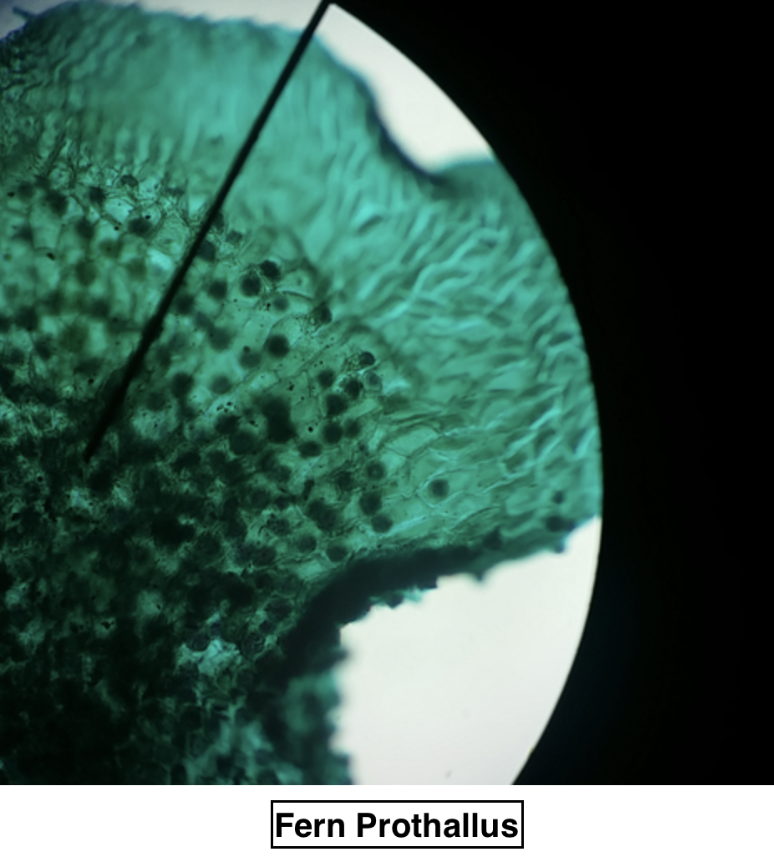
But in some cases, prothallus gives rise to the sporophytic plant body without the formation of gametes or fertilization. Such a condition is known as Apogamy i.e. no formation of gametes. Such a sporophytic plant body will be haploid as there was no involvement of fertilization.
Additional information: Let us look at the life cycle of Pteridophytes.
- The main plant body i.e. sporophyte bears sporangia in which spores are formed by meiosis from spore mother cells.
- These spores germinate to give rise to a small multicellular gametophyte known as prothallus.
- Prothallus bears sex organs known as antheridia and archegonia that produce male and female gametes respectively.
- The male gametes are released in water by which they swim through to real the female sex organ and fertilize the female gamete.
- The zygote produced as a result of this fertilization, develops into a well- differentiated sporophyte.
So, the correct option is ‘Apogamy’.
Note:
- Selaginella has a special structure known as Rhizophore.
- Pteridophytes are used for medicinal purposes such as Selaginella which is known as Sanjeevni booti.
- In Bryophytes, the main plant body is gametophytic.
Complete Answer:
Pteridophytes are the first vascular tissues possessing plants and include horsetails and ferns in them. Ferns are plants with large leaves known as macrophylla. The prothallus of such plants is small, inconspicuous as the main plant body is sporophytic. But, this prothallus is free-living and photosynthetic thus not dependent on sporophyte. Prothallus requires cool shady places to grow and water for the fertilization of gametes to produce sporophyte.
But in some cases, prothallus gives rise to the sporophytic plant body without the formation of gametes or fertilization. Such a condition is known as Apogamy i.e. no formation of gametes. Such a sporophytic plant body will be haploid as there was no involvement of fertilization.
Additional information: Let us look at the life cycle of Pteridophytes.
- The main plant body i.e. sporophyte bears sporangia in which spores are formed by meiosis from spore mother cells.
- These spores germinate to give rise to a small multicellular gametophyte known as prothallus.
- Prothallus bears sex organs known as antheridia and archegonia that produce male and female gametes respectively.
- The male gametes are released in water by which they swim through to real the female sex organ and fertilize the female gamete.
- The zygote produced as a result of this fertilization, develops into a well- differentiated sporophyte.
So, the correct option is ‘Apogamy’.
Note:
- Selaginella has a special structure known as Rhizophore.
- Pteridophytes are used for medicinal purposes such as Selaginella which is known as Sanjeevni booti.
- In Bryophytes, the main plant body is gametophytic.
Recently Updated Pages
Master Class 9 General Knowledge: Engaging Questions & Answers for Success

Master Class 9 Maths: Engaging Questions & Answers for Success
Master Class 9 Science: Engaging Questions & Answers for Success
Master Class 9 English: Engaging Questions & Answers for Success
Master Class 9 Social Science: Engaging Questions & Answers for Success
Class 9 Question and Answer - Your Ultimate Solutions Guide
Trending doubts
Which are the Top 10 Largest Countries of the World?
Draw a labelled sketch of the human eye class 12 physics CBSE
Differentiate between homogeneous and heterogeneous class 12 chemistry CBSE
Sulphuric acid is known as the king of acids State class 12 chemistry CBSE
Why is the cell called the structural and functional class 12 biology CBSE
A dentist uses a small mirror that gives a magnification class 12 physics CBSE