




If \[P\left( {{t}^{2}},2t \right)\], \[t\in [0,2]\], is an arbitrary point on the parabola \[{{y}^{2}}=4x\], Q is the foot of the perpendicular from the focus S on the tangent at P, then maximum area of $\Delta $ PQS is
(a) 1
(b) 2
(c) \[\dfrac{5}{16}\]
(d) 5
Answer
 Verified
595.5k+ views
Hint: We will first find the tangent equation and then find the foot of the perpendicular on it. So we have all the three points and they form a right angled triangle as they mentioned “perpendicular”. So we can find the height and the length of the base. Finally we will just apply the \[\dfrac{1}{2}bh\] formula and get the area. Then we will see its behavior in the interval [0, 2] and find its maximum.
Complete step-by-step answer:
First let us have a look at the diagram.
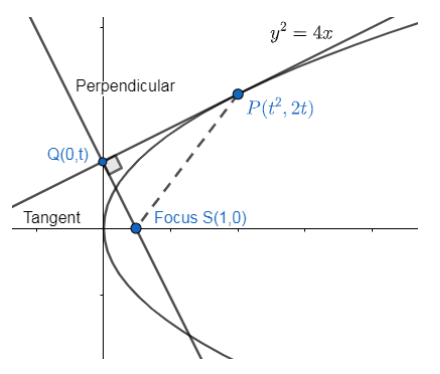
Now we know the point\[P\left( {{t}^{2}},2t \right)\]. Let us find the equation of the tangent at that point.
Let the equation of the tangent be \[y=mx+c\].
Now let us find the slope m.
Given equation of the curve is,
\[{{y}^{2}}=4x\]
\[\Rightarrow {{y}^{2}}-4x=0\]
Differentiating with respect to x on both sides we get,
\[\begin{align}
& 2y\dfrac{dy}{dx}-4=0 \\
& \Rightarrow 2y\dfrac{dy}{dx}=4 \\
& \Rightarrow \dfrac{dy}{dx}=\dfrac{4}{2y} \\
& \Rightarrow \dfrac{dy}{dx}=\dfrac{2}{y} \\
& \Rightarrow m=\dfrac{2}{y} \\
\end{align}\]
Since \[\dfrac{dy}{dx}\] is slope m.
Now let us substitute the point \[P\left( {{t}^{2}},2t \right)\] in the above equation. Therefore,
\[\begin{align}
& m=\dfrac{2}{2t} \\
& \Rightarrow m=\dfrac{1}{t} \\
\end{align}\]
Thus, the equation of the tangent becomes,
\[y=\dfrac{1}{t}x+c\]
Now to find the constant c, substitute the point \[P\left( {{t}^{2}},2t \right)\] in the equation of the tangent since the tangent passes through that point. Therefore, we get,
\[\begin{align}
& 2t=\dfrac{1}{t}{{t}^{2}}+c \\
& \Rightarrow 2t=t+c \\
& \Rightarrow t=c \\
\end{align}\]
Thus the equation of the tangent on the given parabola at the point \[P\left( {{t}^{2}},2t \right)\] is,
\[y=\dfrac{1}{t}x+t\]
\[\Rightarrow \dfrac{1}{t}x-y+t=0\]
Now let us find the foot of the perpendicular from focus S.
First, we need the co-ordinates of the focus S.
General form of the parabola is \[{{y}^{2}}=4ax\], where (a, 0) is its focus.
Comparing the given parabola with the general equation we get, \[a=1\].
Thus the co-ordinates of the focus are (1,0).
Thus, we need to find the foot of the perpendicular from S (1, 0) to the tangent. How do we do that?
First let us find the line perpendicular to the tangent and which is passing S (1, 0).
To find the perpendicular line we exchange the coefficients of the x and y terms and then let the constant be k. Thus the equation of the perpendicular is,
\[x+\dfrac{1}{t}y=k\].
Now it passes through the point (1, 0), substituting the point (1,0) in the equation we get,
\[\begin{align}
& 1+0=k \\
& \Rightarrow k=1 \\
\end{align}\]
Therefore, the equation of the perpendicular becomes,
\[x+\dfrac{1}{t}y=1\]
Solving this line equation and the tangent equation, we get the foot of the perpendicular from S (1, 0). Solving these two,
\[\begin{align}
& \dfrac{1}{t}x-y+t=0..........\times t \\
& x+\dfrac{1}{t}y-1=0..........\times 1 \\
\end{align}\]
This gives us,
\[\begin{align}
& x-ty+{{t}^{2}}=0 \\
& x+\dfrac{1}{t}y-1=0 \\
\end{align}\]
Subtracting the like terms we get,
\[\begin{align}
& \left( -t-\dfrac{1}{t} \right)y+({{t}^{2}}+1)=0 \\
& \Rightarrow ({{t}^{2}}+1)=\left( t+\dfrac{1}{t} \right)y \\
& \Rightarrow ({{t}^{2}}+1)=\left( \dfrac{{{t}^{2}}+1}{t} \right)y \\
\end{align}\]
Cancelling the like terms and cross-multiplying we get,
y = t
Now substituting y = t in the tangent equation we get the x co-ordinate.
\[\dfrac{1}{t}x-y+t=0\]
\[\begin{align}
& \Rightarrow \dfrac{1}{t}x-t+t=0 \\
& \Rightarrow \dfrac{1}{t}x=0 \\
& \Rightarrow x=0 \\
\end{align}\]
Thus, the foot of the perpendicular has co-ordinates Q (0, t).
Thus, we know the co-ordinates \[P\left( {{t}^{2}},\text{ }2t \right),\text{ }Q\left( 0,\text{ }t \right)\] and S (1, 0) and these form a right angled triangle as there is a “perpendicular” line.
The right angle is that the foot of the perpendicular that is Q.
Now let us find the distance between the points P and Q and then between the points Q and S. Now,
\[\begin{align}
& PQ=\sqrt{{{\left( {{x}_{P}}-{{x}_{Q}} \right)}^{2}}+{{\left( {{y}_{P}}-{{y}_{Q}} \right)}^{2}}} \\
& \Rightarrow PQ=\sqrt{{{\left( {{t}^{2}}-0 \right)}^{2}}+{{\left( 2t-t \right)}^{2}}} \\
& \Rightarrow PQ=\sqrt{{{t}^{4}}+{{t}^{2}}} \\
& \Rightarrow PQ=t\sqrt{{{t}^{2}}+1} \\
\end{align}\]
Similarly,
\[\begin{align}
& SQ=\sqrt{{{\left( {{x}_{S}}-{{x}_{Q}} \right)}^{2}}+{{\left( {{y}_{S}}-{{y}_{Q}} \right)}^{2}}} \\
& \Rightarrow SQ=\sqrt{{{\left( 1-0 \right)}^{2}}+{{\left( 0-t \right)}^{2}}} \\
& \Rightarrow SQ=\sqrt{1+{{t}^{2}}} \\
& \Rightarrow SQ=\sqrt{{{t}^{2}}+1} \\
\end{align}\]
Now PQ becomes the base and SQ becomes the height. Thus,
\[\begin{align}
& Area=\dfrac{1}{2}PQ\times SQ \\
& \Rightarrow Area=\dfrac{1}{2}t\sqrt{{{t}^{2}}+1}\times \sqrt{{{t}^{2}}+1} \\
& \Rightarrow Area=\dfrac{1}{2}t\left( {{t}^{2}}+1 \right) \\
& \Rightarrow Area=\dfrac{{{t}^{3}}+t}{2} \\
\end{align}\]
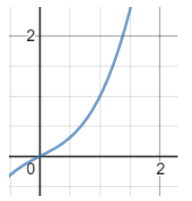
Now as t ϵ [0, 2], Area becomes maximum at t = 2 because \[{{t}^{3}}+t\] would be increasing in that interval.
Thus putting t =2 in the area equation we get,
\[\begin{align}
& Area=\dfrac{2+{{2}^{3}}}{2} \\
& \Rightarrow Area=\dfrac{2+8}{2} \\
& \Rightarrow Area=\dfrac{10}{2} \\
& \Rightarrow Area=5 \\
\end{align}\]
Thus option(d) is correct.
Note:There is a shortcut for finding the foot of the perpendicular.
Let the co-ordinates of the foot of the perpendicular be (h, k) from the point (p,q) on the line \[ax+by+c=0\]. The formula is,
\[\dfrac{h-p}{a}\text{ }=\text{ }\dfrac{k-q}{b}\text{ }=\dfrac{-\left( ap+bq+c \right)}{({{a}^{2}}+{{b}^{2}})}\]
This formula will save you a lot of time.
Complete step-by-step answer:
First let us have a look at the diagram.
Now we know the point\[P\left( {{t}^{2}},2t \right)\]. Let us find the equation of the tangent at that point.
Let the equation of the tangent be \[y=mx+c\].
Now let us find the slope m.
Given equation of the curve is,
\[{{y}^{2}}=4x\]
\[\Rightarrow {{y}^{2}}-4x=0\]
Differentiating with respect to x on both sides we get,
\[\begin{align}
& 2y\dfrac{dy}{dx}-4=0 \\
& \Rightarrow 2y\dfrac{dy}{dx}=4 \\
& \Rightarrow \dfrac{dy}{dx}=\dfrac{4}{2y} \\
& \Rightarrow \dfrac{dy}{dx}=\dfrac{2}{y} \\
& \Rightarrow m=\dfrac{2}{y} \\
\end{align}\]
Since \[\dfrac{dy}{dx}\] is slope m.
Now let us substitute the point \[P\left( {{t}^{2}},2t \right)\] in the above equation. Therefore,
\[\begin{align}
& m=\dfrac{2}{2t} \\
& \Rightarrow m=\dfrac{1}{t} \\
\end{align}\]
Thus, the equation of the tangent becomes,
\[y=\dfrac{1}{t}x+c\]
Now to find the constant c, substitute the point \[P\left( {{t}^{2}},2t \right)\] in the equation of the tangent since the tangent passes through that point. Therefore, we get,
\[\begin{align}
& 2t=\dfrac{1}{t}{{t}^{2}}+c \\
& \Rightarrow 2t=t+c \\
& \Rightarrow t=c \\
\end{align}\]
Thus the equation of the tangent on the given parabola at the point \[P\left( {{t}^{2}},2t \right)\] is,
\[y=\dfrac{1}{t}x+t\]
\[\Rightarrow \dfrac{1}{t}x-y+t=0\]
Now let us find the foot of the perpendicular from focus S.
First, we need the co-ordinates of the focus S.
General form of the parabola is \[{{y}^{2}}=4ax\], where (a, 0) is its focus.
Comparing the given parabola with the general equation we get, \[a=1\].
Thus the co-ordinates of the focus are (1,0).
Thus, we need to find the foot of the perpendicular from S (1, 0) to the tangent. How do we do that?
First let us find the line perpendicular to the tangent and which is passing S (1, 0).
To find the perpendicular line we exchange the coefficients of the x and y terms and then let the constant be k. Thus the equation of the perpendicular is,
\[x+\dfrac{1}{t}y=k\].
Now it passes through the point (1, 0), substituting the point (1,0) in the equation we get,
\[\begin{align}
& 1+0=k \\
& \Rightarrow k=1 \\
\end{align}\]
Therefore, the equation of the perpendicular becomes,
\[x+\dfrac{1}{t}y=1\]
Solving this line equation and the tangent equation, we get the foot of the perpendicular from S (1, 0). Solving these two,
\[\begin{align}
& \dfrac{1}{t}x-y+t=0..........\times t \\
& x+\dfrac{1}{t}y-1=0..........\times 1 \\
\end{align}\]
This gives us,
\[\begin{align}
& x-ty+{{t}^{2}}=0 \\
& x+\dfrac{1}{t}y-1=0 \\
\end{align}\]
Subtracting the like terms we get,
\[\begin{align}
& \left( -t-\dfrac{1}{t} \right)y+({{t}^{2}}+1)=0 \\
& \Rightarrow ({{t}^{2}}+1)=\left( t+\dfrac{1}{t} \right)y \\
& \Rightarrow ({{t}^{2}}+1)=\left( \dfrac{{{t}^{2}}+1}{t} \right)y \\
\end{align}\]
Cancelling the like terms and cross-multiplying we get,
y = t
Now substituting y = t in the tangent equation we get the x co-ordinate.
\[\dfrac{1}{t}x-y+t=0\]
\[\begin{align}
& \Rightarrow \dfrac{1}{t}x-t+t=0 \\
& \Rightarrow \dfrac{1}{t}x=0 \\
& \Rightarrow x=0 \\
\end{align}\]
Thus, the foot of the perpendicular has co-ordinates Q (0, t).
Thus, we know the co-ordinates \[P\left( {{t}^{2}},\text{ }2t \right),\text{ }Q\left( 0,\text{ }t \right)\] and S (1, 0) and these form a right angled triangle as there is a “perpendicular” line.
The right angle is that the foot of the perpendicular that is Q.
Now let us find the distance between the points P and Q and then between the points Q and S. Now,
\[\begin{align}
& PQ=\sqrt{{{\left( {{x}_{P}}-{{x}_{Q}} \right)}^{2}}+{{\left( {{y}_{P}}-{{y}_{Q}} \right)}^{2}}} \\
& \Rightarrow PQ=\sqrt{{{\left( {{t}^{2}}-0 \right)}^{2}}+{{\left( 2t-t \right)}^{2}}} \\
& \Rightarrow PQ=\sqrt{{{t}^{4}}+{{t}^{2}}} \\
& \Rightarrow PQ=t\sqrt{{{t}^{2}}+1} \\
\end{align}\]
Similarly,
\[\begin{align}
& SQ=\sqrt{{{\left( {{x}_{S}}-{{x}_{Q}} \right)}^{2}}+{{\left( {{y}_{S}}-{{y}_{Q}} \right)}^{2}}} \\
& \Rightarrow SQ=\sqrt{{{\left( 1-0 \right)}^{2}}+{{\left( 0-t \right)}^{2}}} \\
& \Rightarrow SQ=\sqrt{1+{{t}^{2}}} \\
& \Rightarrow SQ=\sqrt{{{t}^{2}}+1} \\
\end{align}\]
Now PQ becomes the base and SQ becomes the height. Thus,
\[\begin{align}
& Area=\dfrac{1}{2}PQ\times SQ \\
& \Rightarrow Area=\dfrac{1}{2}t\sqrt{{{t}^{2}}+1}\times \sqrt{{{t}^{2}}+1} \\
& \Rightarrow Area=\dfrac{1}{2}t\left( {{t}^{2}}+1 \right) \\
& \Rightarrow Area=\dfrac{{{t}^{3}}+t}{2} \\
\end{align}\]
Now as t ϵ [0, 2], Area becomes maximum at t = 2 because \[{{t}^{3}}+t\] would be increasing in that interval.
Thus putting t =2 in the area equation we get,
\[\begin{align}
& Area=\dfrac{2+{{2}^{3}}}{2} \\
& \Rightarrow Area=\dfrac{2+8}{2} \\
& \Rightarrow Area=\dfrac{10}{2} \\
& \Rightarrow Area=5 \\
\end{align}\]
Thus option(d) is correct.
Note:There is a shortcut for finding the foot of the perpendicular.
Let the co-ordinates of the foot of the perpendicular be (h, k) from the point (p,q) on the line \[ax+by+c=0\]. The formula is,
\[\dfrac{h-p}{a}\text{ }=\text{ }\dfrac{k-q}{b}\text{ }=\dfrac{-\left( ap+bq+c \right)}{({{a}^{2}}+{{b}^{2}})}\]
This formula will save you a lot of time.
Recently Updated Pages
Master Class 12 Economics: Engaging Questions & Answers for Success

Master Class 12 Physics: Engaging Questions & Answers for Success
Master Class 12 English: Engaging Questions & Answers for Success
Master Class 12 Social Science: Engaging Questions & Answers for Success
Master Class 12 Maths: Engaging Questions & Answers for Success
Master Class 12 Business Studies: Engaging Questions & Answers for Success
Trending doubts
Which are the Top 10 Largest Countries of the World?
What are the major means of transport Explain each class 12 social science CBSE
Draw a labelled sketch of the human eye class 12 physics CBSE
Why cannot DNA pass through cell membranes class 12 biology CBSE
Differentiate between insitu conservation and exsitu class 12 biology CBSE
Draw a neat and well labeled diagram of TS of ovary class 12 biology CBSE