




If normal at \[P(18,12)\]to the parabola \[{y^2} = 8x\] cuts it again at Q , Show that \[9PQ = 8\sqrt {109} \].
Answer
 Verified
665.7k+ views
Hint: Here, we find the value of \[a\] by comparing the general equation of a parabola \[{y^2} = 4ax\] with the given equation of a parabola. Further, we use this value of \[a\] to find the coordinates of points on the parabola and then using the formula for length of a line joining two points \[(x,y)\] and \[(a,b)\] \[L = \sqrt {{{(x - a)}^2} + {{(y - b)}^2}} \] we find the distance between two points.
Complete step by step solution:
Given a parabola\[{y^2} = 8x\] , firstly find the points of the parabola
When \[x = 0\] , \[{y^2} = 8 \times 0 = 0\] , so, \[y = 0\]
When \[x = 2\] , \[{y^2} = 8 \times 2 = 16\] , so, \[y = \sqrt {16} = \pm 4\]
When \[x = 8\] , \[{y^2} = 8 \times 8 = 64\] , so, \[y = \sqrt {64} = \pm 8\]
Therefore some coordinates of the parabola \[{y^2} = 8x\] are \[(0,0),(2, - 4),(2,4),(8, - 8),(8,8)\]
Now we plot the graph of the parabola \[{y^2} = 8x\]
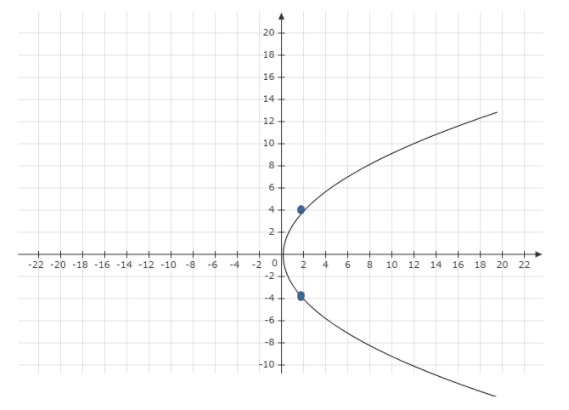
We can clearly see the parabola \[{y^2} = 8x\] lies in Quadrant \[1\] and quadrant \[4\].
On comparing the parabola \[{y^2} = 8x\] to \[{y^2} = 4ax\] (standard form of parabola), we get
\[8x = 4ax\]
i.e. \[a = \dfrac{{8x}}{{4x}} = 2\] \[...(i)\]
As we know any coordinates of normal on the parabola can be written as \[(a{t^2},2at)\] where \[t\] is a point on the normal.
Therefore substituting the value of \[a = 2\] from equation \[(i)\]
Coordinates can be written as \[(2{t^2},4t)\] \[...(ii)\]
Now we know point \[P(18,12)\] lies on the curve, therefore it must satisfy equation \[(ii)\]
i.e. \[2{t^2} = 18\] and \[4t = 12\]
i.e. \[{t^2} = \dfrac{{18}}{2}\] and \[t = \dfrac{{12}}{4}\]
i.e. \[{t^2} = 9\] and \[t = 3\]
i.e. \[t = \sqrt 9 \] and \[t = 3\]
i.e. \[t = \pm 3\] and \[t = 3\]
Therefore \[t = 3\] \[...(iii)\]
Now for any other point \[Q\] lying on the graph, the normal at \[P\]cuts it again at point \[Q\]say at point \[{t_1}\] then, \[{t_1} = (t + \dfrac{a}{t}) = (t + \dfrac{2}{t}) = (3 + \dfrac{2}{3}) = (\dfrac{{9 + 2}}{3}) = \dfrac{{11}}{3}\]
Again by equation \[(ii)\] coordinates of \[Q\] are \[\left( {2{{\left( {\dfrac{{11}}{3}} \right)}^2},4\left( {\dfrac{{11}}{3}} \right)} \right)\]
\[ = \left( {2 \times \dfrac{{121}}{9},4 \times \dfrac{{11}}{3}} \right)\]
\[ = \left( {\dfrac{{242}}{9},\dfrac{{44}}{3}} \right)\]
Since, formula for length of a line joining two points \[({x_1},{y_1})\] and \[({x_2},{y_2})\] \[ = \sqrt {{{({x_2} - {x_1})}^2} + {{({y_2} - {y_1})}^2}} \]
Thus, length \[PQ\] of the line joining the points \[P(18,12)\] and \[Q\left( {\dfrac{{242}}{9},\dfrac{{44}}{3}} \right)\]\[ = \sqrt {{{\left( {18 - \dfrac{{242}}{9}} \right)}^2} - {{\left( {12 - \dfrac{{44}}{3}} \right)}^2}} \]
\[ = \sqrt {{{\left( {\dfrac{{18 \times 9 - 242}}{9}} \right)}^2} + {{\left( {\dfrac{{12 \times 3 - 44}}{3}} \right)}^2}} \]
\[ = \sqrt {{{\left( {\dfrac{{ - 80}}{9}} \right)}^2} + {{\left( {\dfrac{{ - 8}}{3}} \right)}^2}} \]
\[ = \sqrt {\left( {\dfrac{{6400}}{{81}}} \right) + \left( {\dfrac{{64}}{9}} \right)} \]
\[ = \sqrt {\dfrac{{6400 + 64 \times 9}}{{81}}} \]
\[ = \sqrt {\dfrac{{6400 + 576}}{{81}}} \]
\[ = \sqrt {\dfrac{{6976}}{{81}}} \]
\[ = \sqrt {\dfrac{{64 \times 109}}{{81}}} \]
\[ = \sqrt {\dfrac{{{{(8)}^2} \times 109}}{{{{(9)}^2}}}} \]
\[ = \dfrac{8}{9}\sqrt {109} \]
Thus, \[PQ = \dfrac{8}{9}\sqrt {109} \]
i.e. \[9PQ = 8\sqrt {109} \]
Note:
In these types of problems, plotting the graph of parabola gives us an idea about the sign of the points. It is very common for students to get confused between a tangent and a normal. A tangent is a straight line that touches the parabola at one point but doesn’t cut the parabola, whereas a Normal is a straight line which is perpendicular to the tangent of the parabola.
Complete step by step solution:
Given a parabola\[{y^2} = 8x\] , firstly find the points of the parabola
When \[x = 0\] , \[{y^2} = 8 \times 0 = 0\] , so, \[y = 0\]
When \[x = 2\] , \[{y^2} = 8 \times 2 = 16\] , so, \[y = \sqrt {16} = \pm 4\]
When \[x = 8\] , \[{y^2} = 8 \times 8 = 64\] , so, \[y = \sqrt {64} = \pm 8\]
Therefore some coordinates of the parabola \[{y^2} = 8x\] are \[(0,0),(2, - 4),(2,4),(8, - 8),(8,8)\]
Now we plot the graph of the parabola \[{y^2} = 8x\]
We can clearly see the parabola \[{y^2} = 8x\] lies in Quadrant \[1\] and quadrant \[4\].
On comparing the parabola \[{y^2} = 8x\] to \[{y^2} = 4ax\] (standard form of parabola), we get
\[8x = 4ax\]
i.e. \[a = \dfrac{{8x}}{{4x}} = 2\] \[...(i)\]
As we know any coordinates of normal on the parabola can be written as \[(a{t^2},2at)\] where \[t\] is a point on the normal.
Therefore substituting the value of \[a = 2\] from equation \[(i)\]
Coordinates can be written as \[(2{t^2},4t)\] \[...(ii)\]
Now we know point \[P(18,12)\] lies on the curve, therefore it must satisfy equation \[(ii)\]
i.e. \[2{t^2} = 18\] and \[4t = 12\]
i.e. \[{t^2} = \dfrac{{18}}{2}\] and \[t = \dfrac{{12}}{4}\]
i.e. \[{t^2} = 9\] and \[t = 3\]
i.e. \[t = \sqrt 9 \] and \[t = 3\]
i.e. \[t = \pm 3\] and \[t = 3\]
Therefore \[t = 3\] \[...(iii)\]
Now for any other point \[Q\] lying on the graph, the normal at \[P\]cuts it again at point \[Q\]say at point \[{t_1}\] then, \[{t_1} = (t + \dfrac{a}{t}) = (t + \dfrac{2}{t}) = (3 + \dfrac{2}{3}) = (\dfrac{{9 + 2}}{3}) = \dfrac{{11}}{3}\]
Again by equation \[(ii)\] coordinates of \[Q\] are \[\left( {2{{\left( {\dfrac{{11}}{3}} \right)}^2},4\left( {\dfrac{{11}}{3}} \right)} \right)\]
\[ = \left( {2 \times \dfrac{{121}}{9},4 \times \dfrac{{11}}{3}} \right)\]
\[ = \left( {\dfrac{{242}}{9},\dfrac{{44}}{3}} \right)\]
Since, formula for length of a line joining two points \[({x_1},{y_1})\] and \[({x_2},{y_2})\] \[ = \sqrt {{{({x_2} - {x_1})}^2} + {{({y_2} - {y_1})}^2}} \]
Thus, length \[PQ\] of the line joining the points \[P(18,12)\] and \[Q\left( {\dfrac{{242}}{9},\dfrac{{44}}{3}} \right)\]\[ = \sqrt {{{\left( {18 - \dfrac{{242}}{9}} \right)}^2} - {{\left( {12 - \dfrac{{44}}{3}} \right)}^2}} \]
\[ = \sqrt {{{\left( {\dfrac{{18 \times 9 - 242}}{9}} \right)}^2} + {{\left( {\dfrac{{12 \times 3 - 44}}{3}} \right)}^2}} \]
\[ = \sqrt {{{\left( {\dfrac{{ - 80}}{9}} \right)}^2} + {{\left( {\dfrac{{ - 8}}{3}} \right)}^2}} \]
\[ = \sqrt {\left( {\dfrac{{6400}}{{81}}} \right) + \left( {\dfrac{{64}}{9}} \right)} \]
\[ = \sqrt {\dfrac{{6400 + 64 \times 9}}{{81}}} \]
\[ = \sqrt {\dfrac{{6400 + 576}}{{81}}} \]
\[ = \sqrt {\dfrac{{6976}}{{81}}} \]
\[ = \sqrt {\dfrac{{64 \times 109}}{{81}}} \]
\[ = \sqrt {\dfrac{{{{(8)}^2} \times 109}}{{{{(9)}^2}}}} \]
\[ = \dfrac{8}{9}\sqrt {109} \]
Thus, \[PQ = \dfrac{8}{9}\sqrt {109} \]
i.e. \[9PQ = 8\sqrt {109} \]
Note:
In these types of problems, plotting the graph of parabola gives us an idea about the sign of the points. It is very common for students to get confused between a tangent and a normal. A tangent is a straight line that touches the parabola at one point but doesn’t cut the parabola, whereas a Normal is a straight line which is perpendicular to the tangent of the parabola.
Recently Updated Pages
If x a + bt + ct2 where x is in meters and t is in class 11 physics CBSE

A car covers the first half distance between two places class 11 physics CBSE
The resultant of two vectors overrightarrow P and overrightarrow class 11 physics CBSE
Find the value of cos 135 class 11 maths CBSE
A mass M is held in place by an applied force F and class 11 physics CBSE
A solution of glucose in water is labelled as 10 dfracwv class 11 chemistry CBSE
Trending doubts
Find the value of the expression given below sin 30circ class 11 maths CBSE
One Metric ton is equal to kg A 10000 B 1000 C 100 class 11 physics CBSE
Draw a diagram of nephron and explain its structur class 11 biology CBSE
10 examples of friction in our daily life
Proton was discovered by A Thomson B Rutherford C Chadwick class 11 chemistry CBSE
Bond order ofO2 O2+ O2 and O22 is in order A O2 langle class 11 chemistry CBSE