




If lines $\dfrac{x-1}{2}=\dfrac{y+1}{3}=\dfrac{z-1}{4}$ and $\dfrac{x-3}{1}=\dfrac{y-k}{2}=\dfrac{z}{1}$ intersect, then find the value of k and hence find the equation of the plane containing these lines.
Answer
 Verified
575.7k+ views
Hint: We here have been given two lines and have been told that these lines intersect and have been asked to find the value of k. For this, we will first keep both of these lines equal to any constants like $\lambda $ and $\mu $. Using these constants, we will find the general point on both these lines and since these lines are intersecting, the general points will be equal at that point. We will hence keep the other two points, which do not contain k equal and obtain the value of $\lambda $ and $\mu $. Then we will keep these values in the equation containing k and hence obtain the value of k. Further, we’ve been asked to find the equation of the plane containing these two lines. For that, we will use the method shown as follows:
The equation of a plane containing the point (f,g,h) which contains two vectors given as ${{x}_{1}}\hat{i}+{{y}_{1}}\hat{j}+{{z}_{1}}\hat{k}$ and ${{x}_{2}}\hat{i}+{{y}_{2}}\hat{j}+{{z}_{2}}\hat{k}$ is given as:
$\left| \begin{matrix}
x-f & y-g & z-h \\
{{x}_{1}} & {{y}_{1}} & {{z}_{1}} \\
{{x}_{2}} & {{y}_{2}} & {{z}_{2}} \\
\end{matrix} \right|=0$
We will keep the required values in this formula from the lines given to us in the question and then we will open this determinant. Hence, we will obtain the r=equation of the required plane.
Complete step-by-step solution:
Here, we have been given equations of two lines. Let us assume the first line to be ${{L}_{1}}$ and second to be ${{L}_{2}}$. Thus, we can say that:
$\begin{align}
& {{L}_{1}}\equiv \dfrac{x-1}{2}=\dfrac{y+1}{3}=\dfrac{z-1}{4} \\
& {{L}_{2}}\equiv \dfrac{x-3}{1}=\dfrac{y-k}{2}=\dfrac{z}{1} \\
\end{align}$
Now, if we keep ${{L}_{1}}$ equal to a constant $\lambda $ and ${{L}_{2}}$ to a constant $\mu $, we will get:
$\begin{align}
& {{L}_{1}}\equiv \dfrac{x-1}{2}=\dfrac{y+1}{3}=\dfrac{z-1}{4}=\lambda \\
& {{L}_{2}}\equiv \dfrac{x-3}{1}=\dfrac{y-k}{2}=\dfrac{z}{1}=\mu \\
\end{align}$
Thus, any general point on ${{L}_{1}}$ may be calculated as:
$\begin{align}
& {{L}_{1}}\equiv \dfrac{x-1}{2}=\dfrac{y+1}{3}=\dfrac{z-1}{4}=\lambda \\
& \dfrac{x-1}{2}=\lambda \\
& \Rightarrow x=2\lambda +1 \\
& \dfrac{y+1}{3}=\lambda \\
& \Rightarrow y=3\lambda -1 \\
& \dfrac{z-1}{4}=\lambda \\
& \Rightarrow z=4\lambda +1 \\
\end{align}$
Thus, the general point on line ${{L}_{1}}$ is given as $\left( 2\lambda +1,3\lambda -1,4\lambda +1 \right)$.
Now, the general point on ${{L}_{2}}$ is calculated as:
$\begin{align}
& {{L}_{2}}\equiv \dfrac{x-3}{1}=\dfrac{y-k}{2}=\dfrac{z}{1}=\mu \\
& \dfrac{x-3}{1}=\mu \\
& \Rightarrow x=\mu +3 \\
& \dfrac{y-k}{2}=\mu \\
& \Rightarrow y=2\mu +k \\
& \dfrac{z}{1}=\mu \\
& \Rightarrow z=\mu \\
\end{align}$
Thus, the general point on line ${{L}_{2}}$ is given as $\left( \mu +3,2\mu +k,\mu \right)$.
Now, we have been given that these lines intersect. Thus, if these lines intersect, they should have a common point.
The rough figure would look like
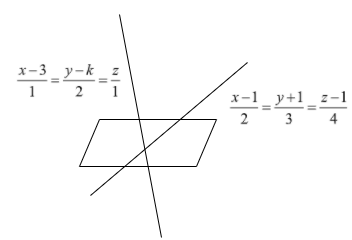
Hence, at the point of intersection of these lines, the value of x, y, and z is the same for both these lines.
Thus, we can say that:
$2\lambda +1=\mu +3$ …..(i)
$3\lambda -1=2\mu +k$ …..(ii)
$4\lambda +1=\mu $ …..(iii)
Now, if we consider equations (i) and (iii), we can see that these are two linear equations in two variables- $\lambda $ and $\mu $. Thus, if we solve these equations simultaneously, we will be able to obtain the values of these variables.
Hence, we get:
$\begin{align}
& 2\lambda +1=\mu +3 \\
& \underline{-\left( 4\lambda +1=\mu \right)} \\
& -2\lambda =3 \\
& \Rightarrow \lambda =-\dfrac{3}{2} \\
\end{align}$
Now, putting the value of $\lambda $ in equation (iii), we get:
$\begin{align}
& 4\lambda +1=\mu \\
& \Rightarrow 4\left( -\dfrac{3}{2} \right)+1=\mu \\
& \Rightarrow -6+1=\mu \\
& \Rightarrow \mu =-5 \\
\end{align}$
Now, if we put the value of $\lambda $ and $\mu $ in equation (ii), we will get the value of k.
Thus, putting these values in equation (ii), we have:
$\begin{align}
& 3\lambda -1=2\mu +k \\
& \Rightarrow 3\left( -\dfrac{3}{2} \right)-1=2\left( -5 \right)+k \\
& \Rightarrow -\dfrac{9}{2}-1=-10+k \\
& \Rightarrow \dfrac{-9-2}{2}=-10+k \\
& \Rightarrow k=10-\dfrac{11}{2} \\
& \Rightarrow k=\dfrac{20-11}{2} \\
& \therefore k=\dfrac{9}{2} \\
\end{align}$
Thus, the required value of k is $\dfrac{9}{2}$.
Now, we have to find the equation of the plane containing these lines.
We know that equation of a plane containing the point (f,g,h) which contains two vectors given as ${{x}_{1}}\hat{i}+{{y}_{1}}\hat{j}+{{z}_{1}}\hat{k}$ and ${{x}_{2}}\hat{i}+{{y}_{2}}\hat{j}+{{z}_{2}}\hat{k}$ is given as:
$\left| \begin{matrix}
x-f & y-g & z-h \\
{{x}_{1}} & {{y}_{1}} & {{z}_{1}} \\
{{x}_{2}} & {{y}_{2}} & {{z}_{2}} \\
\end{matrix} \right|=0$
Here, if we consider the line ${{L}_{1}}$, we can see that (f,g,h)=(1,-1,1).
Now, if we consider both the given lines, we can see the parallel vectors of the line and since these are parallel vectors to the given line, these will also lie in the plane containing these lines.
Thus, we can get $\left( {{x}_{1}},{{y}_{1}},{{z}_{1}} \right)$ as (2,3,4) and $\left( {{x}_{2}},{{y}_{2}},{{z}_{2}} \right)$ as (1,2,1).
Hence, we can get the equation of the required plane as:
$\begin{align}
& \left| \begin{matrix}
x-1 & y-\left( -1 \right) & z-1 \\
2 & 3 & 4 \\
1 & 2 & 1 \\
\end{matrix} \right|=0 \\
& \Rightarrow \left| \begin{matrix}
x-1 & y+1 & z-1 \\
2 & 3 & 4 \\
1 & 2 & 1 \\
\end{matrix} \right|=0 \\
\end{align}$
Now, opening the determinant we get:
$\begin{align}
& \left| \begin{matrix}
x-1 & y+1 & z-1 \\
2 & 3 & 4 \\
1 & 2 & 1 \\
\end{matrix} \right|=0 \\
& \Rightarrow \left( x-1 \right)\left( 3-8 \right)-\left( y+1 \right)\left( 2-4 \right)+\left( z-1 \right)\left( 4-3 \right)=0 \\
& \Rightarrow -5\left( x-1 \right)+2\left( y+1 \right)+\left( z-1 \right)=0 \\
& \Rightarrow -5x+5+2y+2+z-1=0 \\
& \therefore 5x-2y-z=6 \\
\end{align}$
Hence, the equation of the required plane is $5x-2y-z=6$
Note: We here could have calculated the equation by calculating the cross product of the parallel vectors too as it will give us the value of the normal vector to the plane. If we assume the normal vector, i.e. the cross product of the parallel vectors to be $\vec{n}$ then the equation of the plane is given as:
$\vec{r}.\vec{n}=\vec{n}.\vec{q}$
Where $\vec{q}$ is the position vector of any point lying in the plane and $\vec{r}$ is the position vector of any general point on the plane.
The equation of a plane containing the point (f,g,h) which contains two vectors given as ${{x}_{1}}\hat{i}+{{y}_{1}}\hat{j}+{{z}_{1}}\hat{k}$ and ${{x}_{2}}\hat{i}+{{y}_{2}}\hat{j}+{{z}_{2}}\hat{k}$ is given as:
$\left| \begin{matrix}
x-f & y-g & z-h \\
{{x}_{1}} & {{y}_{1}} & {{z}_{1}} \\
{{x}_{2}} & {{y}_{2}} & {{z}_{2}} \\
\end{matrix} \right|=0$
We will keep the required values in this formula from the lines given to us in the question and then we will open this determinant. Hence, we will obtain the r=equation of the required plane.
Complete step-by-step solution:
Here, we have been given equations of two lines. Let us assume the first line to be ${{L}_{1}}$ and second to be ${{L}_{2}}$. Thus, we can say that:
$\begin{align}
& {{L}_{1}}\equiv \dfrac{x-1}{2}=\dfrac{y+1}{3}=\dfrac{z-1}{4} \\
& {{L}_{2}}\equiv \dfrac{x-3}{1}=\dfrac{y-k}{2}=\dfrac{z}{1} \\
\end{align}$
Now, if we keep ${{L}_{1}}$ equal to a constant $\lambda $ and ${{L}_{2}}$ to a constant $\mu $, we will get:
$\begin{align}
& {{L}_{1}}\equiv \dfrac{x-1}{2}=\dfrac{y+1}{3}=\dfrac{z-1}{4}=\lambda \\
& {{L}_{2}}\equiv \dfrac{x-3}{1}=\dfrac{y-k}{2}=\dfrac{z}{1}=\mu \\
\end{align}$
Thus, any general point on ${{L}_{1}}$ may be calculated as:
$\begin{align}
& {{L}_{1}}\equiv \dfrac{x-1}{2}=\dfrac{y+1}{3}=\dfrac{z-1}{4}=\lambda \\
& \dfrac{x-1}{2}=\lambda \\
& \Rightarrow x=2\lambda +1 \\
& \dfrac{y+1}{3}=\lambda \\
& \Rightarrow y=3\lambda -1 \\
& \dfrac{z-1}{4}=\lambda \\
& \Rightarrow z=4\lambda +1 \\
\end{align}$
Thus, the general point on line ${{L}_{1}}$ is given as $\left( 2\lambda +1,3\lambda -1,4\lambda +1 \right)$.
Now, the general point on ${{L}_{2}}$ is calculated as:
$\begin{align}
& {{L}_{2}}\equiv \dfrac{x-3}{1}=\dfrac{y-k}{2}=\dfrac{z}{1}=\mu \\
& \dfrac{x-3}{1}=\mu \\
& \Rightarrow x=\mu +3 \\
& \dfrac{y-k}{2}=\mu \\
& \Rightarrow y=2\mu +k \\
& \dfrac{z}{1}=\mu \\
& \Rightarrow z=\mu \\
\end{align}$
Thus, the general point on line ${{L}_{2}}$ is given as $\left( \mu +3,2\mu +k,\mu \right)$.
Now, we have been given that these lines intersect. Thus, if these lines intersect, they should have a common point.
The rough figure would look like
Hence, at the point of intersection of these lines, the value of x, y, and z is the same for both these lines.
Thus, we can say that:
$2\lambda +1=\mu +3$ …..(i)
$3\lambda -1=2\mu +k$ …..(ii)
$4\lambda +1=\mu $ …..(iii)
Now, if we consider equations (i) and (iii), we can see that these are two linear equations in two variables- $\lambda $ and $\mu $. Thus, if we solve these equations simultaneously, we will be able to obtain the values of these variables.
Hence, we get:
$\begin{align}
& 2\lambda +1=\mu +3 \\
& \underline{-\left( 4\lambda +1=\mu \right)} \\
& -2\lambda =3 \\
& \Rightarrow \lambda =-\dfrac{3}{2} \\
\end{align}$
Now, putting the value of $\lambda $ in equation (iii), we get:
$\begin{align}
& 4\lambda +1=\mu \\
& \Rightarrow 4\left( -\dfrac{3}{2} \right)+1=\mu \\
& \Rightarrow -6+1=\mu \\
& \Rightarrow \mu =-5 \\
\end{align}$
Now, if we put the value of $\lambda $ and $\mu $ in equation (ii), we will get the value of k.
Thus, putting these values in equation (ii), we have:
$\begin{align}
& 3\lambda -1=2\mu +k \\
& \Rightarrow 3\left( -\dfrac{3}{2} \right)-1=2\left( -5 \right)+k \\
& \Rightarrow -\dfrac{9}{2}-1=-10+k \\
& \Rightarrow \dfrac{-9-2}{2}=-10+k \\
& \Rightarrow k=10-\dfrac{11}{2} \\
& \Rightarrow k=\dfrac{20-11}{2} \\
& \therefore k=\dfrac{9}{2} \\
\end{align}$
Thus, the required value of k is $\dfrac{9}{2}$.
Now, we have to find the equation of the plane containing these lines.
We know that equation of a plane containing the point (f,g,h) which contains two vectors given as ${{x}_{1}}\hat{i}+{{y}_{1}}\hat{j}+{{z}_{1}}\hat{k}$ and ${{x}_{2}}\hat{i}+{{y}_{2}}\hat{j}+{{z}_{2}}\hat{k}$ is given as:
$\left| \begin{matrix}
x-f & y-g & z-h \\
{{x}_{1}} & {{y}_{1}} & {{z}_{1}} \\
{{x}_{2}} & {{y}_{2}} & {{z}_{2}} \\
\end{matrix} \right|=0$
Here, if we consider the line ${{L}_{1}}$, we can see that (f,g,h)=(1,-1,1).
Now, if we consider both the given lines, we can see the parallel vectors of the line and since these are parallel vectors to the given line, these will also lie in the plane containing these lines.
Thus, we can get $\left( {{x}_{1}},{{y}_{1}},{{z}_{1}} \right)$ as (2,3,4) and $\left( {{x}_{2}},{{y}_{2}},{{z}_{2}} \right)$ as (1,2,1).
Hence, we can get the equation of the required plane as:
$\begin{align}
& \left| \begin{matrix}
x-1 & y-\left( -1 \right) & z-1 \\
2 & 3 & 4 \\
1 & 2 & 1 \\
\end{matrix} \right|=0 \\
& \Rightarrow \left| \begin{matrix}
x-1 & y+1 & z-1 \\
2 & 3 & 4 \\
1 & 2 & 1 \\
\end{matrix} \right|=0 \\
\end{align}$
Now, opening the determinant we get:
$\begin{align}
& \left| \begin{matrix}
x-1 & y+1 & z-1 \\
2 & 3 & 4 \\
1 & 2 & 1 \\
\end{matrix} \right|=0 \\
& \Rightarrow \left( x-1 \right)\left( 3-8 \right)-\left( y+1 \right)\left( 2-4 \right)+\left( z-1 \right)\left( 4-3 \right)=0 \\
& \Rightarrow -5\left( x-1 \right)+2\left( y+1 \right)+\left( z-1 \right)=0 \\
& \Rightarrow -5x+5+2y+2+z-1=0 \\
& \therefore 5x-2y-z=6 \\
\end{align}$
Hence, the equation of the required plane is $5x-2y-z=6$
Note: We here could have calculated the equation by calculating the cross product of the parallel vectors too as it will give us the value of the normal vector to the plane. If we assume the normal vector, i.e. the cross product of the parallel vectors to be $\vec{n}$ then the equation of the plane is given as:
$\vec{r}.\vec{n}=\vec{n}.\vec{q}$
Where $\vec{q}$ is the position vector of any point lying in the plane and $\vec{r}$ is the position vector of any general point on the plane.
Recently Updated Pages
Master Class 12 Economics: Engaging Questions & Answers for Success

Master Class 12 Physics: Engaging Questions & Answers for Success
Master Class 12 English: Engaging Questions & Answers for Success
Master Class 12 Social Science: Engaging Questions & Answers for Success
Master Class 12 Maths: Engaging Questions & Answers for Success
Master Class 12 Business Studies: Engaging Questions & Answers for Success
Trending doubts
Which are the Top 10 Largest Countries of the World?
What are the major means of transport Explain each class 12 social science CBSE
Draw a labelled sketch of the human eye class 12 physics CBSE
Why cannot DNA pass through cell membranes class 12 biology CBSE
Differentiate between insitu conservation and exsitu class 12 biology CBSE
Draw a neat and well labeled diagram of TS of ovary class 12 biology CBSE