




If light of wavelength $412.5nm$ is incident on each of the metals given below, which ones will show photoelectric emission and why?
Answer
 Verified
676.5k+ views
Hint :Photoelectric effect is the emission of electrons when a electromagnetic radiation of a certain minimum frequency falls on the surface of a metal. A certain minimum frequency is required for rejecting the electron. For photoelectric emission $h\nu = W + K.E$.
Complete answer:
When light of a certain minimum frequency hits the metal surface the electrons will be just ejected. This minimum frequency required is called threshold frequency ${\nu _0}$. .The value $h{\nu _0}$ is called the work function. This work function varies according to each metal surface. The light falling on the metal surface therefore should be greater than the threshold frequency.
If a electromagnetic radiation of frequency $\nu $ which is greater than the threshold frequency falls on the metal surface the additional energy will be given to the electron as kinetic energy. This can be written in equation form as $h\nu = h{\nu _0} + KE$. Here KE represents the kinetic energy.
Here given that light falling gas a wavelength of $412.5nm$ .Therefore using equation $\nu = \dfrac{c}{\lambda }$ we get the frequency of the incident light is
$ = \dfrac{{3 \times {{10}^8}}}{{412.5 \times {{10}^ - }9}}$
$ = 7.27 \times {10^{14}}$
Calculating its energy and converting it into electron volts ($1J = 6.242 \times {10^{18}}eV)$
$E = h\nu = 6.626 \times {10^{ - 34}} \times {\text{ }}7.27 \times {10^{14}} \times 6.6242 \times {10^{18}}$
$ = 3eV$
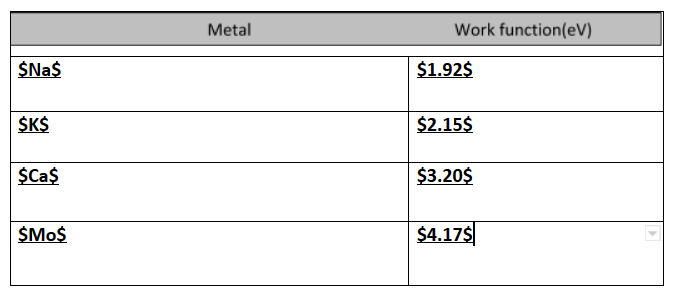
Therefore all the metals having a work function less than 3eV will be ejected.$Na$ and $K$ which has a work function of $1.92$ and $2.15$ will eject electrons.
Note When the wavelength of the incident light is given its energy in electron volts is directly given by the equation (by substituting all other constant values)$E = \dfrac{{1240}}{{\lambda (in\;nm)}}eV$
Substituting the wavelength here we get the energy in electron volt is equal to $3eV$.
Memorising this equation will help to solve the question faster.
Complete answer:
When light of a certain minimum frequency hits the metal surface the electrons will be just ejected. This minimum frequency required is called threshold frequency ${\nu _0}$. .The value $h{\nu _0}$ is called the work function. This work function varies according to each metal surface. The light falling on the metal surface therefore should be greater than the threshold frequency.
If a electromagnetic radiation of frequency $\nu $ which is greater than the threshold frequency falls on the metal surface the additional energy will be given to the electron as kinetic energy. This can be written in equation form as $h\nu = h{\nu _0} + KE$. Here KE represents the kinetic energy.
Here given that light falling gas a wavelength of $412.5nm$ .Therefore using equation $\nu = \dfrac{c}{\lambda }$ we get the frequency of the incident light is
$ = \dfrac{{3 \times {{10}^8}}}{{412.5 \times {{10}^ - }9}}$
$ = 7.27 \times {10^{14}}$
Calculating its energy and converting it into electron volts ($1J = 6.242 \times {10^{18}}eV)$
$E = h\nu = 6.626 \times {10^{ - 34}} \times {\text{ }}7.27 \times {10^{14}} \times 6.6242 \times {10^{18}}$
$ = 3eV$
Therefore all the metals having a work function less than 3eV will be ejected.$Na$ and $K$ which has a work function of $1.92$ and $2.15$ will eject electrons.
Note When the wavelength of the incident light is given its energy in electron volts is directly given by the equation (by substituting all other constant values)$E = \dfrac{{1240}}{{\lambda (in\;nm)}}eV$
Substituting the wavelength here we get the energy in electron volt is equal to $3eV$.
Memorising this equation will help to solve the question faster.
Recently Updated Pages
Explain the structure of megasporangium class 12 biology CBSE

Why is chloroform kept in dark coloured bottles class 12 chemistry CBSE
Derive the balancing condition of a Wheatstone bri class 12 physics CBSE
Draw VI characteristics of a pn junction diode Explain class 12 physics CBSE
Is it possible to carry pride in ones language too class 12 english CBSE
In a population at Hardy Weinberg equilibrium the allele class 12 biology CBSE
Trending doubts
Draw a labelled sketch of the human eye class 12 physics CBSE
Which are the Top 10 Largest Countries of the World?
Draw ray diagrams each showing i myopic eye and ii class 12 physics CBSE
One megawatt is equal to how many units of electri class 12 physics CBSE
Which is the correct genotypic ratio of mendel dihybrid class 12 biology CBSE
Give 10 examples of unisexual and bisexual flowers