




If in triangle ABC, \[a=\left( 1+\sqrt{3} \right)cm\], $b=2\text{ }cm$ and $\angle C={{60}^{{}^\circ }}$, find the other two angles and third side.
Answer
 Verified
626.4k+ views
Hint:We will use law of cosines to find the third side of the $\Delta ABC$, that is ${{c}^{2}}={{a}^{2}}+{{b}^{2}}-2ab\cos \left( c \right)$ and then we will use sine formula to find the other two angles of the triangle $\dfrac{a}{\sin a}=\dfrac{b}{\sin b}=\dfrac{c}{\sin c}$.
Complete step-by-step answer:
It is given in the question that ABC is a triangle with sides \[a=\left( 1+\sqrt{3} \right)cm\], $b=2\text{ }cm$ and $\angle C={{60}^{{}^\circ }}$ then we have to find the other two angles and third side of the triangle.
The law of cosines say that is ABC is a triangle as follows
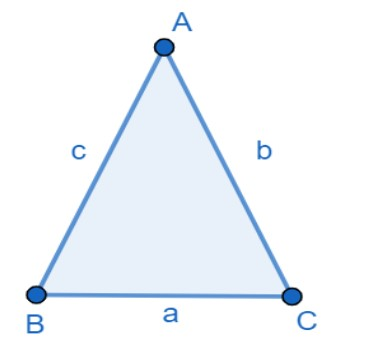
then ${{c}^{2}}={{a}^{2}}+{{b}^{2}}-2ab\cos \left( c \right)$.
Now, we have \[a=\left( 1+\sqrt{3} \right)cm\], $b=2\text{ }cm$ and $\angle C={{60}^{{}^\circ }}$, therefore putting the values in the cosine formula, we get \[{{c}^{2}}={{\left( 1+\sqrt{3} \right)}^{2}}+{{2}^{2}}-2\left( 1+\sqrt{3} \right)\left( 2 \right)\cos \left( {{60}^{{}^\circ }} \right)\]
Using the general formula of ${{\left( a+b \right)}^{2}}={{a}^{2}}+{{b}^{2}}+2ab$ and putting the value $\cos {{60}^{{}^\circ }}=\dfrac{1}{2}$ we get,
\[{{c}^{2}}=1+3+2\sqrt{3}+4-\left( 2+2\sqrt{3} \right)\left( 2 \right)\times \dfrac{1}{2}\], solving further,
\[{{c}^{2}}=8+2\sqrt{3}-2-2\sqrt{3}\left( 2 \right)\times \dfrac{1}{2}\], simplifying further, we get,
\[{{c}^{2}}=8+2\sqrt{3}-2-2\sqrt{3}\] or
\[{{c}^{2}}=6\].
Thus $c=\sqrt{6}$ is the third side of the given triangle ABC.
Now, by using the sine formula, we will find the other two angles $\angle A\text{ }and\text{ }\angle B$ of triangle ABC. According to sine formula
$\dfrac{a}{\sin a}=\dfrac{b}{\sin b}=\dfrac{c}{\sin c}$. We have \[a=\left( 1+\sqrt{3} \right)cm\], $b=2\text{ }cm$ and $\angle C={{60}^{{}^\circ }}$, also $c=\sqrt{6}$. Putting all the values in the sine formula, we get
$\dfrac{1+\sqrt{3}}{\sin a}=\dfrac{2}{\sin b}=\dfrac{\sqrt{6}}{\sin 60}$.
Now, for finding the value of angle B, we will equate the following ratio $\dfrac{2}{\sin b}=\dfrac{\sqrt{6}}{\sin 60}$. Therefore on solving this and using the value of $\sin 60=\dfrac{\sqrt{3}}{2}$, we get,
$\sin b=\dfrac{2\sin 60}{\sqrt{6}}=\dfrac{2\times \dfrac{\sqrt{3}}{2}}{\sqrt{6}}$ , solving further, we get,
$\sin b=\dfrac{\sqrt{3}}{\sqrt{6}}=\dfrac{1}{\sqrt{2}}$. Now, we know that $\sin {{45}^{{}^\circ }}=\dfrac{1}{\sqrt{2}}$, therefore, on comparing we get $\angle B={{45}^{{}^\circ }}$.
Now, we know that sum of all angles of a triangle is ${{180}^{{}^\circ }}$, that is, $\angle A+\angle B+\angle C={{180}^{{}^\circ }}$, therefore putting the values , we get
$\angle A+{{45}^{{}^\circ }}+{{60}^{{}^\circ }}={{180}^{{}^\circ }}$
$\angle A={{180}^{{}^\circ }}-{{60}^{{}^\circ }}-{{45}^{{}^\circ }}={{75}^{{}^\circ }}$.
Thus, $\angle A={{75}^{{}^\circ }}$.
Therefore, the other two angles of $\Delta ABC$ are $\angle A={{75}^{{}^\circ }}$ and $\angle B={{45}^{{}^\circ }}$ also the length of third side is equal to $c=\sqrt{6}$cm.
Note: Many students do not know about cosine formula and how to use it in mathematical problems. Also many of them do not remember this as a result they may skip such questions in examination. For remembering this we can take help of pythagoras theorem is pythagoras theorem also seem similar to cosine formula: Pythagoras theorem: ${{a}^{2}}+{{b}^{2}}={{c}^{2}}$ and cosine formula: ${{c}^{2}}={{a}^{2}}+{{b}^{2}}-2ab\cos \left( c \right)$, only an extra term $2ab\cos c$ comes. Also, angle A can be calculated in a similar way as we calculated angle B by equating the necessary ratios.
Complete step-by-step answer:
It is given in the question that ABC is a triangle with sides \[a=\left( 1+\sqrt{3} \right)cm\], $b=2\text{ }cm$ and $\angle C={{60}^{{}^\circ }}$ then we have to find the other two angles and third side of the triangle.
The law of cosines say that is ABC is a triangle as follows
then ${{c}^{2}}={{a}^{2}}+{{b}^{2}}-2ab\cos \left( c \right)$.
Now, we have \[a=\left( 1+\sqrt{3} \right)cm\], $b=2\text{ }cm$ and $\angle C={{60}^{{}^\circ }}$, therefore putting the values in the cosine formula, we get \[{{c}^{2}}={{\left( 1+\sqrt{3} \right)}^{2}}+{{2}^{2}}-2\left( 1+\sqrt{3} \right)\left( 2 \right)\cos \left( {{60}^{{}^\circ }} \right)\]
Using the general formula of ${{\left( a+b \right)}^{2}}={{a}^{2}}+{{b}^{2}}+2ab$ and putting the value $\cos {{60}^{{}^\circ }}=\dfrac{1}{2}$ we get,
\[{{c}^{2}}=1+3+2\sqrt{3}+4-\left( 2+2\sqrt{3} \right)\left( 2 \right)\times \dfrac{1}{2}\], solving further,
\[{{c}^{2}}=8+2\sqrt{3}-2-2\sqrt{3}\left( 2 \right)\times \dfrac{1}{2}\], simplifying further, we get,
\[{{c}^{2}}=8+2\sqrt{3}-2-2\sqrt{3}\] or
\[{{c}^{2}}=6\].
Thus $c=\sqrt{6}$ is the third side of the given triangle ABC.
Now, by using the sine formula, we will find the other two angles $\angle A\text{ }and\text{ }\angle B$ of triangle ABC. According to sine formula
$\dfrac{a}{\sin a}=\dfrac{b}{\sin b}=\dfrac{c}{\sin c}$. We have \[a=\left( 1+\sqrt{3} \right)cm\], $b=2\text{ }cm$ and $\angle C={{60}^{{}^\circ }}$, also $c=\sqrt{6}$. Putting all the values in the sine formula, we get
$\dfrac{1+\sqrt{3}}{\sin a}=\dfrac{2}{\sin b}=\dfrac{\sqrt{6}}{\sin 60}$.
Now, for finding the value of angle B, we will equate the following ratio $\dfrac{2}{\sin b}=\dfrac{\sqrt{6}}{\sin 60}$. Therefore on solving this and using the value of $\sin 60=\dfrac{\sqrt{3}}{2}$, we get,
$\sin b=\dfrac{2\sin 60}{\sqrt{6}}=\dfrac{2\times \dfrac{\sqrt{3}}{2}}{\sqrt{6}}$ , solving further, we get,
$\sin b=\dfrac{\sqrt{3}}{\sqrt{6}}=\dfrac{1}{\sqrt{2}}$. Now, we know that $\sin {{45}^{{}^\circ }}=\dfrac{1}{\sqrt{2}}$, therefore, on comparing we get $\angle B={{45}^{{}^\circ }}$.
Now, we know that sum of all angles of a triangle is ${{180}^{{}^\circ }}$, that is, $\angle A+\angle B+\angle C={{180}^{{}^\circ }}$, therefore putting the values , we get
$\angle A+{{45}^{{}^\circ }}+{{60}^{{}^\circ }}={{180}^{{}^\circ }}$
$\angle A={{180}^{{}^\circ }}-{{60}^{{}^\circ }}-{{45}^{{}^\circ }}={{75}^{{}^\circ }}$.
Thus, $\angle A={{75}^{{}^\circ }}$.
Therefore, the other two angles of $\Delta ABC$ are $\angle A={{75}^{{}^\circ }}$ and $\angle B={{45}^{{}^\circ }}$ also the length of third side is equal to $c=\sqrt{6}$cm.
Note: Many students do not know about cosine formula and how to use it in mathematical problems. Also many of them do not remember this as a result they may skip such questions in examination. For remembering this we can take help of pythagoras theorem is pythagoras theorem also seem similar to cosine formula: Pythagoras theorem: ${{a}^{2}}+{{b}^{2}}={{c}^{2}}$ and cosine formula: ${{c}^{2}}={{a}^{2}}+{{b}^{2}}-2ab\cos \left( c \right)$, only an extra term $2ab\cos c$ comes. Also, angle A can be calculated in a similar way as we calculated angle B by equating the necessary ratios.
Recently Updated Pages
Three beakers labelled as A B and C each containing 25 mL of water were taken A small amount of NaOH anhydrous CuSO4 and NaCl were added to the beakers A B and C respectively It was observed that there was an increase in the temperature of the solutions contained in beakers A and B whereas in case of beaker C the temperature of the solution falls Which one of the following statements isarecorrect i In beakers A and B exothermic process has occurred ii In beakers A and B endothermic process has occurred iii In beaker C exothermic process has occurred iv In beaker C endothermic process has occurred

Master Class 12 Social Science: Engaging Questions & Answers for Success
Master Class 12 Physics: Engaging Questions & Answers for Success
Master Class 12 Maths: Engaging Questions & Answers for Success
Master Class 12 Economics: Engaging Questions & Answers for Success
Master Class 12 Chemistry: Engaging Questions & Answers for Success
Three beakers labelled as A B and C each containing 25 mL of water were taken A small amount of NaOH anhydrous CuSO4 and NaCl were added to the beakers A B and C respectively It was observed that there was an increase in the temperature of the solutions contained in beakers A and B whereas in case of beaker C the temperature of the solution falls Which one of the following statements isarecorrect i In beakers A and B exothermic process has occurred ii In beakers A and B endothermic process has occurred iii In beaker C exothermic process has occurred iv In beaker C endothermic process has occurred
Master Class 12 Social Science: Engaging Questions & Answers for Success
Master Class 12 Physics: Engaging Questions & Answers for Success
Trending doubts
Which are the Top 10 Largest Countries of the World?
Draw a labelled sketch of the human eye class 12 physics CBSE
Differentiate between homogeneous and heterogeneous class 12 chemistry CBSE
What are the major means of transport Explain each class 12 social science CBSE
Sulphuric acid is known as the king of acids State class 12 chemistry CBSE
Why should a magnesium ribbon be cleaned before burning class 12 chemistry CBSE