




If I is the center of a circle inscribed in a triangle ABC, then
\[\left| \overrightarrow{BC} \right|\overrightarrow{IA}+\left| \overrightarrow{CA} \right|\overrightarrow{IB}+\left| \overrightarrow{AB} \right|\overrightarrow{IC}\] is
(A) \[\overline{0}\]
(B) \[\overrightarrow{IA}+\overrightarrow{IB}+\overrightarrow{IC}\]
(C) \[\dfrac{\overrightarrow{IA}+\overrightarrow{IB}+\overrightarrow{IC}}{3}\]
(D) \[\dfrac{\overrightarrow{IA}+\overrightarrow{IB}+\overrightarrow{IC}}{2}\]
Answer
 Verified
566.4k+ views
Hint: Get the position of the vertices A, B, and C of \[\Delta ABC\] with respect to the incenter I. Use the formula for the position vector of incenter of \[\Delta ABC\] , \[\dfrac{BC.\overrightarrow{a}+CA.\overrightarrow{b}+AB.\overrightarrow{c}}{BC+CA+AB}\] where \[\overrightarrow{a}\] , \[\overrightarrow{b}\] , and \[\overrightarrow{c}\] are the affixes of vertices of \[\Delta ABC\] and get the position vector of I. Since the calculated position vector is with respect to I so, the position vector of I with respect to I must be equal to zero. Now, solve it further and calculate the value of \[\left| \overrightarrow{BC} \right|\overrightarrow{IA}+\left| \overrightarrow{CA} \right|\overrightarrow{IB}+\left| \overrightarrow{AB} \right|\overrightarrow{IC}\] .
Complete step by step solution:
According to the question, we are given that I is the center of the circle inscribed in the triangle ABC and we are asked to find the possible value of the expression, \[\left| \overrightarrow{BC} \right|\overrightarrow{IA}+\left| \overrightarrow{CA} \right|\overrightarrow{IB}+\left| \overrightarrow{AB} \right|\overrightarrow{IC}\] .
First of all, let us assume that I is the incenter of \[\Delta ABC\] .
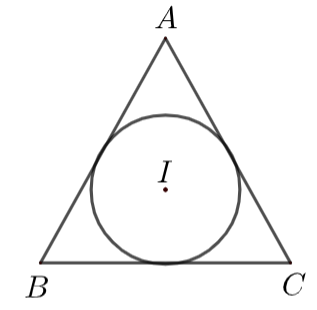
From the above diagram, we can observe that
The position vector of vertex A with respect to the incenter I = \[\overrightarrow{IA}\] …………………………………………….(1)
The position vector of vertex B with respect to the incenter I = \[\overrightarrow{IB}\] ……………………………………….……(2)
The position vector of vertex C with respect to the incenter I = \[\overrightarrow{IC}\] …………………………………………….(3)
We know the formula for the incenter of \[\Delta ABC\] , \[\dfrac{BC.\overrightarrow{a}+CA.\overrightarrow{b}+AB.\overrightarrow{c}}{BC+CA+AB}\] where \[\overrightarrow{a}\] , \[\overrightarrow{b}\] , and \[\overrightarrow{c}\] are the affixes of the vertices of \[\Delta ABC\] ………………………………………..(4)
Now, from equation (1), equation (2), equation (3), and equation (4), we get
The affix of the incenter of \[\Delta ABC\] = \[\dfrac{BC\left| \overrightarrow{IA} \right|+CA\left| \overrightarrow{IB} \right|+AB\left| \overrightarrow{IC} \right|}{BC+CA+AB}\] ………………………………..(5)
But the position vector of I with respect to I must be equal to zero ……………………………………..(6)
Now, from equation (5) and equation (6), we get
\[\Rightarrow \overrightarrow{0}=\dfrac{BC.\overrightarrow{IA}+CA.\overrightarrow{IB}+AB.\overrightarrow{IC}}{BC+CA+AB}\]
\[\Rightarrow \overrightarrow{0}=BC.\overrightarrow{IA}+CA.\overrightarrow{IB}+AB.\overrightarrow{IC}\] ……………………………………………….(7)
BC, CA, and AB can also be written as \[\left| \overrightarrow{BC} \right|\] , \[\left| \overrightarrow{CA} \right|\] , and \[\left| \overrightarrow{AB} \right|\] …………………………………………..(8)
Now, from equation (7) and equation (8), we get
\[\Rightarrow \overrightarrow{0}=\left| \overrightarrow{BC} \right|\overrightarrow{IA}+\left| \overrightarrow{CA} \right|\overrightarrow{IB}+\left| \overrightarrow{AB} \right|\overrightarrow{IC}\]
So, the correct answer is “Option A”.
Note: For this type of question, one must remember the formula for the position vector of the incenter of any triangle. That is the position vector of incenter of \[\Delta ABC\] , \[\dfrac{BC.\overrightarrow{a}+CA.\overrightarrow{b}+AB.\overrightarrow{c}}{BC+CA+AB}\] where \[\overrightarrow{a}\] , \[\overrightarrow{b}\] , and \[\overrightarrow{c}\] are the affixes of vertices of \[\Delta ABC\] .
Complete step by step solution:
According to the question, we are given that I is the center of the circle inscribed in the triangle ABC and we are asked to find the possible value of the expression, \[\left| \overrightarrow{BC} \right|\overrightarrow{IA}+\left| \overrightarrow{CA} \right|\overrightarrow{IB}+\left| \overrightarrow{AB} \right|\overrightarrow{IC}\] .
First of all, let us assume that I is the incenter of \[\Delta ABC\] .
From the above diagram, we can observe that
The position vector of vertex A with respect to the incenter I = \[\overrightarrow{IA}\] …………………………………………….(1)
The position vector of vertex B with respect to the incenter I = \[\overrightarrow{IB}\] ……………………………………….……(2)
The position vector of vertex C with respect to the incenter I = \[\overrightarrow{IC}\] …………………………………………….(3)
We know the formula for the incenter of \[\Delta ABC\] , \[\dfrac{BC.\overrightarrow{a}+CA.\overrightarrow{b}+AB.\overrightarrow{c}}{BC+CA+AB}\] where \[\overrightarrow{a}\] , \[\overrightarrow{b}\] , and \[\overrightarrow{c}\] are the affixes of the vertices of \[\Delta ABC\] ………………………………………..(4)
Now, from equation (1), equation (2), equation (3), and equation (4), we get
The affix of the incenter of \[\Delta ABC\] = \[\dfrac{BC\left| \overrightarrow{IA} \right|+CA\left| \overrightarrow{IB} \right|+AB\left| \overrightarrow{IC} \right|}{BC+CA+AB}\] ………………………………..(5)
But the position vector of I with respect to I must be equal to zero ……………………………………..(6)
Now, from equation (5) and equation (6), we get
\[\Rightarrow \overrightarrow{0}=\dfrac{BC.\overrightarrow{IA}+CA.\overrightarrow{IB}+AB.\overrightarrow{IC}}{BC+CA+AB}\]
\[\Rightarrow \overrightarrow{0}=BC.\overrightarrow{IA}+CA.\overrightarrow{IB}+AB.\overrightarrow{IC}\] ……………………………………………….(7)
BC, CA, and AB can also be written as \[\left| \overrightarrow{BC} \right|\] , \[\left| \overrightarrow{CA} \right|\] , and \[\left| \overrightarrow{AB} \right|\] …………………………………………..(8)
Now, from equation (7) and equation (8), we get
\[\Rightarrow \overrightarrow{0}=\left| \overrightarrow{BC} \right|\overrightarrow{IA}+\left| \overrightarrow{CA} \right|\overrightarrow{IB}+\left| \overrightarrow{AB} \right|\overrightarrow{IC}\]
So, the correct answer is “Option A”.
Note: For this type of question, one must remember the formula for the position vector of the incenter of any triangle. That is the position vector of incenter of \[\Delta ABC\] , \[\dfrac{BC.\overrightarrow{a}+CA.\overrightarrow{b}+AB.\overrightarrow{c}}{BC+CA+AB}\] where \[\overrightarrow{a}\] , \[\overrightarrow{b}\] , and \[\overrightarrow{c}\] are the affixes of vertices of \[\Delta ABC\] .
Recently Updated Pages
Master Class 12 Social Science: Engaging Questions & Answers for Success

Master Class 12 Physics: Engaging Questions & Answers for Success
Master Class 12 Maths: Engaging Questions & Answers for Success
Master Class 12 Economics: Engaging Questions & Answers for Success
Master Class 12 Chemistry: Engaging Questions & Answers for Success
Master Class 12 Business Studies: Engaging Questions & Answers for Success
Trending doubts
Which are the Top 10 Largest Countries of the World?
Draw a labelled sketch of the human eye class 12 physics CBSE
Explain the structure of megasporangium class 12 biology CBSE
What are the major means of transport Explain each class 12 social science CBSE
How many chromosomes are found in human ovum a 46 b class 12 biology CBSE
The diagram of the section of a maize grain is given class 12 biology CBSE