




If $f\left( x \right)=\min \left\{ \tan x,\cot x \right\},$ then
a) Range of f(x) is $(-\infty ,1]\cup \left( 0,1 \right)$
b) F is periodic function whose period is $\pi $
c) F is discontinuous at $x=\dfrac{n\pi }{2},n\in z$
d) F is not differentiable at $x=\dfrac{n\pi }{4},n\in z$
Answer
 Verified
636k+ views
Hint: For solving this problem, we consider all the options individually and then analyse each option for its truth value as multiple answers are possible. We use the concept of minima in graph regions for analysing each option. First, we find the common part in the two graphs for a specific interval as both $\tan x\text{ and }\cot x$ are periodic and then we shade the minimum value for corresponding region to get minima. By doing so, we get the final result.
Complete step-by-step answer:
As per given the function is: $f\left( x \right)=\min \left\{ \tan x,\cot x \right\}$
To find the range of function f(x), we will use the graphical approach.
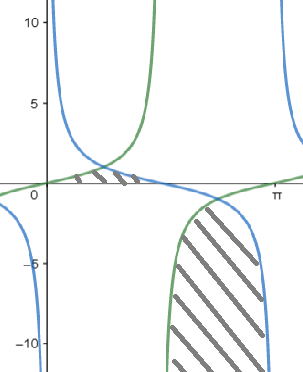
Draw the graph for tan x, cot x for all $x\in \left[ 0,\pi \right]$and that graph will give us range as they both are periodic functions with period $\pi $.
cot x = tan x
$\begin{align}
& {{\tan }^{2}}x=1 \\
& \Rightarrow \tan x=\pm 1 \\
\end{align}$
The value of tan x is 1 when the value of x is $\dfrac{\pi }{4},\dfrac{3\pi }{4}$.
Therefore, $x=\dfrac{\pi }{4},\dfrac{3\pi }{4}$ as $x\in \left[ 0,\pi \right]$
From the graph the darker lines give the required answer this range of f(x) is $(-\infty ,-1]\cup (0,1]$ as both tan x and cot x are periodic f(x) is periodic with period $\pi $.
So, option (a) and (b) are correct.
Now, considering option (c),
f(x) = min (tan x, cot x), and the periodicity of tan and cot function is $\pi $. Now, to obtain the periodicity of f(x):
\[\begin{align}
& f\left( x+\pi \right)=\min \left( \tan \left( x+\pi \right),\cot \left( x+\pi \right) \right) \\
& \because \tan \left( x+\pi \right)=\tan \left( x \right)\text{ and }\cot \left( x+\pi \right)=\cot \left( x \right) \\
& \therefore f\left( \pi +x \right)=\min \left( \tan \left( x \right),\cot \left( x \right) \right) \\
& \text{thus, }f\left( x \right)=f\left( x+\pi \right) \\
\end{align}\]
Hence, option (c) is also correct.
From graph we can see f(x) is discontinuous at point where $x=\dfrac{n\pi }{2},n\in z$ and as at points where $x=n\dfrac{\pi }{4},n\in z$ there exists a corner thus these are non- differentiable. So, option (d) is also correct.
Therefore, all the options are correct.
Note: The knowledge of the concept of minima for periodic function is must for solving this problem. Students must be careful while drawing the graph and should take the interval of periodicity carefully. All the options are analysed once the graph is formed.
Complete step-by-step answer:
As per given the function is: $f\left( x \right)=\min \left\{ \tan x,\cot x \right\}$
To find the range of function f(x), we will use the graphical approach.
Draw the graph for tan x, cot x for all $x\in \left[ 0,\pi \right]$and that graph will give us range as they both are periodic functions with period $\pi $.
cot x = tan x
$\begin{align}
& {{\tan }^{2}}x=1 \\
& \Rightarrow \tan x=\pm 1 \\
\end{align}$
The value of tan x is 1 when the value of x is $\dfrac{\pi }{4},\dfrac{3\pi }{4}$.
Therefore, $x=\dfrac{\pi }{4},\dfrac{3\pi }{4}$ as $x\in \left[ 0,\pi \right]$
From the graph the darker lines give the required answer this range of f(x) is $(-\infty ,-1]\cup (0,1]$ as both tan x and cot x are periodic f(x) is periodic with period $\pi $.
So, option (a) and (b) are correct.
Now, considering option (c),
f(x) = min (tan x, cot x), and the periodicity of tan and cot function is $\pi $. Now, to obtain the periodicity of f(x):
\[\begin{align}
& f\left( x+\pi \right)=\min \left( \tan \left( x+\pi \right),\cot \left( x+\pi \right) \right) \\
& \because \tan \left( x+\pi \right)=\tan \left( x \right)\text{ and }\cot \left( x+\pi \right)=\cot \left( x \right) \\
& \therefore f\left( \pi +x \right)=\min \left( \tan \left( x \right),\cot \left( x \right) \right) \\
& \text{thus, }f\left( x \right)=f\left( x+\pi \right) \\
\end{align}\]
Hence, option (c) is also correct.
From graph we can see f(x) is discontinuous at point where $x=\dfrac{n\pi }{2},n\in z$ and as at points where $x=n\dfrac{\pi }{4},n\in z$ there exists a corner thus these are non- differentiable. So, option (d) is also correct.
Therefore, all the options are correct.
Note: The knowledge of the concept of minima for periodic function is must for solving this problem. Students must be careful while drawing the graph and should take the interval of periodicity carefully. All the options are analysed once the graph is formed.
Recently Updated Pages
Master Class 12 Business Studies: Engaging Questions & Answers for Success

Master Class 12 Biology: Engaging Questions & Answers for Success
Master Class 12 Chemistry: Engaging Questions & Answers for Success
Class 12 Question and Answer - Your Ultimate Solutions Guide
Master Class 11 Social Science: Engaging Questions & Answers for Success
Master Class 11 English: Engaging Questions & Answers for Success
Trending doubts
Which are the Top 10 Largest Countries of the World?
Draw a labelled sketch of the human eye class 12 physics CBSE
Name the crygenes that control cotton bollworm and class 12 biology CBSE
Differentiate between homogeneous and heterogeneous class 12 chemistry CBSE
Ribosomal RNA is actively synthesised in A Nucleoplasm class 12 biology CBSE
How many molecules of ATP and NADPH are required information class 12 biology CBSE