




If an inverse trigonometric equation is given as ${{\tan }^{-1}}x+{{\tan }^{-1}}y=\dfrac{\pi }{4}$ , xy<1 . Then write the value of $x+y+xy$.
Answer
 Verified
595.5k+ views
Hint: As it is given that xy<1 and the looking at the form of the equation, it is very clear that you have to use the formula ${{\tan }^{-1}}A+{{\tan }^{-1}}B={{\tan }^{-1}}\dfrac{A+B}{1-AB}$ . After that you need to take tangent of both sides of the equation followed by use of the identity $\tan \left( {{\tan }^{-1}}x \right)=x$ .
Complete step-by-step answer:
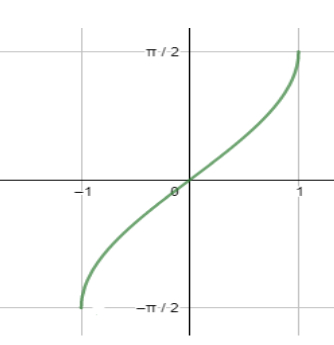
Before starting with the solution to the above question, we will first talk about the required details of different inverse trigonometric ratios. So, we must remember that inverse trigonometric ratios are completely different from trigonometric ratios and have many constraints related to their range and domain. So, to understand these constraints and the behaviour of inverse trigonometric functions, let us look at some of the important graphs. First, let us see the graph of ${{\sin }^{-1}}x$ .
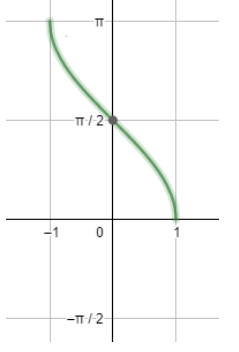
Now let us draw the graph of $co{{s}^{-1}}x$ .
Also, we will draw the graph of ${{\tan }^{-1}}x$ as well.
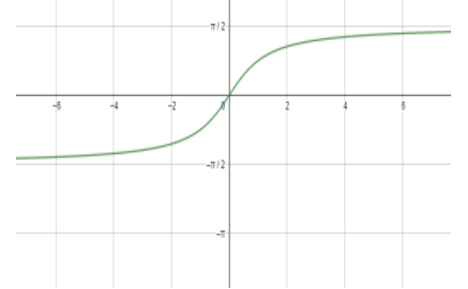
So, looking at the above graphs, we can draw the conclusion that ${{\tan }^{-1}}x$ is defined for all real values of x, i.e., the domain of the function ${{\tan }^{-1}}x$ is all real numbers while its range comes out to be $\left( -\dfrac{\pi }{2},\dfrac{\pi }{2} \right)$ . Unlike ${{\tan }^{-1}}x$ the functions $si{{n}^{-1}}x\text{ and co}{{\text{s}}^{-1}}x$ have the is defined only for $x\in [-1,1]$ .
Now moving to the solution to the above question, we will start with the simplification of the equation given in the question.
${{\tan }^{-1}}x+{{\tan }^{-1}}y=\dfrac{\pi }{4}$
Now, we know $xy<1$ . So, if we use the formula ${{\tan }^{-1}}A+{{\tan }^{-1}}B={{\tan }^{-1}}\dfrac{A+B}{1-AB}$ , we get
${{\tan }^{-1}}\dfrac{x+y}{1-xy}=\dfrac{\pi }{4}$
Now we will take the tangent of both the sides of the equations. On doing so, we get
\[tan\left( {{\tan }^{-1}}\dfrac{x+y}{1-xy} \right)=\tan \dfrac{\pi }{4}\]
Now we know that $\tan \left( {{\tan }^{-1}}A \right)=A$ and the value of $\tan \dfrac{\pi }{4}$ is equal to 1. So, we get
\[\dfrac{x+y}{1-xy}=1\]
\[\Rightarrow x+y=1-xy\]
\[\Rightarrow x+y+xy=1\]
Therefore, the value of x+y+xy is equal to 1.
Note: While dealing with inverse trigonometric functions, it is preferred to know about the domains and ranges of the different inverse trigonometric functions. For example: the domain of ${{\sin }^{-1}}x$ is $[-1,1]$ and the range is $\left[ -\dfrac{\pi }{2},\dfrac{\pi }{2} \right]$ . Also, the formula ${{\tan }^{-1}}A+{{\tan }^{-1}}B$ is different for different cases and can be represented as:
${{\tan }^{-1}}A+{{\tan }^{-1}}B=\left\{ \begin{align}
& {{\tan }^{-1}}\dfrac{A+B}{1-AB}\text{; AB < 1} \\
& \pi +{{\tan }^{-1}}\dfrac{A+B}{1-AB}\text{; AB > 1} \\
\end{align} \right.$
Complete step-by-step answer:
Before starting with the solution to the above question, we will first talk about the required details of different inverse trigonometric ratios. So, we must remember that inverse trigonometric ratios are completely different from trigonometric ratios and have many constraints related to their range and domain. So, to understand these constraints and the behaviour of inverse trigonometric functions, let us look at some of the important graphs. First, let us see the graph of ${{\sin }^{-1}}x$ .
Now let us draw the graph of $co{{s}^{-1}}x$ .
Also, we will draw the graph of ${{\tan }^{-1}}x$ as well.
So, looking at the above graphs, we can draw the conclusion that ${{\tan }^{-1}}x$ is defined for all real values of x, i.e., the domain of the function ${{\tan }^{-1}}x$ is all real numbers while its range comes out to be $\left( -\dfrac{\pi }{2},\dfrac{\pi }{2} \right)$ . Unlike ${{\tan }^{-1}}x$ the functions $si{{n}^{-1}}x\text{ and co}{{\text{s}}^{-1}}x$ have the is defined only for $x\in [-1,1]$ .
Now moving to the solution to the above question, we will start with the simplification of the equation given in the question.
${{\tan }^{-1}}x+{{\tan }^{-1}}y=\dfrac{\pi }{4}$
Now, we know $xy<1$ . So, if we use the formula ${{\tan }^{-1}}A+{{\tan }^{-1}}B={{\tan }^{-1}}\dfrac{A+B}{1-AB}$ , we get
${{\tan }^{-1}}\dfrac{x+y}{1-xy}=\dfrac{\pi }{4}$
Now we will take the tangent of both the sides of the equations. On doing so, we get
\[tan\left( {{\tan }^{-1}}\dfrac{x+y}{1-xy} \right)=\tan \dfrac{\pi }{4}\]
Now we know that $\tan \left( {{\tan }^{-1}}A \right)=A$ and the value of $\tan \dfrac{\pi }{4}$ is equal to 1. So, we get
\[\dfrac{x+y}{1-xy}=1\]
\[\Rightarrow x+y=1-xy\]
\[\Rightarrow x+y+xy=1\]
Therefore, the value of x+y+xy is equal to 1.
Note: While dealing with inverse trigonometric functions, it is preferred to know about the domains and ranges of the different inverse trigonometric functions. For example: the domain of ${{\sin }^{-1}}x$ is $[-1,1]$ and the range is $\left[ -\dfrac{\pi }{2},\dfrac{\pi }{2} \right]$ . Also, the formula ${{\tan }^{-1}}A+{{\tan }^{-1}}B$ is different for different cases and can be represented as:
${{\tan }^{-1}}A+{{\tan }^{-1}}B=\left\{ \begin{align}
& {{\tan }^{-1}}\dfrac{A+B}{1-AB}\text{; AB < 1} \\
& \pi +{{\tan }^{-1}}\dfrac{A+B}{1-AB}\text{; AB > 1} \\
\end{align} \right.$
Recently Updated Pages
Master Class 12 Economics: Engaging Questions & Answers for Success

Master Class 12 Physics: Engaging Questions & Answers for Success
Master Class 12 English: Engaging Questions & Answers for Success
Master Class 12 Social Science: Engaging Questions & Answers for Success
Master Class 12 Maths: Engaging Questions & Answers for Success
Master Class 12 Business Studies: Engaging Questions & Answers for Success
Trending doubts
Which are the Top 10 Largest Countries of the World?
What are the major means of transport Explain each class 12 social science CBSE
Draw a labelled sketch of the human eye class 12 physics CBSE
Why cannot DNA pass through cell membranes class 12 biology CBSE
Differentiate between insitu conservation and exsitu class 12 biology CBSE
Draw a neat and well labeled diagram of TS of ovary class 12 biology CBSE