




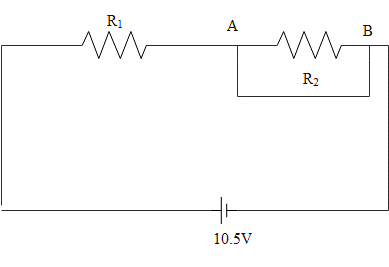
If an ammeter of negligible internal resistance has been inserted in series with circuit, it reads $1A$. If a voltmeter of very high value of resistance is connected across ${{R}_{1}}$, it reads $3V$. But if the points A and B are short circuited with the use of a conducting wire, then the voltmeter measures $10.5V$ across the battery. Find out the internal resistance of the battery?
$\begin{align}
& A.\dfrac{3}{7}\Omega \\
& B.5\Omega \\
& C.3\Omega \\
& D.\text{none of these} \\
\end{align}$
Answer
 Verified
641.4k+ views
Hint: The electric potential of the conducting wire will be equivalent to the product of the current passing through it and the resistance across it. This is the ohm’s law. The internal resistance will be the difference between the initial electric potential and the electric potential after short circuiting to the current flowing when short circuited. This all will help you in solving this question.
Complete step by step answer:
the electric potential has been mentioned as,
$E=3V$
The current in the circuit can be mentioned as,
$I=1A$
Using this, the value of the resistance can be written as,
${{R}_{1}}=\dfrac{E}{I}$
Substituting the values in it will give,
${{R}_{1}}=\dfrac{3}{1}=3\Omega $
When the points A and B are connected using a conducting wire, ${{R}_{2}}$ will be short-circuited. Hence we can write that,
$\begin{align}
& 10.5={I}'{{R}_{1}} \\
& \Rightarrow 10.5={I}'\times 3 \\
& {I}'=\dfrac{10.5}{3}=3.5A \\
\end{align}$
From this the internal resistance should be calculated. We can write that,
$10.5=E-{I}'r$
Substituting the values in it will give,
$10.5=12-3.5\times r$
Rearrange the obtained equation as,
$r=\dfrac{1.5}{3.5}=\dfrac{3}{7}\Omega $
Therefore the value of the internal resistance has been calculated.
So, the correct answer is “Option A”.
Note: Internal resistance is the resistance or the opposition provided against the flow of electrons or the current in a battery. This will cause the production of heat in it. Internal resistance is also having the units of ohm. Every battery will be having some internal resistances as the zero internal resistance is ideal.
Complete step by step answer:
the electric potential has been mentioned as,
$E=3V$
The current in the circuit can be mentioned as,
$I=1A$
Using this, the value of the resistance can be written as,
${{R}_{1}}=\dfrac{E}{I}$
Substituting the values in it will give,
${{R}_{1}}=\dfrac{3}{1}=3\Omega $
When the points A and B are connected using a conducting wire, ${{R}_{2}}$ will be short-circuited. Hence we can write that,
$\begin{align}
& 10.5={I}'{{R}_{1}} \\
& \Rightarrow 10.5={I}'\times 3 \\
& {I}'=\dfrac{10.5}{3}=3.5A \\
\end{align}$
From this the internal resistance should be calculated. We can write that,
$10.5=E-{I}'r$
Substituting the values in it will give,
$10.5=12-3.5\times r$
Rearrange the obtained equation as,
$r=\dfrac{1.5}{3.5}=\dfrac{3}{7}\Omega $
Therefore the value of the internal resistance has been calculated.
So, the correct answer is “Option A”.
Note: Internal resistance is the resistance or the opposition provided against the flow of electrons or the current in a battery. This will cause the production of heat in it. Internal resistance is also having the units of ohm. Every battery will be having some internal resistances as the zero internal resistance is ideal.
Recently Updated Pages
Which of the following graphs shows the variation of class 12 physics CBSE

Draw a labelled diagram of the human male reproductive class 12 biology CBSE
Describe the experiment to compare the emf of two cells class 12 physics CBSE
What is standard hydrogen electrode
What is conventional current and electric current class 12 physics CBSE
2Bromopentane is treated with an alcoholic KOH solution class 12 chemistry CBSE
Trending doubts
Draw a labelled sketch of the human eye class 12 physics CBSE
Which are the Top 10 Largest Countries of the World?
Differentiate between homogeneous and heterogeneous class 12 chemistry CBSE
Draw ray diagrams each showing i myopic eye and ii class 12 physics CBSE
Which is the correct genotypic ratio of mendel dihybrid class 12 biology CBSE
What is the Full Form of PVC, PET, HDPE, LDPE, PP and PS ?