




If $a\cdot b=0$ and $a+b$ makes an angle of ${{60}^{\circ }}$ with $b$ then $\left| a \right|$ is equal to
$\left( A \right)\text{ 0}$
$\left( B \right)\text{ }\dfrac{1}{\sqrt{3}}\left| b \right|$
$\left( C \right)\text{ }\dfrac{1}{\left| b \right|}$
$\left( D \right)\text{ }\left| b \right|$
$\left( E \right)\text{ }\sqrt{3}\left| b \right|$
Answer
 Verified
534k+ views
Hint: In this question we have been given with two vectors which are $a$ and $b$. We have to find the value of $\left| a \right|$ given that $a\cdot b=0$ and $a+b$ makes an angle of ${{60}^{\circ }}$. We will use the property of dot product of vectors to find the all the angles in the triangle, we will then use trigonometric properties to get the relationship with the sides and get the required value of $\left| a \right|$.
Complete step by step answer:
We know that $a\cdot b=0$, which represents the dot product of vectors. We know that the dot product of perpendicular vectors is always zero. Which implies that since $a\cdot b=0$, $a$ is perpendicular to $b$. Mathematically it can be written as $a\bot b$.
This implies that the vectors $a,b$ and $a+b$ which is the resultant vector, form a right-angled triangle.
Consider the triangle to be $\Delta PQR$, we have the triangle as:
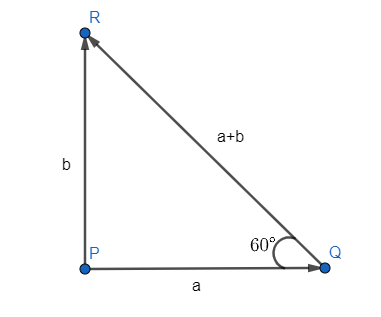
Now we know that $\tan \theta =\dfrac{perpendicular}{base}$ therefore, in $\Delta PQR$, we have:
$\Rightarrow \tan {{60}^{\circ }}=\dfrac{\left| a \right|}{\left| b \right|}$
Now we know that the value of $\tan {{60}^{\circ }}=\sqrt{3}$ therefore, on substituting, we get:
$\Rightarrow \sqrt{3}=\dfrac{\left| a \right|}{\left| b \right|}$
On transferring the term $\left| b \right|$ from the right-hand side to the left-hand side, we get:
$\Rightarrow \sqrt{3}\left| b \right|=\left| a \right|$
On rearranging, we get:
$\Rightarrow \left| a \right|=\sqrt{3}\left| b \right|$, which is the required value of $\left| a \right|$
So, the correct answer is “Option E”.
Note: It is to be remembered that modulus sign is used in representing the value since the value of vectors cannot be negative. The dot product in vectors represents the amount of which one vector goes in the direction of another vector. It is to be noted that vector dot product and cross product are two different things.
Complete step by step answer:
We know that $a\cdot b=0$, which represents the dot product of vectors. We know that the dot product of perpendicular vectors is always zero. Which implies that since $a\cdot b=0$, $a$ is perpendicular to $b$. Mathematically it can be written as $a\bot b$.
This implies that the vectors $a,b$ and $a+b$ which is the resultant vector, form a right-angled triangle.
Consider the triangle to be $\Delta PQR$, we have the triangle as:
Now we know that $\tan \theta =\dfrac{perpendicular}{base}$ therefore, in $\Delta PQR$, we have:
$\Rightarrow \tan {{60}^{\circ }}=\dfrac{\left| a \right|}{\left| b \right|}$
Now we know that the value of $\tan {{60}^{\circ }}=\sqrt{3}$ therefore, on substituting, we get:
$\Rightarrow \sqrt{3}=\dfrac{\left| a \right|}{\left| b \right|}$
On transferring the term $\left| b \right|$ from the right-hand side to the left-hand side, we get:
$\Rightarrow \sqrt{3}\left| b \right|=\left| a \right|$
On rearranging, we get:
$\Rightarrow \left| a \right|=\sqrt{3}\left| b \right|$, which is the required value of $\left| a \right|$
So, the correct answer is “Option E”.
Note: It is to be remembered that modulus sign is used in representing the value since the value of vectors cannot be negative. The dot product in vectors represents the amount of which one vector goes in the direction of another vector. It is to be noted that vector dot product and cross product are two different things.
Recently Updated Pages
Master Class 12 Economics: Engaging Questions & Answers for Success

Master Class 12 Physics: Engaging Questions & Answers for Success
Master Class 12 English: Engaging Questions & Answers for Success
Master Class 12 Social Science: Engaging Questions & Answers for Success
Master Class 12 Maths: Engaging Questions & Answers for Success
Master Class 12 Business Studies: Engaging Questions & Answers for Success
Trending doubts
Which are the Top 10 Largest Countries of the World?
What are the major means of transport Explain each class 12 social science CBSE
Draw a labelled sketch of the human eye class 12 physics CBSE
Why cannot DNA pass through cell membranes class 12 biology CBSE
Differentiate between insitu conservation and exsitu class 12 biology CBSE
Draw a neat and well labeled diagram of TS of ovary class 12 biology CBSE