




If ABCDEF is a regular hexagon and if $\overline{AB}+\overline{AC}+\overline{AD}+\overline{AE}+\overline{AF}=\lambda \overline{AD}$ , then $\lambda $ is:
(A). 0
(B). 1
(C). 2
(D). 3
Answer
 Verified
634.5k+ views
Hint: We will be using the concepts of vector algebra. We will be using vector addition through triangle law of vector addition in which two vectors to be added is represented as the side of a triangle and resultant vector is the third side of the triangle.
Complete step-by-step solution -
We have been given a regular hexagon ABCDEF as
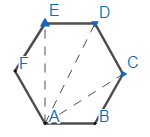
Now, we have been given that $\overline{AB}+\overline{AC}+\overline{AD}+\overline{AE}+\overline{AF}=\lambda \overline{AD}$. And we have to find the value of $\lambda $.
Now we know that according to the triangle law of vector addition, when two vectors are represented as two sides of a triangle with the order and magnitude then the third side is the resultant vector.
Now, we consider \[\Delta ACD\]. We get,
\[\overline{AC}+\overline{CD}=\overline{AD}\] …………………….. (1)
In $\Delta ADE$ we get $\overline{AE}+\overline{ED}=\overline{AD}$ …………………. (2)
Now, we will add (1) and (2)
\[\overline{AC}+\overline{CD}+\overline{AE}+\overline{ED}=2\overline{AD}\]……………….. (3)
Now, we know that ABCEDF is a regular hexagon, therefore, opposite sides are equal in magnitude and direction. Therefore,
$\overline{AF}=\overline{CD}$ …………… (4)
$\overline{ED}=\overline{AB}$ …………… (5)
Now we will substitute the value of $\overline{CD}$ and $\overline{ED}$ from (1) and (2) in (3) so that,
$\overline{AC}+\overline{AF}+\overline{AE}+\overline{AB}=2\overline{AD}$ .
Now, we will add $\overline{AD}$ on both sides. Therefore we have,
\[\overline{AB}+\overline{AC}+\overline{AD}+\overline{AE}+\overline{AF}=3\overline{AD}\].
Now, we will compare this with
$\overline{AB}+\overline{AC}+\overline{AD}+\overline{AE}+\overline{AF}=\lambda \overline{AD}$.
So, the value of $\lambda $ is 3.
Hence, the correct option is (D).
Note: To solve these types of questions one must know the triangle law of vector addition also it has to be noted that we have $\overline{AF}=\overline{CD}$ and $\overline{ED}=\overline{AD}$ through geometry. Here we need to know about the concept of vectors to be parallel.
Complete step-by-step solution -
We have been given a regular hexagon ABCDEF as
Now, we have been given that $\overline{AB}+\overline{AC}+\overline{AD}+\overline{AE}+\overline{AF}=\lambda \overline{AD}$. And we have to find the value of $\lambda $.
Now we know that according to the triangle law of vector addition, when two vectors are represented as two sides of a triangle with the order and magnitude then the third side is the resultant vector.
Now, we consider \[\Delta ACD\]. We get,
\[\overline{AC}+\overline{CD}=\overline{AD}\] …………………….. (1)
In $\Delta ADE$ we get $\overline{AE}+\overline{ED}=\overline{AD}$ …………………. (2)
Now, we will add (1) and (2)
\[\overline{AC}+\overline{CD}+\overline{AE}+\overline{ED}=2\overline{AD}\]……………….. (3)
Now, we know that ABCEDF is a regular hexagon, therefore, opposite sides are equal in magnitude and direction. Therefore,
$\overline{AF}=\overline{CD}$ …………… (4)
$\overline{ED}=\overline{AB}$ …………… (5)
Now we will substitute the value of $\overline{CD}$ and $\overline{ED}$ from (1) and (2) in (3) so that,
$\overline{AC}+\overline{AF}+\overline{AE}+\overline{AB}=2\overline{AD}$ .
Now, we will add $\overline{AD}$ on both sides. Therefore we have,
\[\overline{AB}+\overline{AC}+\overline{AD}+\overline{AE}+\overline{AF}=3\overline{AD}\].
Now, we will compare this with
$\overline{AB}+\overline{AC}+\overline{AD}+\overline{AE}+\overline{AF}=\lambda \overline{AD}$.
So, the value of $\lambda $ is 3.
Hence, the correct option is (D).
Note: To solve these types of questions one must know the triangle law of vector addition also it has to be noted that we have $\overline{AF}=\overline{CD}$ and $\overline{ED}=\overline{AD}$ through geometry. Here we need to know about the concept of vectors to be parallel.
Recently Updated Pages
Master Class 12 Business Studies: Engaging Questions & Answers for Success

Master Class 12 Chemistry: Engaging Questions & Answers for Success
Master Class 12 Biology: Engaging Questions & Answers for Success
Class 12 Question and Answer - Your Ultimate Solutions Guide
Master Class 11 English: Engaging Questions & Answers for Success
Master Class 11 Maths: Engaging Questions & Answers for Success
Trending doubts
The value of constant k in coulombs law is beginalign class 12 physics CBSE
Which one is the sweetest sugar a Glucose b Fructose class 12 biology CBSE
Who discovered the cell and how class 12 biology CBSE
The correct structure of ethylenediaminetetraacetic class 12 chemistry CBSE
What is the Full Form of 1.DPT 2.DDT 3.BCG
How much time does it take to bleed after eating p class 12 biology CBSE