




If AB is a double ordinate of the hyperbola \[\dfrac{{{x}^{2}}}{{{a}^{2}}}-\dfrac{{{y}^{2}}}{{{b}^{2}}}=1\] such that △OAB is an equilateral triangle, O being the origin, then the eccentricity of the hyperbola satisfies:
A. \[e >\sqrt{3}\]
B. \[1< e <\dfrac{2}{\sqrt{3}}\]
C. \[e=\dfrac{2}{\sqrt{3}}\]
D. \[e>\dfrac{2}{\sqrt{3}}\]
Answer
 Verified
632.4k+ views
Hint: First we have to consider the double ordinate length. From that we will get the ordinate. By using this we have to find the abscissa. From that we have to do a set of operations to find the value of e.
Complete step-by-step solution -
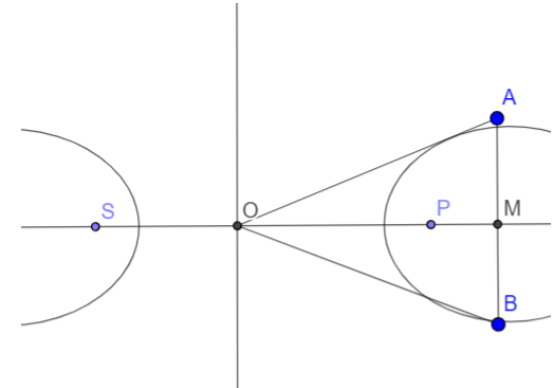
Let the length of the double ordinate be \[2l\].
From the figure AB = \[2l\], AM = \[l\], BM= \[l\].
The ordinate of point A is l.
We have to find the abscissa of the point A, that is by substituting the value of ordinate in the hyperbola equation.
\[\dfrac{{{x}^{2}}}{{{a}^{2}}}-\dfrac{{{l}^{2}}}{{{b}^{2}}}=1\]
\[\dfrac{{{x}^{2}}}{{{a}^{2}}}=1+\dfrac{{{l}^{2}}}{{{b}^{2}}}\]
\[{{x}^{2}}={{a}^{2}}\left( 1+\dfrac{{{l}^{2}}}{{{b}^{2}}} \right)\]
\[x=\dfrac{a\left( \sqrt{{{b}^{2}}+{{l}^{2}}} \right)}{b}\] . . . . . . . . . . . . . . . . . . . . . . . (1)
Therefore point A is \[\left( \dfrac{a\left( \sqrt{{{b}^{2}}+{{l}^{2}}} \right)}{b},l \right)\]
Given that △OAB is an equilateral triangle, therefore
\[OA=OB=AB=2l\]
From Pythagoras theorem, we get \[O{{M}^{2}}+A{{M}^{2}}=O{{A}^{2}}\]
\[\Rightarrow \dfrac{{{a}^{2}}\left( {{b}^{2}}+{{l}^{2}} \right)}{{{b}^{2}}}+{{l}^{2}}=4{{l}^{2}}\]
\[\Rightarrow {{l}^{2}}=\dfrac{{{a}^{2}}{{b}^{2}}}{3{{b}^{2}}-{{a}^{2}}}\]
Here \[{{l}^{2}}>0\]
\[\Rightarrow \dfrac{{{a}^{2}}{{b}^{2}}}{3{{b}^{2}}-{{a}^{2}}}>0\] . . . . . . . . . . . . . . . . . . . . . . (2)
\[\Rightarrow 3{{b}^{2}}-{{a}^{2}}>0\]
Now, \[{{e}^{2}}=1+\dfrac{{{b}^{2}}}{{{a}^{2}}}\] . . . . . . . . . . . . . . . . . . . . . . . . . .. . . . (a)
Writing in terms of
\[{{b}^{2}}={{a}^{2}}\left( {{e}^{2}}-1 \right)\]
\[\Rightarrow 3{{a}^{2}}\left( {{e}^{2}}-1 \right)-{{a}^{2}}>0\]
By further solving,
\[{{e}^{2}}>\dfrac{1}{3}+1\]
\[\Rightarrow {{e}^{2}}>\dfrac{4}{3}\]
\[\Rightarrow e > \dfrac{2}{\sqrt{3}}\]
Therefore the answer is option D.
Note: The term (a) is the eccentricity. In (2) we have taken only \[3{{b}^{2}}-{{a}^{2}}\] because in the numerator \[{{a}^{2}}{{b}^{2}}\] is there which is a positive term for the \[l\] to become >0 the denominator term should not be negative. So we have taken that term in the denominator.
Complete step-by-step solution -
Let the length of the double ordinate be \[2l\].
From the figure AB = \[2l\], AM = \[l\], BM= \[l\].
The ordinate of point A is l.
We have to find the abscissa of the point A, that is by substituting the value of ordinate in the hyperbola equation.
\[\dfrac{{{x}^{2}}}{{{a}^{2}}}-\dfrac{{{l}^{2}}}{{{b}^{2}}}=1\]
\[\dfrac{{{x}^{2}}}{{{a}^{2}}}=1+\dfrac{{{l}^{2}}}{{{b}^{2}}}\]
\[{{x}^{2}}={{a}^{2}}\left( 1+\dfrac{{{l}^{2}}}{{{b}^{2}}} \right)\]
\[x=\dfrac{a\left( \sqrt{{{b}^{2}}+{{l}^{2}}} \right)}{b}\] . . . . . . . . . . . . . . . . . . . . . . . (1)
Therefore point A is \[\left( \dfrac{a\left( \sqrt{{{b}^{2}}+{{l}^{2}}} \right)}{b},l \right)\]
Given that △OAB is an equilateral triangle, therefore
\[OA=OB=AB=2l\]
From Pythagoras theorem, we get \[O{{M}^{2}}+A{{M}^{2}}=O{{A}^{2}}\]
\[\Rightarrow \dfrac{{{a}^{2}}\left( {{b}^{2}}+{{l}^{2}} \right)}{{{b}^{2}}}+{{l}^{2}}=4{{l}^{2}}\]
\[\Rightarrow {{l}^{2}}=\dfrac{{{a}^{2}}{{b}^{2}}}{3{{b}^{2}}-{{a}^{2}}}\]
Here \[{{l}^{2}}>0\]
\[\Rightarrow \dfrac{{{a}^{2}}{{b}^{2}}}{3{{b}^{2}}-{{a}^{2}}}>0\] . . . . . . . . . . . . . . . . . . . . . . (2)
\[\Rightarrow 3{{b}^{2}}-{{a}^{2}}>0\]
Now, \[{{e}^{2}}=1+\dfrac{{{b}^{2}}}{{{a}^{2}}}\] . . . . . . . . . . . . . . . . . . . . . . . . . .. . . . (a)
Writing in terms of
\[{{b}^{2}}={{a}^{2}}\left( {{e}^{2}}-1 \right)\]
\[\Rightarrow 3{{a}^{2}}\left( {{e}^{2}}-1 \right)-{{a}^{2}}>0\]
By further solving,
\[{{e}^{2}}>\dfrac{1}{3}+1\]
\[\Rightarrow {{e}^{2}}>\dfrac{4}{3}\]
\[\Rightarrow e > \dfrac{2}{\sqrt{3}}\]
Therefore the answer is option D.
Note: The term (a) is the eccentricity. In (2) we have taken only \[3{{b}^{2}}-{{a}^{2}}\] because in the numerator \[{{a}^{2}}{{b}^{2}}\] is there which is a positive term for the \[l\] to become >0 the denominator term should not be negative. So we have taken that term in the denominator.
Recently Updated Pages
Master Class 11 Social Science: Engaging Questions & Answers for Success

Master Class 11 English: Engaging Questions & Answers for Success
Master Class 11 Maths: Engaging Questions & Answers for Success
Master Class 11 Chemistry: Engaging Questions & Answers for Success
Master Class 11 Biology: Engaging Questions & Answers for Success
Master Class 11 Physics: Engaging Questions & Answers for Success
Trending doubts
Differentiate between an exothermic and an endothermic class 11 chemistry CBSE
One Metric ton is equal to kg A 10000 B 1000 C 100 class 11 physics CBSE
Difference Between Prokaryotic Cells and Eukaryotic Cells
There are 720 permutations of the digits 1 2 3 4 5 class 11 maths CBSE
Draw a diagram of a plant cell and label at least eight class 11 biology CBSE
Two of the body parts which do not appear in MRI are class 11 biology CBSE