




If a variable plane, at a distance of 3 units from the origin, intersects the coordinate axes at $A$, $B$ and $C$, then the locus of the centroid of $\Delta ABC$ is \[\]
A.$\dfrac{1}{{{x}^{2}}}+\dfrac{1}{{{y}^{2}}}+\dfrac{1}{{{z}^{2}}}=3$\[\]
B. $\dfrac{1}{{{x}^{2}}}+\dfrac{1}{{{y}^{2}}}+\dfrac{1}{{{z}^{2}}}=1$\[\]
C. $\dfrac{1}{{{x}^{2}}}+\dfrac{1}{{{y}^{2}}}+\dfrac{1}{{{z}^{2}}}=\dfrac{1}{9}$\[\]
D. $\dfrac{1}{{{x}^{2}}}+\dfrac{1}{{{y}^{2}}}+\dfrac{1}{{{z}^{2}}}=9$\[\]
Answer
 Verified
586.2k+ views
Complete step-by-step solution:
The distance between a plane $ax+by+cz+d=0$ where $a,b,c,d$ are real numbers and a point $\left( {{x}_{0}},{{y}_{0}},{{z}_{0}} \right)$ in three dimension is given by the formula
\[r=\dfrac{\left| a{{x}_{0}}++b{{y}_{0}}+c{{z}_{0}}+d \right|}{{{\sqrt{{{a}^{2}}+{{b}^{2}}+c}}^{2}}}\]
The given equation of variable plane is $ax+by+cz+d=0$ and it also mentioned that distance between the plane from the origin is fixed 3 units wherever the plane moves in three dimension. The co-ordinates of the origin is $\left( 0,0,0 \right)$. Putting this in the plane to point distance formula
\[\begin{align}
& 3=\dfrac{\left| a.0++b.0+c.0+d \right|}{\sqrt{{{a}^{2}}+{{b}^{2}}+{{c}^{2}}}} \\
& \Rightarrow 3=\dfrac{\left| d \right|}{\sqrt{{{a}^{2}}+{{b}^{2}}+{{c}^{2}}}} \\
& \Rightarrow d=9\left( {{a}^{2}}+{{b}^{2}}+{{c}^{2}} \right)...\left( 1 \right) \\
\end{align}\]
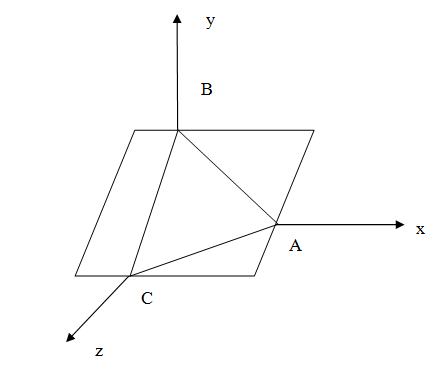
Let us assign $A$ as the point of intersection of the plane and $x$–axis , $B$ as the point of intersection of the plane and $y$–axis, $C$ as the point of intersection of the plane and $z$–axis.\[\]
In $x$–axis , $y=0$ and $z=0$ . Putting these in the equation of the plane , we find the co-ordinates $A$ as $\left( \dfrac{-d}{a},0,0 \right)$\[\]
In $y$–axis , $x=0$ and $z=0$ . Putting these in the equation of the plane, we find the co-ordinates $B$ as $\left( 0,\dfrac{-d}{b}.0 \right)$\[\]
In $z$–axis , $y=0$ and $x=0$ . Putting these in the equation of the plane, we find the co-ordinates $C$ as $\left( 0,0,\dfrac{-d}{c} \right)$\[\]
The centroid of any triangle whose vertices $\left( {{x}_{1}},{{y}_{1}},{{z}_{1}} \right),\left( {{x}_{2}},{{y}_{2}},{{z}_{2}} \right),\left( {{x}_{3}},{{y}_{3}},{{z}_{3}} \right)$ is given by the formula $\left( \dfrac{{{x}_{1}}+{{x}_{2}}+{{x}_{3}}}{3},\dfrac{{{y}_{1}}+{{y}_{2}}+{{v}_{3}}}{3},\dfrac{{{z}_{1}}+{{z}_{2}}+{{z}_{3}}}{3} \right)$. So the centroid of the triangle $\Delta ABC$ is $\left( \dfrac{-d}{3a},\dfrac{-d}{3b},\dfrac{-d}{3c} \right)=\left( l,m,n \right)$. Now we observe the options given in the question and evaluate sum of inversed squares ,
\[\dfrac{1}{{{l}^{2}}}+\dfrac{1}{{{m}^{2}}}+\dfrac{1}{{{n}^{2}}}=\dfrac{9\left( {{a}^{2}}+{{b}^{2}}+{{c}^{2}} \right)}{{{d}^{2}}}\]
We use the value of ${{d}^{2}}$ obtained in equation (1) to get
\[\dfrac{1}{{{l}^{2}}}+\dfrac{1}{{{m}^{2}}}+\dfrac{1}{{{n}^{2}}}=\dfrac{9\left( {{a}^{2}}+{{b}^{2}}+{{c}^{2}} \right)}{9\left( {{a}^{2}}+{{b}^{2}}+{{c}^{2}} \right)}=1\]
No we treat $\left( l,m,n \right)$ as any point of the formed locus to get ,
\[\dfrac{1}{{{x}^{2}}}+\dfrac{1}{{{y}^{2}}}+\dfrac{1}{{{z}^{2}}}=1\]
So the correct option is B.\[\]
Note: We need to be careful of two signs involved in the distance formula $r=\dfrac{a{{x}_{0}}++b{{y}_{0}}+c{{z}_{0}}+d}{\pm {{\sqrt{{{a}^{2}}+{{b}^{2}}+c}}^{2}}}$. We also need to be careful of confusion in formulas of the centroid$\left( \dfrac{{{x}_{1}}+{{x}_{2}}+{{x}_{3}}}{3},\dfrac{{{y}_{1}}+{{y}_{2}}+{{y}_{3}}}{3},\dfrac{{{z}_{1}}+{{z}_{2}}+{{z}_{3}}}{3} \right)$ , the incentre $\left( \dfrac{a{{x}_{1}}+b{{x}_{2}}+c{{x}_{3}}}{a+b+c},\dfrac{a{{y}_{1}}+b{{y}_{2}}+c{{y}_{3}}}{a+b+c},\dfrac{a{{z}_{1}}+b{{z}_{2}}+c{{z}_{3}}}{a+b+c} \right)$ and the circumcenter $\left( \dfrac{{{x}_{1}}\sin A+{{x}_{2}}\sin B+{{x}_{3}}\sin C}{\sin A+\sin B+\sin C},\dfrac{{{y}_{1}}\sin A+{{y}_{2}}\sin B+{{y}_{3}}\sin C}{\sin A+\sin B+\sin C},\dfrac{{{z}_{1}}\sin A+{{z}_{2}}\sin B+{{z}_{3}}\sin C}{\sin A+\sin B+\sin C} \right)$ of a triangle with length of the sides $a,b,c$ and angles $A,B,C$ which can be determined using slopes.
Recently Updated Pages
Master Class 12 Economics: Engaging Questions & Answers for Success

Master Class 12 Physics: Engaging Questions & Answers for Success
Master Class 12 English: Engaging Questions & Answers for Success
Master Class 12 Social Science: Engaging Questions & Answers for Success
Master Class 12 Maths: Engaging Questions & Answers for Success
Master Class 12 Business Studies: Engaging Questions & Answers for Success
Trending doubts
Which are the Top 10 Largest Countries of the World?
What are the major means of transport Explain each class 12 social science CBSE
Draw a labelled sketch of the human eye class 12 physics CBSE
Why cannot DNA pass through cell membranes class 12 biology CBSE
Differentiate between insitu conservation and exsitu class 12 biology CBSE
Draw a neat and well labeled diagram of TS of ovary class 12 biology CBSE