




If a sphere is inscribed in a cube, then the ratio of the volume of the cube to the volume of the sphere will be
$
(a){\text{ 6:}}\pi \\
(b){\text{ }}\pi :6 \\
(c){\text{ 12:}}\pi \\
(d){\text{ }}\pi {\text{:2}} \\
$
Answer
 Verified
644.7k+ views
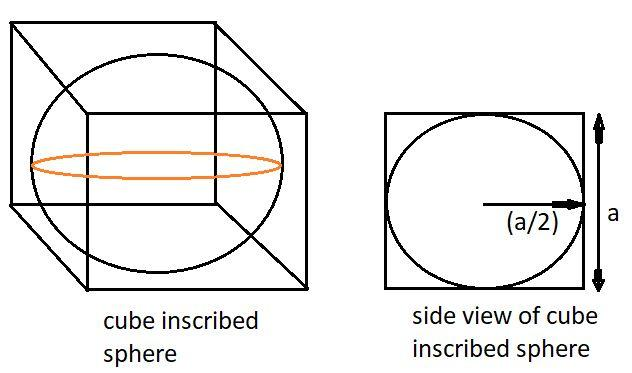
Hint – In this problem let the side of the cube be a unit, if we look at the side view of the diagram in which the sphere is inscribed in a cube, it is clear that the radius of the sphere will be half the side of the cube. Use a direct formula for volume of sphere and cube, to get the required ratio.
Complete step-by-step solution -
As we know that the volume (Vc) of a cube is a side cube.
Let the side of the cube be (a) cm.
So the volume of cube is,
$ \Rightarrow {V_c} = {a^3}$ Cubic units.
Now as we know that the sphere is inscribed in the cube so that the sphere is touching the sides of the cube so the diameter (d) of the sphere is equal to the side of the cube.
$ \Rightarrow d = a$ Unit.
Now as we know radius (r) is half of the diameter.
$ \Rightarrow r = \dfrac{d}{2} = \dfrac{a}{2}$ Unit.
Now we all know that the volume (Vs) of sphere is
$ \Rightarrow {V_s} = \dfrac{4}{3}\pi {\left( r \right)^3}$ Cubic units, where r is the radius of the sphere.
Now substitute the value of radius we have,
$ \Rightarrow {V_s} = \dfrac{4}{3}\pi {\left( {\dfrac{a}{2}} \right)^3} = \dfrac{4}{{3 \times 8}}\pi {a^3} = \dfrac{1}{6}\pi {a^3}$ Cubic units.
So the ratio of volume of cube to volume of sphere is
$ \Rightarrow \dfrac{{{V_c}}}{{{V_s}}} = \dfrac{{{a^3}}}{{\dfrac{1}{6}\pi {a^3}}} = \dfrac{6}{\pi }$
So this is the required ratio.
Hence option (A) is correct.
Note – Diagrammatic representation of the given information always helps in getting relations between the dimensions of different conic sections. Sphere is the locus of the points in three-dimensional space such that these points are always at a constant distance from a fixed point. This constant distance is called the radius and the constant point is the center of the sphere. The Cube is also a three-dimensional shape either hollow or solid, contained by six equal squares.
Complete step-by-step solution -
As we know that the volume (Vc) of a cube is a side cube.
Let the side of the cube be (a) cm.
So the volume of cube is,
$ \Rightarrow {V_c} = {a^3}$ Cubic units.
Now as we know that the sphere is inscribed in the cube so that the sphere is touching the sides of the cube so the diameter (d) of the sphere is equal to the side of the cube.
$ \Rightarrow d = a$ Unit.
Now as we know radius (r) is half of the diameter.
$ \Rightarrow r = \dfrac{d}{2} = \dfrac{a}{2}$ Unit.
Now we all know that the volume (Vs) of sphere is
$ \Rightarrow {V_s} = \dfrac{4}{3}\pi {\left( r \right)^3}$ Cubic units, where r is the radius of the sphere.
Now substitute the value of radius we have,
$ \Rightarrow {V_s} = \dfrac{4}{3}\pi {\left( {\dfrac{a}{2}} \right)^3} = \dfrac{4}{{3 \times 8}}\pi {a^3} = \dfrac{1}{6}\pi {a^3}$ Cubic units.
So the ratio of volume of cube to volume of sphere is
$ \Rightarrow \dfrac{{{V_c}}}{{{V_s}}} = \dfrac{{{a^3}}}{{\dfrac{1}{6}\pi {a^3}}} = \dfrac{6}{\pi }$
So this is the required ratio.
Hence option (A) is correct.
Note – Diagrammatic representation of the given information always helps in getting relations between the dimensions of different conic sections. Sphere is the locus of the points in three-dimensional space such that these points are always at a constant distance from a fixed point. This constant distance is called the radius and the constant point is the center of the sphere. The Cube is also a three-dimensional shape either hollow or solid, contained by six equal squares.
Recently Updated Pages
Master Class 12 Economics: Engaging Questions & Answers for Success

Master Class 12 English: Engaging Questions & Answers for Success
Master Class 12 Social Science: Engaging Questions & Answers for Success
Master Class 12 Maths: Engaging Questions & Answers for Success
Master Class 12 Physics: Engaging Questions & Answers for Success
Master Class 10 English: Engaging Questions & Answers for Success
Trending doubts
Why is it 530 pm in india when it is 1200 afternoon class 10 social science CBSE
The speaker of the Lok Sabha is elected by the APresident class 10 social science CBSE
Complete the sentence with the most appropriate word class 10 english CBSE
a Draw a labelled diagram of a sectional view of the class 10 biology CBSE
Fill the blanks with proper collective nouns 1 A of class 10 english CBSE
Why did Frederic Sorrieu present utopian vision in class 10 social science CBSE