




If a cell has 24 chromosomes and it undergoes mitosis to create two cells, how many chromosomes do the daughter cells have?
Answer
 Verified
612.6k+ views
Hint: Mitosis is a process in which a single cell divides to form two identical daughter cells with the same number of genetic materials as the parent cell has. Its main function is related to the growth of the organism.
Complete answer:
If a cell has 24 chromosomes and it undergoes mitosis to create two cells, then the daughter cells also have 24 chromosomes each. Mitosis is a process of division of cells where a parent cell divides into two daughter cells each of which is genetically just like the parent cell. Mitosis is also known as vegetative cell division.
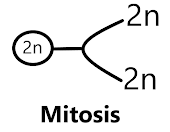
Here in the image ‘n’ stands for the number of chromosomes.
The complete process of mitosis occurs in several stages, these stages are-
-Prophase: Here the chromatin condenses into discrete chromosomes. Then the nuclear membrane breaks down and spindles start forming at opposite poles of the cell.
-Metaphase: At this stage the spindle reaches maturity and chromosomes align at the equator.
-Anaphase: During anaphase paired chromosomes separate and start moving to poles. Spindle fibers are not connected to chromatids. At the top of the anaphase, each pole contains an entire compilation of chromosomes.
-Telophase: The chromosomes begin to condense two new nuclei form, one for every set of chromosomes.
-Cytokinesis: Cytokinesis may be a sort of division of the cell's cytoplasm. The process of cytokinesis starts before the end of mitosis in anaphase and completes shortly after telophase/mitosis. At the top of cytokinesis, two genetically identical daughter cells are produced. These are diploid cells and each cell is having a complement set of chromosomes.
-The major functions of mitosis are tissue repair or replacement, growth of the organism, asexual reproduction, and development of embryos.
Note:
-Mitosis produces two daughter cells with an equal number of chromosomes as the parents have through several stages such as prophase, metaphase, anaphase, and telophase.
-The main function of mitosis is in the growth and replacement of worn-out cells.
-Mitosis was first discovered by Walther Flemming in the year 1879, he is also called as the father of mitosis.
Complete answer:
If a cell has 24 chromosomes and it undergoes mitosis to create two cells, then the daughter cells also have 24 chromosomes each. Mitosis is a process of division of cells where a parent cell divides into two daughter cells each of which is genetically just like the parent cell. Mitosis is also known as vegetative cell division.
Here in the image ‘n’ stands for the number of chromosomes.
The complete process of mitosis occurs in several stages, these stages are-
-Prophase: Here the chromatin condenses into discrete chromosomes. Then the nuclear membrane breaks down and spindles start forming at opposite poles of the cell.
-Metaphase: At this stage the spindle reaches maturity and chromosomes align at the equator.
-Anaphase: During anaphase paired chromosomes separate and start moving to poles. Spindle fibers are not connected to chromatids. At the top of the anaphase, each pole contains an entire compilation of chromosomes.
-Telophase: The chromosomes begin to condense two new nuclei form, one for every set of chromosomes.
-Cytokinesis: Cytokinesis may be a sort of division of the cell's cytoplasm. The process of cytokinesis starts before the end of mitosis in anaphase and completes shortly after telophase/mitosis. At the top of cytokinesis, two genetically identical daughter cells are produced. These are diploid cells and each cell is having a complement set of chromosomes.
-The major functions of mitosis are tissue repair or replacement, growth of the organism, asexual reproduction, and development of embryos.
Note:
-Mitosis produces two daughter cells with an equal number of chromosomes as the parents have through several stages such as prophase, metaphase, anaphase, and telophase.
-The main function of mitosis is in the growth and replacement of worn-out cells.
-Mitosis was first discovered by Walther Flemming in the year 1879, he is also called as the father of mitosis.
Recently Updated Pages
If x a + bt + ct2 where x is in meters and t is in class 11 physics CBSE

A car covers the first half distance between two places class 11 physics CBSE
The resultant of two vectors overrightarrow P and overrightarrow class 11 physics CBSE
Find the value of cos 135 class 11 maths CBSE
A mass M is held in place by an applied force F and class 11 physics CBSE
A solution of glucose in water is labelled as 10 dfracwv class 11 chemistry CBSE
Trending doubts
What is the maximum height of a projectile class 11 physics CBSE
Describe various types of epithelial tissues with the class 11 biology CBSE
Lysosomes are known as suicidal bags of cell why class 11 biology CBSE
Simon Commission came to India in A 1927 B 1928 C 1929 class 11 social science CBSE
State and derive law of conservation of momentum class 11 physics CBSE
How are involuntary actions and reflex actions different class 11 biology CBSE