




If a bicycle wheel makes 5000 revolutions in moving 11 km, then find the diameter of the wheel?
$
{\text{A}}{\text{. 110 cm}} \\
{\text{B}}{\text{. 120 cm}} \\
{\text{C}}{\text{. 70 cm}} \\
{\text{D}}{\text{. 100 cm}} \\
$
Answer
 Verified
656.4k+ views
Hint: Here, we will proceed by using the formula i.e., Total distance covered = (Total number of revolutions)$ \times $(Circumference of the bicycle wheel) and for the circumference we will use the formula which is Circumference$ = 2\pi r$.
Complete step-by-step answer:
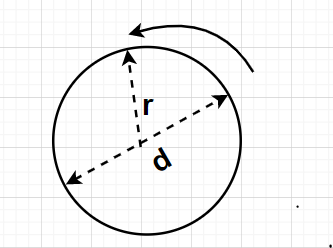
Let r be the radius of the bicycle wheel and d be the diameter of the bicycle wheel
Given, Total number of revolutions N=5000 revolutions
As we know that 1 km = 1000 m and 1 m = 100 cm
So, 1 km = 1000$ \times $100 cm = 100000 cm
Total distance covered = 11 km = 1100000 cm
For any circle having radius r, Circumference$ = 2\pi r$
Since, when the bicycle wheel having radius r is covering 11 km it is making 5000 revolutions.
So, Total distance covered = (Total number of revolutions)$ \times $(Circumference of the bicycle wheel)
$
\Rightarrow 1100000 = \left( {5000} \right) \times \left( {2\pi r} \right) \\
\Rightarrow 2\pi r = \dfrac{{1100000}}{{5000}} \\
\Rightarrow 2\pi r = 220 \\
\Rightarrow 2r = \dfrac{{220}}{\pi } \\
$
Taking $\pi = \dfrac{{22}}{7}$, the above equation becomes
$
\Rightarrow 2r = \dfrac{{220}}{{\left( {\dfrac{{22}}{7}} \right)}} \\
\Rightarrow 2r = \dfrac{{220 \times 7}}{{22}} \\
\Rightarrow 2r = 70 \\
$
Since, Diameter = 2(Radius) i.e., d=2r
$ \Rightarrow d = 2r = 70{\text{ cm}}$
Therefore, the diameter of the bicycle wheel is equal to 70 cm.
Hence, option C is correct.
Note: In this particular problem, we have converted the units of the total distance covered by the bicycle wheel from kilometre to centimetre because the diameter of the bicycle wheel required is in centimetre only according to the given options. Also, here we have retained the value of 2r at the end of the solution because the diameter of the bicycle wheel will be twice its radius.
Complete step-by-step answer:
Let r be the radius of the bicycle wheel and d be the diameter of the bicycle wheel
Given, Total number of revolutions N=5000 revolutions
As we know that 1 km = 1000 m and 1 m = 100 cm
So, 1 km = 1000$ \times $100 cm = 100000 cm
Total distance covered = 11 km = 1100000 cm
For any circle having radius r, Circumference$ = 2\pi r$
Since, when the bicycle wheel having radius r is covering 11 km it is making 5000 revolutions.
So, Total distance covered = (Total number of revolutions)$ \times $(Circumference of the bicycle wheel)
$
\Rightarrow 1100000 = \left( {5000} \right) \times \left( {2\pi r} \right) \\
\Rightarrow 2\pi r = \dfrac{{1100000}}{{5000}} \\
\Rightarrow 2\pi r = 220 \\
\Rightarrow 2r = \dfrac{{220}}{\pi } \\
$
Taking $\pi = \dfrac{{22}}{7}$, the above equation becomes
$
\Rightarrow 2r = \dfrac{{220}}{{\left( {\dfrac{{22}}{7}} \right)}} \\
\Rightarrow 2r = \dfrac{{220 \times 7}}{{22}} \\
\Rightarrow 2r = 70 \\
$
Since, Diameter = 2(Radius) i.e., d=2r
$ \Rightarrow d = 2r = 70{\text{ cm}}$
Therefore, the diameter of the bicycle wheel is equal to 70 cm.
Hence, option C is correct.
Note: In this particular problem, we have converted the units of the total distance covered by the bicycle wheel from kilometre to centimetre because the diameter of the bicycle wheel required is in centimetre only according to the given options. Also, here we have retained the value of 2r at the end of the solution because the diameter of the bicycle wheel will be twice its radius.
Recently Updated Pages
Master Class 11 English: Engaging Questions & Answers for Success

Master Class 11 Social Science: Engaging Questions & Answers for Success
Master Class 11 Maths: Engaging Questions & Answers for Success
Master Class 11 Biology: Engaging Questions & Answers for Success
Master Class 11 Physics: Engaging Questions & Answers for Success
Master Class 11 Chemistry: Engaging Questions & Answers for Success
Trending doubts