




If A (5,3), B (11, -5) and P (12, y) are the vertices of a right angled triangle at P, then y is….?
$A$ -2,4
$B$ -2, -4
$C$ 2, -4
$D$ 2,4
Answer
 Verified
638.7k+ views
Hint: In order to solve this question, we must know the concept of right angle triangle as well as its properties. Along with this, we should also know the Pythagoras theorem to get the angles.
Complete Step-by-Step solution:
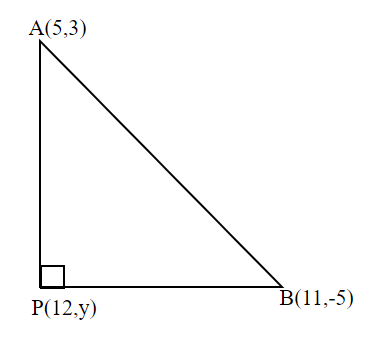
Here, According to the question
Given that A, P, B are the vertices of a right angled triangle at p where
A (5,3)
B (11, -5)
P (12, y)
Now in order to apply Pythagoras theorem, we must convert the vertices.
So we will use the Distance formula –
$ \Rightarrow $ D = $\sqrt {{{\left( {{x_2} - {x_1}} \right)}^2} + {{\left( {{y_2} - {y_1}} \right)}^2}} $
Now we get
$ \Rightarrow $AP$^2$ = ${\left( {12 - 5} \right)^2}$ + ${\left( {y - 3} \right)^2}$
$ \Rightarrow $ BP$^2$ =${\left( {12 - 11} \right)^2}$+${\left( {y + 5} \right)^2}$
$ \Rightarrow $ AB$^2$ = ${\left( {11 - 5} \right)^2}$+${\left( { - 5 - 3} \right)^2}$
So we will now use Pythagoras theorem,
$ \Rightarrow $ AB$^2$= AP$^2$+ BP$^2$
$ \Rightarrow $36+64 = 49 + y$^2$ - 6y + 9 + 1 + y$^2$+ 10y + 25
$ \Rightarrow $100 = 50 + 2 y$^2$+ 34 + 4y
$ \Rightarrow $Simplifying further we get,
$ \Rightarrow $ y$^2$+ 2y – 8 = 0
Now we have to factorise the above calculated quadratic equation to find its root,
$ \Rightarrow $(y + 4) (y – 2) = 0
Thus y = -4, y = 2
$\therefore $ Option C is correct.
Note: To solve this type of question, we should take a simplified quadratic equation so that roots can be easily solved. Along with that one must know the applications of the Pythagoras theorem. This application is appropriate for this type of question as it gives the distance between two points. Hence we will get the desired result.
Complete Step-by-Step solution:
Here, According to the question
Given that A, P, B are the vertices of a right angled triangle at p where
A (5,3)
B (11, -5)
P (12, y)
Now in order to apply Pythagoras theorem, we must convert the vertices.
So we will use the Distance formula –
$ \Rightarrow $ D = $\sqrt {{{\left( {{x_2} - {x_1}} \right)}^2} + {{\left( {{y_2} - {y_1}} \right)}^2}} $
Now we get
$ \Rightarrow $AP$^2$ = ${\left( {12 - 5} \right)^2}$ + ${\left( {y - 3} \right)^2}$
$ \Rightarrow $ BP$^2$ =${\left( {12 - 11} \right)^2}$+${\left( {y + 5} \right)^2}$
$ \Rightarrow $ AB$^2$ = ${\left( {11 - 5} \right)^2}$+${\left( { - 5 - 3} \right)^2}$
So we will now use Pythagoras theorem,
$ \Rightarrow $ AB$^2$= AP$^2$+ BP$^2$
$ \Rightarrow $36+64 = 49 + y$^2$ - 6y + 9 + 1 + y$^2$+ 10y + 25
$ \Rightarrow $100 = 50 + 2 y$^2$+ 34 + 4y
$ \Rightarrow $Simplifying further we get,
$ \Rightarrow $ y$^2$+ 2y – 8 = 0
Now we have to factorise the above calculated quadratic equation to find its root,
$ \Rightarrow $(y + 4) (y – 2) = 0
Thus y = -4, y = 2
$\therefore $ Option C is correct.
Note: To solve this type of question, we should take a simplified quadratic equation so that roots can be easily solved. Along with that one must know the applications of the Pythagoras theorem. This application is appropriate for this type of question as it gives the distance between two points. Hence we will get the desired result.
Recently Updated Pages
Master Class 10 Computer Science: Engaging Questions & Answers for Success

Master Class 10 General Knowledge: Engaging Questions & Answers for Success
Master Class 10 English: Engaging Questions & Answers for Success
Master Class 10 Social Science: Engaging Questions & Answers for Success
Master Class 10 Maths: Engaging Questions & Answers for Success
Master Class 10 Science: Engaging Questions & Answers for Success
Trending doubts
Find the sum of series 1 + 2 + 3 + 4 + 5 + + 100 class 9 maths CBSE
Fill the blanks with the suitable prepositions 1 The class 9 english CBSE
Difference Between Plant Cell and Animal Cell
What is the Full Form of ICSE / ISC ?
What is pollution? How many types of pollution? Define it
Name 10 Living and Non living things class 9 biology CBSE